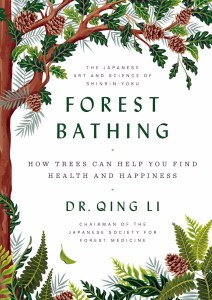
Forest Bathing: The Japanese Art and Science of Shinrin-Yoku
by Qing Li, MD, PhD
“The concept that humans have a biological need to connect with nature has been called biophilia… The American biologist E.O. Wilson… believed that, because we evolved in nature, we have a biological need to connect with it.”
Qing Li is an immunologist and associate professor at Nippon Medical School in Tokyo who studies how spending time in the forest improves our health. In Japanese, shinrin (森林) means forest and yoku (浴) means bathing. “So shinrin-yoku means bathing in the forest atmosphere, or taking in the forest through our senses.” The term forest bathing is analogous to sunbathing, nikkou-yoku (日光浴) in Japanese.
STRESS. “The good news is that even a small amount of time in nature can have an impact on our health. A two-hour forest bath will help you to unplug from technology and slow down… My studies, and those of my fellow researchers, have now proved that forest-bathing:
- lowers the stress hormones cortisol and adrenaline
- suppresses the sympathetic or ‘fight or flight’ system
- enhances the parasympathetic or ‘rest and recover’ system
- lowers blood pressure and increases heart-rate variability”
“Forest-bathing can help you sleep… Not being able to sleep is a well-known side effect of stress.”
IMMUNE SYSTEM. “Research has demonstrated that positive emotions of the kind we experience when we look at nature can increase our levels of anti-inflammatory cytokines. These are the proteins that tell the immune system to work harder. And anything that makes our immune system work harder is a boost to our health.”
“One of the ways we test the health of the immune system is by looking at the activity of our natural killer (NK) cells. Natural killer cells are a type of white blood cell and are so called because they can attack and kill unwanted cells, for example, those infected with a virus, or tumor cells. They do this with the help of anti-cancer proteins: perforin, granulysin and granzymes. These proteins drill holes in cell membranes and this causes the target cells to die. People with higher NK activity show a lower incidence of disease such as cancer.”
“I took measurements on a normal working day before the trip and again one, two, seven, and thirty days after the trip was over. The results showed that natural killer activity and the number of natural killer cells were significantly increased after forest-bathing and that this effect lasted… for as long as thirty days. Hence, a forest-bathing trip once a month is enough to maintain a high level of natural killer cell activity.”
MICROBES. “There is a substance in soil that we breathe in when we walk in the forest and which makes us feel happier. This is a common harmless bacteria, Mycobacterium vaccae.”
“Scientists at Bristol University (UK) injected M. vaccae into mice. They were trying to find out why, when people become sick, they often become depressed. When they injected the mice, they found that the mice behaved as though they were on antidepressants. This was very interesting in itself, but the scientists also discovered something else. The neurons that were activated were those associated with the immune system, which suggested that there is a close communication between the immune system and our emotions.”
“In other words, the soil stimulates the immune system, and a boosted immune system makes us feel happy. Every time you dig in your garden or eat a vegetable plucked from the ground, you will be ingesting M. vaccae and giving yourself this boost… More evidence that being in the forest atmosphere and using all your senses is good for your health, and a very good reason for getting your hands dirty while you are there!”
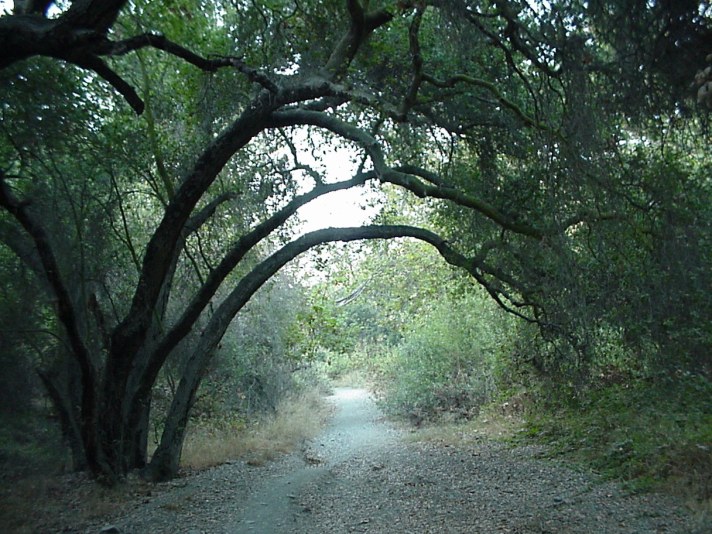
CLEAR YOUR MIND. “Walking in the forest clears our minds and helps us think… Research at the universities of Utah and Kansas… found that spending time in nature can boost problem-solving ability and creativity by 50%.”
“One study undertaken by the University of Michigan that looked at the effects on memory and attention when we engage with nature found that people could remember 20% more after they had been for a walk where there are trees than when they had walked through busy city streets.”
“There are two ways of paying attention. The first is ‘voluntary’, or directed, which is used for tasks that demand effort and concentration… Because of this, just a few moments in a city street can bring on mental fatigue.”
“The second is ‘involuntary’, sometimes called ‘soft fascination’, which I think is a lovely expression. Involuntary attention requires no mental effort, it just comes naturally. This is the kind of attention we use when we are in nature. In nature, our minds are captured effortlessly by clouds and sunsets, by the movement of the leaves in the breeze, by waterfalls and streams, by the sound of the birds or the whisper of the wind. These soothing sights and sounds give our emotional resources a break. They allow our minds to wander and to reflect, and so restore our capacity to think more clearly.”
POLLUTION. “The World Health Organization (WHO) states that, of all the air pollutants, fine particulate matter has the greatest negative effect on our health, contributing to a higher incidence of asthma, lung disease, heart attacks, cancer, and strokes.”
“A single tree, however, can absorb 4.5kg of air pollutants a year. In 2014, the ‘largest tree survey of its kind’ calculated that London’s trees remove 2,241 tons of pollution, store 2,367,000 tons of carbon, provide 77,200 tons of carbon sequestration, and capture 3,414,000 cubic meters of storm water run-off annually.”
“Somes trees do this more effectively than others. The silver birch, for example, can absorb as much as 50% of the particulate matter produced by cars, which is a lot more than the oak can manage.”
SOUND. “Noise isn’t just annoying. It can increase blood pressure, interfere with concentration and sleep, and lead to forgetfulness. It has been found to retard the development of reading and verbal skills in children. Chronic noise is stressful. And we know what stress causes… a whole host of health problems… The sounds of the forest soothe our frazzled heads, lift us out of mental fatigue and give us the silence in which to think.”
“Researchers at Brighton and Sussex Medical School (UK) investigated the connection between the brain, the body, and background noise… The results showed that when the participants listened to artificial sounds, their attention was focused inwards. Inward-focused attention is associated with worry and brooding.”
“When they listened to sounds of nature, they turned their attention outwards… The nature sounds decreased the functioning of the body’s sympathetic nervous system (fight or flight) and increased the parasympathetic system (rest and recover), indicating that we are more relaxed when we listen to nature.”
SIGHT. “Nature creates beautiful patterns everywhere we look… These natural patterns are called fractcals. They are seen in ocean waves, lightning, coastlines and rivers, as well as in flowers, trees, clouds, and snowflakes… Richard Taylor, professor of physics, psychology, and art at the Materials Science Institute in Oregon… has found that looking at these kinds of natural patterns can reduce stress by as much as 60%.”
“However, patterns in nature do more than simply relax and comfort us. They can also amaze us and fill us with awe… It is when we are filled with awe at the sight of nature that we begin to think about things outside ourselves. A sense of awe helps us slow down and stop worrying. It transforms negative emotions into positive feelings. It gives us pause and brings us joy.”
“There is a Japanese word, komorebi (木漏れ日), which has no direct equivalent in English.” The Japanese characters mean trees leaking sunlight. “The closest equivalent in English is probably ‘dappled sunlight’… Komorebi is particularly beautiful when the sun is low, or if there is an early mist or a light fog.”
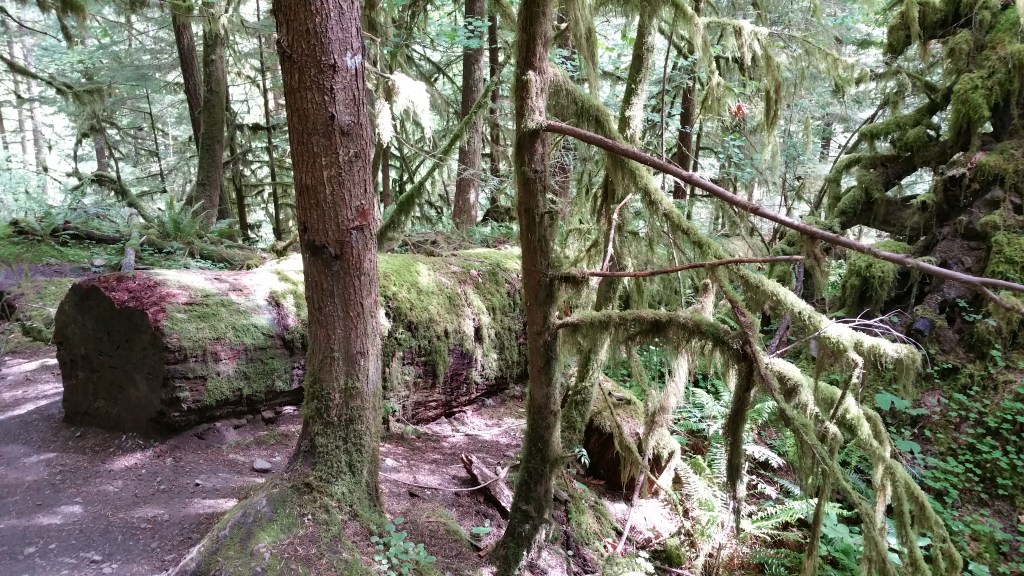
SMELL. “Of all our senses, sense of smell is most primal… One of the most powerful elements of shinrin-yoku is the fragrance the trees release, their phytoncides. When you walk in the forest, you are breathing in its healing power. All you have to do is be there.”
“Phytoncides are the natural oils within a plant and are part of a tree’s defense system. Trees release phytoncides to protect them from bacteria, insects, and fungi… The warmer it is, the more phytoncides there are in the air…Evergreens like pine trees, cedars, spruces, and conifers are the largest producers of phytoncides.”
“Exposure to essential oils was already known to lift depression and help with anxiety, so it seemed clear that phytoncides in the air must be part of what was making my forest-bathers feel so much better and more relaxed… In fact, one study at the Department of Psychiatry at Mie University in Japan, has shown that the citrus fragrance of the phytoncide D-limonene is more effective than antidepressants for lifting mood and ensuring emotional well-being in patients with mental-health disorders.”
The book explains how to diffuse essential oils with a humidifier or a reed diffuser. The author diffuses Japanese hinoki cypress oil, the scent of which also repels mosquitos.
“Then there is that delicious fresh smell of the forest after it has rained. When it is dry for a long time, plant oils collect in the soil and rocks… When it rains, the water releases the oils that have been stored in the rock and the fragrance fills the air… There is a name for this smell, too. Scientists call it petrichor.”
NEGATIVE IONS. “Ions are charged particles in the air. They can be positively charged or negatively charged. Negative ions are the good ones and are said to have energizing and refreshing effects, and to help increase mental clarity and our sense of well-being. There are many more negative ions outdoors than there are indoors. And they are particularly abundant in forests and near waterfalls, rivers, and streams.”
“The air near a waterfall can contain as many as 100,000 negative ions per cubic centimeter, whereas the air in your office might have only a few 100 per cubic centimeter… If you can walk where there is a stream or a river, you will maximize your intake of negative ions and boost your energy levels.”
KODAMA. The author also writes about tree spirits called kodama (木霊 ) in Japanese folklore. “The most famous kodama are the little white creatures with large heads and round black eyes and mouths in the [Studio Ghibli] anime film Princess Mononoke, which tells of an epic struggle between mankind and nature.”
See 森林浴 and 木漏れ日 T-shirt designs below.
Li, Qing. Forest Bathing: How Trees Can Help You Find Health and Happiness. New York: Viking, 2018. Buy from Amazon.com
Disclosure: As an Amazon Associate I earn from qualifying purchases.
Note: I have modified the spelling to appease my American spellchecker.
Related reading:
- Biophilia, The Diversity of Life, Naturalist. Anthology of three works by E. O. Wilson (2021).
- Tales from the Ant World by E.O. Wilson (2020)
- The Nature Fix: Why Nature Makes Us Happier, Healthier, and More Creative by Florence Williams (2018)
- Letters to a Young Scientist by E.O. Wilson (2014)
- Your Brain On Nature by Eva M. Selhub and Alan C. Logan (2014)
- The Nature Principle: Reconnecting with Life in a Virtual Age by Richard Louv (2012)
- Last Child in the Woods: Saving Our Children from Nature-Deficit Disorder by Richard Louv (2008)
- On Human Nature: 25th Anniversary Edition by E.O. Wilson (2004)
- Consilience: The Unity of Knowledge by E.O. Wilson (1999)
- Biophilia by E.O. Wilson (1984)
Click on an image below to purchase a T-shirt on Zazzle.



Discover more from The Key Point
Subscribe to get the latest posts sent to your email.

 The Key Point
3 thoughts on “Forest Bathing: The Japanese Art and Science of Shinrin-Yoku”
Comments are closed.