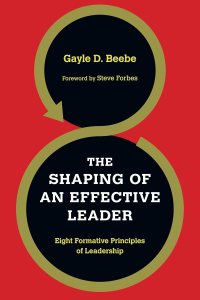
The Shaping of an Effective Leader: Eight Formative Principles of Leadership
by Gayle D. Beebe
Westmont College president Gayle Beebe presents his eight principles of effective leadership and weaves in the wisdom of Peter Drucker, under whom he studied. The eight principles are character, competence, chemistry, culture, compatibility, convictions, connections, and commitment.
“Character is the foundation of all leadership responsibilities for all our life.” However, “without threshold competencies, even the most well-meaning individual can do real harm.”
CHARACTER. Drucker emphasized “there is no such thing as ‘business ethics’—a person is either ethical or unethical, regardless of the situation… [Drucker believed], and I think he is right, that the behavior of senior executives fundamentally sets the tone for an organization… Leaders at all levels of the organization must have basic integrity that can be trusted. It is simply too crucial and cannot be acquired later.”
COMPETENCE. “One of the great challenges for leaders is learning how to recognize patterns and connections. In fact, Drucker believed this is one of the great challenges in turning a specialist into a generalist… learning how to synthesize discrete pieces of information into a meaningful whole.”
“The higher we go in a corporation, the more time we spend accomplishing our work through other people. Technical competence gets us the job, but relational competence helps us advance. All of us are hired for our abilities, but we advance in our positions because of our attitudes, behaviors, and conduct… The qualities which tend to get people promoted today [are] integrity, graciousness, honesty, being predictable, etc.”
STRENGTHS. “At the heart of Drucker’s leadership philosophy is the belief that we must understand who we are and how we are wired if we are to understand what we should do… and to use this self-knowledge to maximize our strengths. Each individual also needs to consider what contribution he or she can make that no one else could make.”
“Drucker also expresses concern that a manager’s attention needs to be focused on the strengths, not the weaknesses, of those he or she is responsible for. He repeatedly emphasizes the importance of making strengths dominant and our weaknesses irrelevant… He believed great leaders understood their people, but this understanding was not so that they could eliminate everyone who didn’t measure up. This understanding helped a leader focus on an individual’s strengths, not their weaknesses, and led to Drucker’s participation and interest in the StrengthsFinder movement.”
“Ultimately, it allows individuals to work in their areas of greatest strength and thereby discover fulfillment through their work.”
EXPERIENCE. Some leaders “have changed responsibilities so often that they have failed to undergo the development that comes from facing mistakes… Their penchant for moving on has allowed them to avoid facing the consequences of their decisions… Instead of having 25 years of experience, they have 25 one-year experiences.”
TOP MANAGEMENT. “Executive leadership requires thinking several moves ahead in anticipation of other challenges. We need an able mix of outsiders (who can help move the organization forward) balanced by insiders (who can preserve a sense of institutional continuity). We need people we can trust. We need to hire competent people who can work from general guidelines and not burden us with a need for constant supervision or correction throughout the day. Ultimately, we need a team who can do the work.”
“Drucker was convinced that the trajectory of a company is set by the quality of the top management team. He was especially mindful of how hard it is to hire, develop, and retain top management talent and how easy it is to demotivate and drive that same talent away… Drucker’s one drawback in this arena is his deemphasis of the need for rapport, empathy, and interpersonal relations among the members.”
DELEGATING. “What can be delegated and what [do] we have to handle ourselves? … Are we doing those activities that only we can do and that will add value to our company? What do we need to stop doing so we can attend to the items that will matter most for our organization’s future?”
HIRING. “We have to apply the same rigor we use in general decision making to the specific challenge of hiring decisions… With few exceptions, organizations rarely rise above their talent level.”
“The people decisions we make have the greatest influence on the trajectory and potential for success of our organization, but how can we stay emotionally connected to our associates while holding the convictions that will drive the company to long-term, sustainable success? This is the essence of effective leadership.”
CULTURE. “First and foremost is the recognition that at the heart of every great institution are its people, the primary resource that determines an organization’s success or failure. Developing a culture that can grow and sustain people is critical for the long-term success of an organization.”
“When we express the qualities of integrity, care, and respect, we create cultures that foster fidelity in others. This level of commitment inspires other people to place confidence and trust in us, and to learn to depend on us as we lead and influence the destinies of our organizations.”
Robert J. Emmons, retired chairman and CEO of Smart & Final “once wrote, ‘relationships drive success.’ Relationships and our ability to connect with constituents, in fact, drive all other aspects of the organization. Relationships with customers, suppliers, service consultants, and even company associates determine the level of success an organization enjoys… The goal, then, is to create the sort of culture, atmosphere, and connectedness that makes employees want to stay long term.”
TRUST. “Achieving the shared goals of the organization requires a level of trust and support that is only possible when meaningful relationships are present. These relationships, in turn, allow a cooperative spirit to develop that prevents sabotage and makes effectiveness possible.”
TEAMS. “Great teams show a capacity for interpersonal understanding. They exhibit high degrees of cooperation. They provide open channels of communication. They have a drive to improve. They are self-aware. They are flexible without being indifferent.”
MOTIVATING. “We all respond well to positive reinforcement. In fact, we respond best to positive reinforcement, and we should deploy it as our most consistent form of motivation.”
“What Drucker found compelling, however, is the idea that every manager must understand how his or her subordinates work: what motivates them, what discourages them, and what drives them to pursue extraordinary results.”
COMMUNICATION. “The Gallup Organization conducted extensive research on the best places to work… One of the most interesting pieces of this entire study is the demonstration that a willingness and ability to communicate expectations was one of the most significant determinants of employee satisfaction.”
Robert Kegan “identifies a behavior that plagues most organizations: referring to a person as awesome or great or fantastic without stopping to identify the specific traits worthy of such appreciation. Conversely, Kegan emphasizes that we must develop direct and specific language by focusing on individual behaviors and specific contributions… In other words, rather than saying ‘Richard is awesome,’ focus on saying ‘the way Richard made his commencement address was timely, articulate, and persuasive.’” This achieves two things: “First, Richard feels appreciated for his contribution. Second, he knows why he is being appreciated and is able to replicate the behavior in the future.”
EMOTION. “Every organization I have ever served had ungracious associates and customers. Being able to make a gracious response to an ungracious person is a hallmark of character formation.”
“Effective leaders set the emotional tone for the organization. Achieving this desired effect requires self-control and self-regulation. It also requires that we learn how to be good listeners and even better observers. Learn how to anticipate what is happening in the lives of the people under your care. Figure out how to engage the other person’s interests. We need to convey the sense that the person we are speaking to is the most important person to us in that moment.”
BE CONSISTENT. “Closely allied with this priority for tone-setting is the need to be consistent, dependable, and predictable. Our employees need to know they can rely on us. They need the assurance that we will do what we say and are true to our word. They need to know that the rewards for their work will be consistent and based on a drive for excellence and success.”
REMOVE OBSTACLES. “Effective leaders build effective teams and foster teamwork. Leaders are responsible for maximizing the strengths of others for the good of the organization. They must work to remove the obstacles that prevent their employees from doing their best work.”
ADDRESS DYSFUNCTION. The author refers to David L. McKenna’s advice: “Never put on a gas mask in a toxic environment… A gas mask is symbolic of people willing to hold their noses and hope a problem will go away… Every organization in which I have served has had its toxic personalities… They are never worth the ruin they bring to the company… When dysfunction emerges, it is imperative that it be confronted, yet confronting dysfunctional patterns is also dangerous since dysfunctional patterns influence who survives in an organization. To change these patterns and move them to health will threaten the influence of the very people who rely on this dysfunction for their sense of contribution and control.”
MISSION. “Effective leaders also know their customers and know their business. Drucker’s five key questions help guide our understanding.
- What is our business?
- Who is our customer?
- What does our customer value?
- What are the results we desire?
- What is our plan for achieving these results?”
INSTITUTIONAL STRENGTHS. “In 2007, my family moved from Spring Arbor to Westmont. During the interview process I was asked if I was going to introduce the same types of graduate and undergraduate programs at Westmont that had worked so effectively at Spring Arbor… This specific question masked a larger question we should all carry: What are the opportunities for innovation that we can pursue at an institution? … What is true of Westmont is that we have tremendous strengths in other areas, and we need to leverage these strengths rather than try to replicate strategies based on the strengths of another institution.”
FOCUS. “What is our business, and is this what it should be? When we ask this question it raises a second, equally important question. What are we doing currently that does not contribute to this task? We are often tempted to ask how can we do something better when we should be asking whether it should be done at all.”
“We first have to determine how we can focus the greatest amount of our efforts on the smallest number of products, services, and customers that stand to produce the greatest results. We must stop and consider where our greatest opportunities lie. What are the products or services, and who are the customers whose even more significant participation would lead to better results?”
“The same holds true for motivating our staff. The effective leader needs to focus his or her greatest efforts on the smallest number who will yield the largest results. We often believe that we need to treat everyone equally. While this is true in terms of fairness, this often disrupts our even greater need to pay attention to the few people who—with 2% more time and resources—would yield 20% more results. Consider: Who are these individuals in the organization, and what am I doing to motivate them?”
AMBIGUITY. “An effective leader makes effective decisions. Decisions are choices between alternative courses of action. Such choices are seldom made with complete clarity or confidence. More often than not the circumstances are ambiguous, and we make decisions that we believe to be ‘directionally correct.’”
OPPORTUNITIES AND PROBLEMS. “Effective leaders focus on opportunities and innovations rather than problems. Problem solving is necessary and must be done in order to prevent damage; however, our focus must be on opportunities and innovations where we produce results that extend the reach and influence of our organization. A key to being opportunity-focused is to have our best people working on our biggest opportunities.”
While I appreciate Beebe and Drucker’s point about opportunities to move the organization forward, I would not trivialize problem solving. An example that comes to mind is Washington Mutual’s aggressive acquisition binge beyond its capacity to integrate the computer systems, resulting in a nightmare of billing errors and customer complaints: What went wrong with WaMu? Start with strategy | The Seattle Times. My take on this is that leadership worshipped business-development megadeals (opportunities) and brushed off severe problems with core competency. A few years later, the bank imploded and was seized by its regulator, i.e. the stock was ultimately worth $0.
COMMON GOALS. “Drucker summarizes the importance of the effective leader by noting… ‘The fundamental task of management is to make people capable of joint performance through common goals, common values, the right structure, and the training and development they need to perform and respond to change.’ … Each member of the organization contributes something different, but all members must contribute toward a common goal.”
Beebe, Gayle D. The Shaping of an Effective Leader: Eight Formative Principles of Leadership. IVP Books, 2011. Buy from Amazon.com
Disclosure: As an Amazon Associate I earn from qualifying purchases.
Also by Gayle Beebe:
- The Crucibles That Shape Us: Navigating the Defining Challenges of Leadership (2024)
Selected books mentioned:
- Leading with Cultural Intelligence: The Real Secret to Success by David Livermore (2022)
- Celebration of Discipline: The Path to Spiritual Growth by Richard J. Foster (2018 Anniversary Edition)
- First, Break All the Rules: What the World’s Greatest Managers Do Differently by Marcus Buckingham (2016)
- Management by Peter F. Drucker (2008 Revised Edition)
- Strengths Finder 2.0 by Tom Rath (2007)
- The Effective Executive by Peter F. Drucker (2006 Revised Edition)
- The Human Side of Enterprise by Douglas McGregor, with commentary by Joel Cutcher-Gershenfeld (2006 Annotated Edition. Originally published in 1960)
- Loving Monday: Succeeding in Business Without Selling Your Soul by John D. Beckett (2006)
- Never Blink in a Hailstorm and Other Lessons on Leadership by David L. McKenna (2005)
- The Contrarian’s Guide to Leadership by Steven B. Sample (2003)
- How the Way We Talk Can Change the Way We Work: Seven Languages for Transformation by Robert Kegan and Lisa Laskow Lahey (2002)
- Whale Done! The Power of Positive Relationships by Ken Blanchard (2002)
- Servant Leadership: A Journey into the Nature of Legitimate Power and Greatness, 25th Anniversary Edition by Robert K. Greenleaf (2002)
- Management Challenges for the 21st Century by Peter F. Drucker (2001)
- Good to Great: Why Some Companies Make the Leap… and Others Don’t by Jim Collins (2001)
- Working with Emotional Intelligence by Daniel Goleman (2000)
- Corporate Cultures: The Rites and Rituals of Corporate Life by Terrence E. Deal and Allan A. Kennedy (2000)
- Connective Leadership: Managing in a Changing World by Jean Lipman-Blumen (2000)
- Built to Last: Successful Habits of Visionary Companies by Jim Collins and Jerry and Porras (1994)
- Childhood and Society by Erik H. Erikson (1993 Second Edition)
- Communities of Discourse: Ideology and Social Structure in the Reformation, the Enlightenment, and European Socialism by Robert Wuthnow (1989)
- The New Realities: In Government and Politics/in Economics and Business/in Society and World View by Peter F. Drucker (1989)
- In Search of Excellence: Lessons from America’s Best-Run Companies by Thomas J. Peters and Robert H. Waterman Jr. (originally published in 1982)
Discover more from The Key Point
Subscribe to get the latest posts sent to your email.


