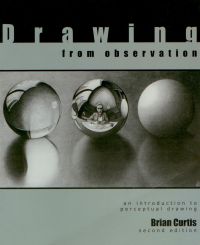
This is a highly informative book about observational drawing. One of the recurring themes is the distinction between what you see (percepts) and what you know (concepts). “There is meaningful conflict between what is perceived (convergence of parallel tracks) and our traditional rational understanding (Euclid’s theorem that parallel lines never meet)… To prevent your concepts from distorting your perceptions you must record the proportion you see, not the proportion you know.”
The Art Forger is a novel inspired by a Hollywood-style art museum robbery that took place in Boston in 1990. It is about a struggling artist who is offered a lot of money and a career-changing opportunity if she will create a forgery from one of the stolen paintings.
She takes possession of an original Degas painting in her studio. Or does she? As she studies details of the painting, she begins to doubt its authenticity. Is she forging a forgery?
Michael Findlay has been an art dealer since 1964. In this opinionated book he discusses the value of art in three categories: financial value, social value, and essential (or intrinsic) value.
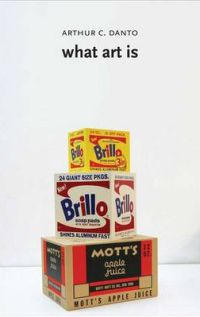
The dust jacket sums up Arthur Danto’s definition of art nicely. “A work of art is always defined by two essential criteria: meaning and embodiment, as well as one additional criterion contributed by the viewer: interpretation.”
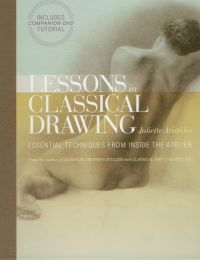
Lessons in Classical Drawing: Essential Techniques from Inside the Atelier by Juliette Aristides
Whether you are interested in learning to draw, or are just curious about the process as an observer of art, this is an outstanding book. It is clearly written, and illustrated with elegant artwork by contemporary artists and old masters. The book includes a DVD with video demonstrations by the author.
“Every good drawing exhibits an understanding and control of tone, proportion, harmony, and composition.”
Rodin on Art and Artists Conversations with Paul Gsell. Translated by Romilly Fedden.
Paul Gsell asked Auguste Rodin questions about his creative process and about art in general. This book is, for the most part, a transcript of those conversations.
Rodin’s favorite subject was the human figure. “Beauty is character and expression. Well, there is nothing in nature which has more character than the human body… The human body is, above all, the mirror of the soul, and from the soul comes its greatest beauty.”
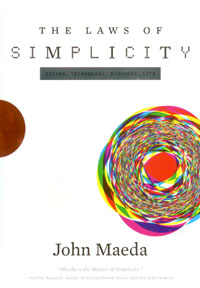
The Laws of Simplicity: Design, Technology, Business, Life by John Maeda
Complex systems and information overload can drive us crazy. John Maeda explains the remedy. “Simplicity is about subtracting the obvious, and adding the meaningful.” The ten laws of simplicity are:
Reduce – The simplest way to achieve simplicity is through thoughtful reduction
Organize – Organization makes a system of many appear fewer.
Time – Savings in time feel like simplicity.
Learn – Knowledge makes everything simpler.
Differences – Simplicity and complexity need each other.
Context – What lies in the periphery of simplicity is definitely not peripheral.
Emotion – More emotions are better than less.
Trust – In Simplicity we trust.
Failure – Some things can never be made simple.
The One – Simplicity is about subtracting the obvious, and adding the meaningful.
Here’s my favorite line in the book: “While great art makes you wonder, great design makes things clear.” I think this thought applies to graphic design, product design, and even process design.
John Maeda is a graphic designer and computer scientist. He wrote this book while he was a professor at MIT Media Lab. Subsequently he was president of Rhode Island School of Design (RISD).
Maeda, John. The Laws of Simplicity: Design, Technology, Business, Life. Cambridge, Massachusetts: MIT, 2006. Buy from Amazon.com
Disclosure: As an Amazon Associate I earn from qualifying purchases.


 The Key Point