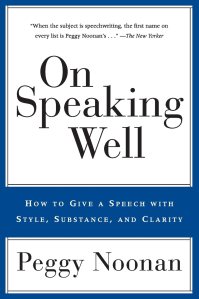
On Speaking Well: How to Give a Speech with Style, Substance, and Clarity
by Peggy Noonan
Prior to writing columns for the Wall Street Journal and Time, Peggy Noonan was a speechwriter for Ronald Reagan and George H.W. Bush. In this book she shares her wisdom about speaking and speechwriting.
KEEP IT SHORT. “No speech should last more than twenty minutes… A twenty-minute speech is about ten typed pages long, double-spaced.”
FOCUS. “What does this speech have to do? Every speech has a job, a reason for being… You should stick to a single subject… If you try to cram everything in the result won’t be comprehensive but jumbled… You have to winnow it down. Once you do you’re halfway home, for it is harder to decide what you want to say than it is to figure out how to say it.”
HEADLINE. “Take notes about the points you want to cover and put them in order. Try to imagine your speech being reduced to a headline—Wilson Says Civil Rights Bill Necessary, or whatever. Write with the headline in mind. It will help keep you focused.”
SHE SELLS SEASHELLS. “You must be able to say the sentences you write… Churchill thought a speech without dashes was not a speech but a magazine piece. He used the dashes to tell him when to take a breath—when to break the rhythm—what to emphasize. Commas, semicolons and periods do this too, but dashes are easier to see when you’re at the podium, easier to understand when you’re under the lights… Once you’ve finished a first draft of your speech—which, as you know, is a first complete version—stand up and read it aloud. Where you falter, alter.”
“Sentences must be short and sayable not only for you, but for your listeners. They’re trying to absorb what you say, and if your sentences are too dense with information they won’t be able to follow… A lot of words sound alike. For instance, saver, savor, saber and savior might all sound pretty much alike when spoken from a podium twenty yards away.”
OH, BY THE WAY. “People like short digressions, they’re a short stop on a long drive.”
BE YOURSELF. “You want to speak in a way that reflects who you are, not in a way that obscures it… When you adopt the language of others it usually doesn’t make you seem more like them but less. It highlights the differences. It’s like wearing a sign that says, ‘I’m talking big because I’m small.’ … Your style should never be taller than you are… Say it the way you’d say it if you were speaking, with concentration and respect, to a friend. Your own style will emerge with time as you write and speak.”
BE SINCERE. “Churchill once asked Bourke Cochran the secret of eloquence, and he replied, ‘Believing in what you are talking about.’ Cochran summed it up with one word: sincerity.”
SIMPLE LANGUAGE. “Most of the important things you will ever say or hear in your life are composed of simple, good, sturdy words… Big things are best said, are almost always said, in small words… We have gained a sense in our lives that true things are usually said straight and plain and direct.”
JARGON. “I think the thing that has replaced accents in America is professional jargon… If you’re speaking at a professional gathering where everyone can be expected to understand the meaning of the terms you’re using, the free use of dialect is good, and a time-saver.”
HUMOR. “Humor is essential. Every speech needs it and you need it too, probably at the top. Ronald Reagan was a perfectionist about public speaking, and by the time I knew him he was a longtime veteran. But he was always nervous before he spoke. Good performers always are, because they’re serious about what they’re doing and want badly to do well. Reagan always needed a joke at the top of a speech because he needed the quick victory of laughter. It helped him relax. It also helped the audience relax.”
LOGIC. “The most moving thing in a speech is always the logic. It’s never flowery words and flourishes, it’s not sentimental exhortations, it’s never the faux poetry we’re all subjected to these days. It’s the logic, the thinking behind your case. A good case well argued and well said is inherently moving. It shows respect for the brains of the listeners.”
SUBSTANCE. “You cannot be eloquent about nothing. You cannot say something banal in a truly interesting way. There are only so many ways to say ‘Pass the butter,’ and the more ornate and highly stylized you get—‘How I desire to have within my grasp the yellow fatted food that so complements the taste of bread’—the more foolish you’ll sound. Because you’re only saying pass the butter, which isn’t a big thing to say.”
“Style enhances substance; it gives substance voice, it makes a message memorable, it makes policy clear and understandable. But it is not itself the message. Style is not a replacement for substance, and cannot camouflage a lack of substance.”
SOUND BITES. “Don’t try to come up with a great line. Try to write well. Which means, try to think well. Try to put clearly the position you’re advancing or the thought you’re explaining. Try to explain why your policy is the best one, your attitude the right one, your program the more just one. Lose yourself in the work and the words will come.”
IMAGERY. “Think. Try to take the abstract and make it concrete, as Churchill did when he wanted to talk about how Europe… had become, at the end of the war, utterly divided. He could have simply said that, and it would have been fine. But he wanted to break through to people with an image… And so he said, ‘An iron curtain has descended across the continent.’ A great image because a truthful one… It was also a great sound bite. But he wasn’t trying to write a sound bite. He was trying to express a thought. Which is what writers do. And what you must do.”
STORYTELLING. “You’re telling stories. You’re giving anecdotes. This is good. Because anecdotes are self-contained, they have a beginning, a middle and an end, and they make your audience see pictures.”
WRITING SPEECH FOR OTHER PEOPLE. “You have to find the voice of the person you’re writing for… Reagan spoke in finished sentences. Bush in bursts… Any speechwriting collaboration… only works well and produces good work if the principal works closely with the writer.”
SAY NO MORE. “I would argue that modern presidents speak too much and diminish the importance of their pronouncements by endless jawboning.” Even if presidents gave fewer speeches, they would still need speechwriters. “One reason is that a president really can’t be winging it a lot because everything he says—he is, after all, the leader of the most powerful nation on earth—has implications, sometimes serious ones. A small aside badly phrased can make the stock market plummet, or give China an excuse to boost its military spending… Speeches aren’t showbiz, they are a way to lead.”
GRACIOUSNESS. “Graciousness springs from a generosity of spirit. It is good. And it can light a speech in subtle ways. Gracious people naturally try to make those around them comfortable. They have, and show, appreciation and respect for those around them. One way to make the people on the dais with you comfortable, or to make those who invited you to speak comfortable, is to acknowledge them and, if you can, compliment them on some aspect of their work… What you say must not only be true, it must be understood to be true by the audience.”
TOASTS AND TRIBUTES. “You do this not with cleverness but with sincerity… Try to sum up the contribution, and the meaning of that contribution, of the person or persons being honored. Again, sincerity is the key… You have to speak about why the departure of the person being honored is a loss, and why their presence was or is a benefit.”
EULOGIES. “It is the place to consider and highlight his obvious virtues—humor, warmth, steadfastness, insouciance, courage—and illustrate them if you can through anecdotes or pictures… A eulogy isn’t for the departed and it isn’t for you; it is for the grieving people in the pews. Be serious but not somber, and be sincere.”
“People always, no matter what the circumstance, like to be able to say, ‘That’s exactly how I feel,’ or ‘That’s what I was thinking this morning.’ … A gentle humor is not inappropriate, and can lift people out of the moment; laughter leavens sorrow. But comedy territory is obviously limited.”
QUESTIONS. “Always do Q&A… A good appearance is often composed of twenty minutes of speech and twenty minutes of questions… By the way, always repeat the question. Chances are the people around the person who asked the question heard it but the rest of the audience didn’t. Also, it gives you another five seconds to try to think of an answer.”
CONSERVE YOURSELF. “Don’t let anyone tire you before you go on… You want to be polite and friendly, but public speaking is performance art and you don’t want to do your material in the car; if you do you’ll be tired and flat when your stand before the audience a few hours later… Also, you don’t want to be answering questions, but asking them… You can learn more about the group, the area, the business, the local political situation, the group’s internal politics.”
STAGE FRIGHT. “Don’t worry about being smooth and slick… A winning eagerness, a surprising awkwardness, an ingenious lack of perfection—these are endearing things to see in a successful person.”
If there’s a reception beforehand, attend it. “Meet people, thank them for inviting you. You’re converting them from stranger to new friend, and it’s easier to speak to friends. Also, it shows you appreciate their inviting you; nausea can make you forget it’s an honor, but it is.”
CREATIVE PROCESS. “I’ve never known a good writer who used a formal outline, ever. The reason, I suppose, is that writing is a creative act and creativity by its nature does not lend itself to point-by-point directives. Creativity is an unbounding; you don’t want to tie yourself down.”
“John Gregory Dunne once called writing ‘intellectual pipe laying.’ He meant that it is hard work that you do not with your back but with your brain, spirit, and soul. Pipe layers rest between bursts of activity, and so must you.”
Take walks. “Work for a few hours and then go for a walk, amble along and look at the trees or the stores or the people or the squirrels. This will not only give you new things to daydream about—and daydreaming is important, for it is your mind unclenching and yielding up connections and images that may be useful to you—but will get the circulation going in your legs again.”
Take naps. “Sometimes when you’re been working hard for a few hours your brain really fires up and barrels, but sometimes it just tires and goes flat… Let your brain go to sleep for forty-five minutes or so. This is restorative. It’s replenishing. And you may find that in the brief space between being awake and being asleep your brain free-associates to a degree that can prove helpful.”
“Reading is another necessary luxury. William Safire once told a budding writer, ‘Never feel guilty about reading, it’s what you do to do your job.’ Reading is the collecting of intellectual income; writing is the spending of it.”
Noonan, Peggy. On Speaking Well: How to Give a Speech with Style, Substance, and Clarity. ReganBooks, 1999. Buy from Amazon.com
Disclosure: As an Amazon Associate I earn from qualifying purchases.
Books mentioned:
- Lend Me Your Ears: Great Speeches in History Edited by William Safire (updated edition, 2004)
- All the Presidents’ Words: The Bully Pulpit and the Creation of the Virtual Presidency by Carol Gelderman (1997)
- The Sir Winston Method: Five Secrets of Speaking the Language of Leadership by James C. Humes (1993)
Books by Peggy Noonan
- A Certain Idea of America: Selected Writings (2024)
- The Time of Our Lives: Collected Writings (2015)
- Patriotic Grace: What It Is and Why We Need It Now (2008)
- John Paul the Great: Remembering a Spiritual Father (2005)
- What I Saw at the Revolution: A Political Life in the Reagan Era (2003)
- When Character Was King: A Story of Ronald Reagan (2002)
- The Case Against Hillary Clinton (2000)
Discover more from The Key Point
Subscribe to get the latest posts sent to your email.

 The Key Point