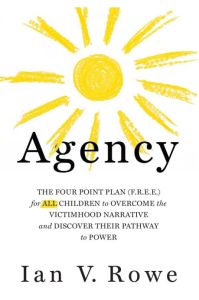
Agency: The Four Point Plan (F.R.E.E.) for All Children to Overcome the Victimhood Narrative and Discover Their Pathway to Power
by Ian V. Rowe
Neil Postman posed this question about public schools: “What kind of public does it create?” Ian Rowe addresses that pertinent question, arguing they are doing a disservice both to students and society, and offers a vision for getting back on track.
The author’s background will provide some context. Rowe immigrated to the United States from Jamaica with his parents and brother in 1968. He attended public schools in New York City, then earned an engineering degree from Cornell and an MBA from Harvard Business School. He worked on postsecondary education philanthropy at the Bill and Melinda Gates Foundation and was an executive in charge of public service campaigns for MTV. He then served as CEO of charter elementary schools in the South Bronx for 10 years before cofounding Vertex Partnership Academies charter high schools.
WHAT IS AGENCY? “My short definition is that it is the force of your free will guided by moral discernment. It is the force that closes the delta between… what is and what ought to be. It is the conviction that we are active players in our own story… Agency is learning to see ourselves not as victims of our circumstances, but rather as architects of our own better futures, and to do so even in the face of real obstacles.”
“However—and this is key—no human being acts alone. Agency is individually practiced, yet socially empowered.”
“The question is this: What are we going to lead young people to believe they can achieve? Are we going to teach them a narrative of oppression, tyranny, and victimization? Or are we going to provide them with the character and tools to thrive?”
EQUITY. “Sadly, this definition—equity as equality of outcome rather than equality of opportunity—has become the unspoken real meaning for many of today’s educators, especially in the ever-lucrative industry of diversity, equity, and inclusion consulting.”
“It makes assumptions about group ability and artificially suppresses differences in outcomes that organically emerge from individual differences in attitudes and behaviors.”
“The misguided pursuit of equity [is] disempowering children of all colors by robbing them of the agency they need to build flourishing futures.”
“The San Diego Unified School District typifies this dysfunction… School officials decided that the 13% disparity between blacks and whites was wholly a function of systemic racism… The San Diego district determined that the ‘removal of non-academic factors from academic grades was critical in addressing the discriminatory grading practice harming our students.’ And what qualifies as a ‘non-academic factor’? One was asking students to hand in homework on time.”
“Imagine telling a child that submitting a completed assignment by the teacher’s due date is ‘discriminatory’ and ‘harming you,’ even though this most basic requirement prepares students to meet the greater expectations of timeliness later on in college, work, and life. It is educational malpractice and typifies the ‘soft bigotry of low expectations.’”
“In its quest to ‘be an anti-racist school district,’ it dumbed down the grading system for everyone.”
Rowe advocates color-blind approaches and eschews “color-bound” thinking… The antidote to racial inequity is not diminished expectations for all. It’s equal opportunity for all and a belief in each individual’s capacity for upward mobility—their sense of personal agency—no matter their skin color, class, or sex.”
THIS ISN’T WORKING. “The Citizens’ Committee for Children (CCC) had issued its annual report on child well-being in New York City… In 2015, the five districts showing the highest risk to child well-being were all in the South Bronx… It is unconscionable that only 12% of the Hunts Point students were able to pass a math exam… A little earlier, a student advocacy group had released a study showing that at 90 New York City public schools, not a single black or Hispanic student had passed the 2014 state tests—not one.”
CYCLE OF POVERTY. “The research is clear and widely accepted: single parenthood among young adults is one of the strongest predictors of child poverty, school suspensions, incarceration, and educational disadvantage.”
“The last five decades have seen an explosion in nonmarital birthrates among women of all races. The share of all babies born outside marriage has risen from about 5% in the 1960s to today’s ‘new normal’ of 40%.”
“In 2019, 91% of all babies born to black women under age 25 were outside marriage and 61% of babies born to white women under age 25 were outside marriage.”
THE SUCCESS SEQUENCE. “If I were to tell you that there is a series of decisions that, when followed by millions of young people, have resulted in 97% of those young people and their kids avoiding poverty and having economic success, would you want to know?”
Brookings Institution economists Isabel Sawhill and Ron Haskins are “the most widely credited champions of what’s known as the Success Sequence… At the center of their strategy was a simple series of behaviors: get at least a high school education, find a full-time job, and wait for marriage to have children—in that order.”
“The arguments against the Success Sequence have been handily rebutted. In response to one of the standard critiques, Bryan Caplan, professor of economics at George Mason University, retorts, ‘Even if the ‘work does all the work’ criticism were statistically true, it misses the point: Single parenthood makes it very hard to work full-time.’”
THE FREE FRAMEWORK: FAMILY, RELIGION, EDUCATION, ENTREPRENEURSHIP. “Young people do not typically find success or meaning in isolation; they need social support from vibrant, well-functioning mediating structures.”
FAMILY. “The structure and stability of the family within which a child is raised matters monumentally in the acquisition of agency… While a young person has no control over the family they are from, the do have the power to determine the family they will form—and that can make all the difference.”
RELIGION. “Human beings are innately created to be ‘rooted’ in a belief system… In the absence of traditional religion, a new form of identity politics has risen to fill this spiritual vacuum. In Woke Racism: How a New Religion Has Betrayed Black America, Columbia University professor John McWhorter describes how a well-meaning but pernicious form of ‘antiracism’ has become, not simply a progressive ideology, but a religion—one that’s illogical, unreachable, and unintentionally neoracist. McWhorter argues that this illiberal neoracism is actually hurting black communities and weakening the America social fabric. And he’s right.”
EDUCATION. “I now run public charter schools because I want kids to know that they can do hard things, that success is within their grasp, and that there are caring adults ready to show them the pathways to the life they want to lead.”
“If we want the rising generation to usher in a new age of agency, we must make the following five changes in K-12 and higher education:
- Eliminate barriers to school choice nationwide;
- Teach the Success Sequence as a probabilities class in middle, high, and post-secondary schools;
- Focus on the ‘Distance-to-100’ gap rather than the racial achievement gap;
- Expand content-rich curricula, with a particular focus on civics and historical content;
- Replace race-based affirmative action with class-based preferences in higher education.”
“In May 2021, the Rhode Island State Board of Education asked me to testify on how to improve educational outcomes. In preparing for the hearing, I compiled 8th grade National Assessment of Educational Progress reading proficiency scores for Rhode Island students since 1998, the first year the Nation’s Report Card was administered there. The racial achievement gap has essentially remained the same for two decades. And here’s the sad point: if Rhode Island had, in fact, closed the black- or Hispanic-to-white achievement gap without improving outcomes for all students, black and Hispanic students would still be mired in mediocrity. They would have merely moved from slightly less than mediocrity to full mediocrity because every year since 1998, less than half of the state’s white 8th graders achieved NAEP proficiency in reading.”
“These numbers highlight our massive national failure to effectively teach literacy and build proficiency across all races. They also shatter the false assumption that racism is the sole, or even the primary, cause of low proficiency rates among black and Hispanic Americans. ‘Systemic racism’ can hardly be the cause of such poor performance among thousands of white students.”
“There is an alternative approach that I refer to as ‘Distance to 100.’ [It emphasizes] eliminating the gap to 100% proficiency for all students. Indeed, we would start by asking why only roughly a third of all American students are reading at proficiency. That Distance to 100—nearly 70%—is more than double the class- or race-based achievement gaps.”
“If we adopted this approach, we would soon discover that the reason a majority of white students have consistently not been reading at grade level overlaps with the reason a majority of black students have not been reading at grade level.”
“Properly done, the promotion of civic literacy can simultaneously increase basic literacy in our students. Both, it seems to me, are essential elements of agency… There is also the freely available curriculum from the Woodson Center’s 1776 Unites project [which rejects] the victimhood culture. It showcases the millions of black Americans who have prospered by embracing our nation’s founding ideals.”
Rowe’s schools also teach financial literacy using special brokerage accounts in which students can buy fractional shares of S&P 500 companies using a small amount of seed capital provided by the school.
ENTREPRENEURSHIP. “An entrepreneur is usually viewed as someone who creates a for-profit business. My definition of an entrepreneur includes that idea, but it is broader to encompass one who takes ownership of all facets of their life to create financial, social, and other forms of wealth.”
“Entrepreneurship is the exact opposite of learned helplessness. It is the force that enables young people to become problem solvers when obstacles arise. By embracing the concept of entrepreneurship, you can better envision yourself as an owner, a steward, a curator of your own life: someone who has the ability to handle temporary setbacks and who can leverage the factors within your control to reshape outcomes, even when conditions may suggest otherwise.”
RESILIENCY. “Resiliency is the character-based strength I have most relied on in leading organizations and teams in a range of sectors. Things will not always go your way, but that doesn’t matter. The odds may seem stacked against you, but that doesn’t matter. You may fail at first, but that doesn’t matter either. Instead, you matter. The choices you make matter. Your agency matters.”
BREAKING THE CYCLE. “If more young people adopted a FREE life that incorporated the wisdom of the Success Sequence on when to start their own family, their children and their children’s children would more likely be born into stable, married, two-parent households and to break the cycle of despair we have seen for generations.”
Rowe, Ian. Agency: The Four Point Plan (F.R.E.E.) for All Children to Overcome the Victimhood Narrative and Discover Their Pathway to Power. Templeton Press, 2022. Buy from Amazon.com
Disclosure: As an Amazon Associate I earn from qualifying purchases.
Books mentioned:
- Woke Racism: How a New Religion Has Betrayed Black America by John McWhorter (2021)
- The Knowledge Gap: The Hidden Cause of America’s Broken Education System—and How to Fix It by Natalie Wexler (2019)
- Grit: The Power of Passion and Perseverance by Angela Duckworth (2016)
- Education for Upward Mobility edited by Michael J. Petrilli (2015)
- Generation Unbound: Drifting into Sex and Parenthood without Marriage by Isabel V. Sawhill (2014)
- Doing the Best I Can: Fathering in the Inner City by Kathy Edin (2013)
- Creating an Opportunity Society by Ron Haskins and Isabel Sawhill (2009)
- Work Hard. Be Nice. How Two Inspired Teachers Created the Most Promising Schools in America. by Jay Mathews (2009)
- Mindset: The New Psychology of Success by Carol Dweck (2006)
- Promises I Can Keep: Why Poor Women Put Motherhood before Marriage by Kathy Edin (2005)
- Behind the Oval Office: Winning the Presidency in the Nineties by Dick Morris (1997)
- To Empower People: From State to Civil Society by Peter Berger and Richard Neuhaus (1976)
- Harrison Bergeron by Kurt Vonnegut (1961)
- Man’s Search for Meaning by Viktor E. Frankl (1959)
- Atlas Shrugged by Ayn Rand (1957)
- Democracy in America by Alexis de Tocqueville (1835)
Related Reading:
- Self-Censorship by Glenn C. Loury (2025)
- Diversity without Discrimination: How to Promote a Culture of Unity in a Post-DEI/Affirmative Action World by Carol M Swain and Mike Towle (2025)
- Rethinking Charity: Restoring Dignity to Poverty Relief by Ismael Hernandez (2024)
- How to Educate a Citizen: The Power of Shared Knowledge to Unify a Nation by E. D. Hirsch Jr. (2021)
- Charter Schools and Their Enemies by Thomas Sowell (2020)
- Lessons From the Least of These: The Woodson Principles by Robert L. Woodson Sr. (2020)
- Why Place Matters: Geography, Identity, and Civic Life in Modern America edited by Wilfred M. McClay and Ted V. McAllister (2020)
- Flourish: A Visionary New Understanding of Happiness and Well-being by Martin E. P. Seligman (2012)
- Making a Love Connection: Teen Relationships, Pregnancy, and Marriage by Barbara Dafoe Whitehead and Marline Pearson (2006)
- The End of Education: Redefining the Value of School by Neil Postman (1996)
- The Content of Our Character by Shelby Steele (1991)
- Reality Therapy: A New Approach to Psychiatry – The Classic Bestseller on Fulfilling Needs Through Present-Focused Responsibility by William Glasser M.D. (1975)
Discover more from The Key Point
Subscribe to get the latest posts sent to your email.

 The Key Point