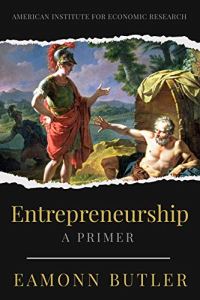
Entrepreneurship: A Primer
by Eamonn Butler
“Entrepreneurship is the unseen factor of production. Land, labor, and capital produce nothing until they are actively put to work. They need to be directed and focused by some human mind—an entrepreneurial mind that realizes how they can be used to create value.”
“British philosopher and economist John Stuart Milll (1806-1873) identified entrepreneurs as people who assume both the risk and the management of a business. Today, economists focus on the role of entrepreneurs as innovators or in spotting opportunities or taking risks in a world of future uncertainty.”
Here are some highlights of major topics covered in Butler’s scholarly overview.
INNOVATION. “None of these aspects of entrepreneurship is more important to human progress and economic growth than innovation.”
“Markets respond to… changing circumstances. They are dynamic—a perpetual flux of changing demand for and supply of countless goods and services.”
“Real-life competition spurs entrepreneurs to create products that are different. They want to win customers from their competitors by offering them products that are not the same, but better or cheaper or both… As a result, consumers enjoy a huge variety of products to choose from, with different features and at different levels of price and quality.”
“The idea of the entrepreneur as an innovator and disruptor is associated principally with Joseph Schumpeter… Schumpeter called this process ‘creative destruction.’ … Perhaps ‘creative disruption’ might have been a happier term. But Schumpeter wanted to emphasize the dynamism of entrepreneurial innovation, shifting resources to more productive uses, in contrast to the textbook notion that markets naturally remained stable and balanced.”
“The more experimentation we can encourage, the greater chance we have of finding success.”
EXECUTION. “To succeed, entrepreneurs need to be able to do more than have innovative ideas or keep alert to opportunities. They actually have to turn their vision into reality. That means not only initiating an enterprise but steering it through to fruition, which entails a good deal of management effort as well. At the very least, that requires them to draw together resources such as personnel and capital, and to focus those resources on delivering their vision.”
ECONOMISTS. “Entrepreneurship is crucial to us all as the driver of economic growth and prosperity. It motivates, directs, organizes the other factors of production into the creation of value. Yet mainstream economists rarely appreciate this important catalytic function.”
“The textbook view takes firms as given and permanent. It ignores how or why firms come into being, how they grow and develop, why they shut down, and what their different needs are at various stages of their lives.”
“In so-called ‘perfect competition,’ products are identical. In reality, they are obviously not.”
Nor do entrepreneurs operate with “the ‘perfect information’ that the textbooks imagine. They cannot know in advance which processes will prove practicable and profitable, nor what products the public might want, of what quality and at what price. Their task is all guesswork… Entrepreneurs take risks, make investment decisions, and commit time, effort, capital and other resources into their project, while facing a fog of uncertainty about what the future will bring and what the needs and choices of future consumers will be.”
COMPLEXITY. “Surpluses, shortages and opportunities occur all the time in markets—a natural result of their dynamism and complexity, and the daily fluctuations and mismatches in supply, demand and prices that inevitably open up.”
“Under market competition, entrepreneurs must act fast, or competitors will gladly exploit those opportunities and gain the rewards of success instead.”
“Entrepreneurs can never create a ‘perfect’ product, nor a ‘perfect’ production method. It is always possible that another will top them. The most we can say is that in competitive markets, the less successful products and processes give way to more successful one. They do not have to be perfect and forever—merely better fitted to the market conditions that happen to prevail at the time. But inevitably, those conditions too will change… Since markets are never at rest, entrepreneurs must make their best production choices within a very risky and uncertain environment.”
RISK & UNCERTAINTY. “As the Chicago economist Frank Knight (1885-1972) put it, market players have to navigate both risk and uncertainty. Risk is where we can quantify the probability of certain events… Uncertainty is where we have no information on which to make predictions.”
“Since markets are in constant flux, and since we do not fully understand what moves them, those who are active in the market, such as entrepreneurs, can do no more than act on their best guesses… But taking risks against such a background of uncertainty is, according to some theorists, the very definition of entrepreneurism.”
“The American economist Peter G. Klein suggests that the defining characteristic of entrepreneurship is judgment under uncertainty. The entrepreneur faces an uncertain future and must take a view about how things might turn out… It is the diversity of those views that makes entrepreneurship potentially profitable… Significant profits come to entrepreneurs only when they make correct judgments while others are making wrong ones.”
FAILURE. “The Global Entrepreneurial Monitor reports that two-fifths (40%) of Americans think it is easy to start a business, and nearly half (49%) think they could run one. Given the high failure rate of new businesses, they are plainly mistaken on both counts.”
“Most start-ups will fail… Typically, a fifth of new businesses fail within one year, a third within two years, and around half within five.”
“Failure teaches entrepreneurs what sorts of processes and products do not work, and through their past experience they learn what the market does want.”
CORPORATE ENTRPRENEURS? “A lot of bad public policy stems from confusing entrepreneurship with start-ups or self-employment.”
“Certainly, large firms, with their capital and personnel resources, can be entrepreneurial too: remember the Sony Walkman… As Schumpeter realized, salaried employees of large firms can be entrepreneurs too. But large firms need to have a strategy in place for supporting them… It means creating a culture that welcomes a multiplicity of ideas and experiments.”
It seems strange to consider that Fortune 500 companies could be “entrepreneurial.” Certainly, the risk exposure of owner-operators betting their own capital is very different than employees collecting a salary plus benefits while putting the corporation’s capital at risk. But on reflection, collecting a salary and betting other people’s money is what the management of venture-capital-funded startups do, as well.
“But it is new, smaller, growing companies that account for most innovation, and most new job creation… Many entrepreneurs get their start in larger businesses, where they learn about a particular industry, and perhaps see potential opportunities that they can exploit by starting up independently.”
COUNTRY SIMILARITIES AND DIFFERENCES. “Though entrepreneurship exists everywhere, some countries stand out… Hong Kong, Israel, the United States, Switzerland, Singapore, Norway, Ireland, Taiwan, Canada, and Australia lead the field.”
“Culture is plainly important too… A cultural acceptance of failure may encourage people to take risks and grasp potential opportunities.”
“Some legal systems seem to be much better at encouraging entrepreneurship than others. Entrepreneurship is twice as prevalent in the English legal tradition than the German, for example. Even more remarkable, it is three times greater in the English tradition over the Scandinavian, and five times greater over the French.”
“A possible explanation for these surprising differences is that the English legal tradition was built on common law, which is ‘bottom up.’ … Other traditions, deriving from Roman or Napoleonic law, are ‘top-down’ systems. The presumption is that action is permitted only if government authorities specifically permit it… That extra bureaucracy is plainly bad for innovators.”
“How then do we create the institutions and incentives to keep entrepreneurism productive? A stable political environment and good access to capital can certainly help. Secure property rights, the reliability of the justice system, and limits on political power seem important too. But creating these conditions is not easy.”
TAX POLICY. “Large up-front tax incentives and subsidies are particularly damaging: they encourage over-expansion and expensive production techniques rather than focus on what customers really want. An example is the $120 million that the British government offered the DeLorean Motor Company in the 1970s (more than half of its start-up costs) to produce its famous ‘gull-wing’ model in high-unemployment Northern Ireland. But the demand was not there, the company failed, and both the jobs and the taxpayers’ money were lost. Another interesting feature of this case… The UK government felt it had to match or outdo DeLorean’s other suitor, the government of Ireland. Trying to match or outdo bad incentives offered by other governments is a certain way to waste a lot of public money to no good effect.”
“The best and most durable businesses are not ‘made’ but evolve and grow naturally from small start-ups, following the demands of their customers.”
Butler, Eamonn. Entrepreneurship: A Primer. American Institute for Economic Research, 2020. Buy from Amazon.com
Disclosure: As an Amazon Associate I earn from qualifying purchases.
Note: I have modified the spelling to appease my American spellchecker.
Related Reading:
- How Innovation Works: And Why It Flourishes in Freedom by Matt Ridley (2021)
- Why Government Cannot Be Run Like a Business Peter G. Klein (2017) (article)
- Permissionless Innovation: The Continuing Case for Comprehensive Technological Freedom by Adam Thierer (2016)
- Boulevard of Broken Dreams: Why Public Efforts to Boost Entrepreneurship and Venture Capital Have Failed by Josh Lerner (2012)
- 18 Mistakes that Kill Startups by Paul Graham (2006) (article)
Other Books by Eamonn Butler:
- An Introduction to Schools of Economic Thought (2025)
- Introduction to Economic Inequality (2022)
- Scaling the Heights: Thoughts Leadership, Liberal Values and the History of the Mont Pelerin Society (2022)
- Introduction to Democracy (2021)
- Introduction to Trade and Globalisation (2021)
- Classical Liberalism: A Primer (2020)
- Capitalism: An Introduction (2018)
- Ayn Rand: An Introduction (2018)
- The Economics of Success: 12 Things Everyone Needs to Know About Capitalism (2014)
- Forty Centuries of Wage and Price Controls: How Not to Fight Inflation (2014)
- The Best Book on the Market: How to Stop Worrying and Love the Free Economy (2008)
- Adam Smith: A Primer (2007)
- Ludwig Von Mises: Fountainhead of the Modern Microeconomic Revolution (1988)
- Hayek: his contribution to the political and economic thought of our time (1983)
Discover more from The Key Point
Subscribe to get the latest posts sent to your email.

 The Key Point