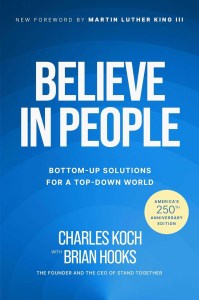
Believe in People: Bottom-Up Solutions for a Top-Down World
by Charles Koch with Brian Hooks
“This book… calls for all of us to move away from a top-down approach to solving the really big problems in society toward an approach that focuses on empowering people from the bottom up to act on their unique gifts and contribute to the lives of others.”
Bottom-Up
“Bottom up tends to work better for a simple reason. When people are empowered, they find solutions to the problems they are closest to, as they have the proximity and knowledge to do so. For this reason, the most important contributions often come from those who are overlooked or dismissed.”
“Bottom-up empowerment is at odds with the prevailing ideas of our time, most of which are based on the paradigm of control.”
Finding Your Path
“If I had to sum up my life in just a few words, they would be ‘trial and error’ with an emphasis on ‘error.’”
“As you try to develop skills, you’re going to find a lot of areas where you just don’t have the necessary aptitude. Trial and error is a principle on its own, and in my decades of experience, there’s no such thing as too much error. Every dead end gives you a better sense of your best path.”
“To be happy, you have to discover your gifts, fully develop them, and apply them constructively.”
“The path to progress is never straight and is always full of pitfalls… What’s more important than the setback is the lesson you learn from it. Far from stopping you, setbacks should cause you to rethink the path forward.”
“Embrace who you are and what you know, because that’s how you can make the greatest contribution and find fulfillment… Your natural abilities—and the firsthand knowledge you have from your experiences (and, yes, from your mistakes!)—are central to what you can be and what you want to be.”
Lifelong Learning
At MIT, Koch learned “the second law of thermodynamics, which holds that entropy virtually always increases in a closed system. Entropy is a measure of disorder or uselessness.In lay terms, this means that progress stalls or declines when something is walled off from the outside world… Usually you hear this concept in discussion of technology, but it applies to every facet of life. People, as well as organizations, stagnate when they aren’t open to new ideas or fail to experiment or learn new skills.”
Core Institutions of Society
“When I say ‘institutions’ I mean… community, education, business, and government.”
“America is on a trajectory toward a two-tiered society because the institutions are breaking down.”
“For example, failing schools mean that students who can’t afford an expensive alternative suffer more than those who can. Similarly, corrupt business practices based on corporate welfare can make it difficult for companies to compete, especially small ones and start-ups.”
“The institutions are also interconnected: a failure in one usually creates problems in the others.” See also Systems Thinking.
“Transforming these institutions so they consistently empower people to succeed is the job of Social Entrepreneurs.”
Social Entrepreneurs
“All of us have a role to play in improving our country.”
“If you’re reading this, I suspect you’re a Social Entrepreneur—or perhaps aspire to be one… An entrepreneur is someone who discovers (or wants to discover) new and improved ways of doing things. In the context of business, this means driving the innovation that improves people’s lives through an enterprise. In a social context, it’s a matter of finding new ways to break the barriers and overcome the injustices that prevent others from realizing their potential. These individuals disrupt the status quo to help others, especially the least fortunate, rise.”
“Where do you have experience? Where have you learned what works? What’s your passion? Is it tackling poverty, finding more effective ways for kids to learn, or fighting a harmful public policy that’s affecting your family, friends, or neighbors? Maybe it’s building a business that better satisfies its customers, empowers its employees, and contributes to its community.”
“As a Social Entrepreneur, you have the ability to transform society’s core institutions so that more people are empowered and succeed. Whatever your gift may be, you can use it to help others improve their lives. But beware the temptation to double down on the failed approaches to the past. Many, if not most, Social Entrepreneurs risk becoming captive to the control paradigm. As a result, despite the best of intentions, their efforts can often hurt the people they want to help.”
Uniting a Diversity of Voices
“Social Entrepreneurs need to go out of their way to find a diversity of allies and get them engaged. So what if you disagree with someone on this, that, or the other thing? You agree on the need to defeat at least one injustice, and by uniting, you’ll be able to make real progress. By contrast, the agree-with-me-on-everything approach means movements shrink, not grow.”
The Failure of One-Size-Fits-All
“Sadly, empowerment isn’t the approach of the vast majority of anti-poverty efforts. Take the War on Poverty, which President Lyndon B. Johnson launched in 1965…. All told, our country has spent $15 trillion and counting in this titanic struggle, and what do we have to show for it? Poverty has become easier to endure but harder to escape.”
“The poverty-industrial complex is almost entirely focused on people’s deficiencies… Yet by focusing on what the least fortunate lack, policymakers and philanthropists miss what they have—the potential to overcome the obstacles holding them back.”
“Why do such efforts fail, whether governmental or philanthropic? … Because they generally view the people being helped as problems that need to be solved, rather than as the source of the solutions. Their efforts are based on top-down control, not bottom-up empowerment.”
“Additionally, the people and programs devoted to helping the least fortunate are typically measured on inputs (dollars spent) instead of outcomes (individuals empowered).”
“Whatever problem you’re focused on, know that there is no single solution. That’s a paradigm that must be dispelled—that one approach, one program, or a one-size-fits-all initiative can make everything right. When you look at these issues from the bottom up, you don’t go to communities and tell them what works. You go there to find what works and learn how you can help it improve and spread.” This is similar to the “genchi genbutsu” concept presented in The Toyota Way: “You cannot be sure you really understand any part of any business problem unless you go and see for yourself firsthand.”
K-12 Education
Koch has a lot to say about the chronic dysfunction of American schools. “It makes no sense to spend ever-larger sums on the same failing model in the hope of a better outcome.”
“By helping students identify their gifts, develop them into valued skills, and apply them to benefit themselves and others, a good education enables people to have the best possible life and contribute to the creation of the best possible society. When students learn that the way to succeed is to create value for others, it changes the entire culture from one of conflict to one of mutual benefit.”
“Yet if the goal really is to help students realize their potential, then American education is clearly falling short. It is an injustice holding back millions of people.”
“By high school graduation, many (if not most) students have little clue what gifts they have, what motivates them, and how they can succeed. They aren’t contribution motivated. They’re often not motivated at all.”
“The most recent federal data show that only 25% of twelfth-grade students are proficient at math. The numbers are slightly better for reading, where 37% of students are proficient—still a far cry from success.”
“Although there are some bright spots, the K-12 system is typically designed with the average student in mind. But the average student doesn’t exist.”
“One-size-fits-all solutions are inherently harmful… It necessarily fails to tailor education to each student’s unique aptitudes and needs. Instead of understanding how schooling can benefit them and allow them to experience the joy of learning, students rightly see it as a painful, boring exercise of little value.”
“It also prevents kids from becoming lifelong learners—a crucial factor for long-term success. Standardization is terribly counterproductive.”
“The standardized system is reinforced by policies and practices that stifle competition and innovation. These include caps and moratoriums on new kinds of schools. Another example is the teacher certification process, which forces would-be educators to go through their own process of standardization, limiting their ability to reach students, excel at their careers, and find fulfillment in their own lives.”
“There are many other examples of how education fails students in both K-12 and higher ed. The common thread among all of them is protectionism. If you recall, protectionism is a hostility to beneficial change… ‘School choice’ is meaningless if the choices aren’t that different from the status quo.”
Higher Education
“The National Association of Colleges and Employers asked businesses to rank college graduates on eight measures of career readiness. In five categories, fewer than half of graduates were deemed ready for employment.”
“Unsurprisingly, a growing number of people now wonder if higher education is worth it. One recent poll found that only half of Americans think a college education is very important, down from 70% in 2013.”
“One major problem is the accreditation system… Guess who sits on the accreditation boards? That’s right—the existing universities. Why should accreditors certify innovative schools that would compete with their own employers? Why should colleges and universities experiment with new programs if it puts their accreditation at risk? The incentive is usually to stop a potentially better education in its tracks.”
“Of course, this is not to say that nothing has changed over the years. For instance, there are now more administrators than educators at the typical U.S. college. (The same is true for K-12 schools, where the number of administrators grew eight times faster than the number of students between 1950 and 2009.) There is no evidence that students benefit from this. There is evidence, however, that without the bureaucratic bloat since 1976, college tuition would be 20% cheaper.”
“The university system itself needs innovators to disrupt the usual four-year, debt-riddled, on-campus college experience… A better way is individualized education… Individualized education is the essence of bottom up.”
“We also need to recognize that higher education isn’t for everyone… Many young people have aptitudes that would be better developed in alternative settings. Trade and vocational schools, coding boot camps, and experiential learning programs are often scoffed at over overlooked, even though they provide a better learning environment for many, if not most, students.”
“Student loans could also use more than a little disruption, as they are bankrupting students and making it easier for schools to hike tuition… Purdue University recently introduced income-sharing agreements, which pay a student’s way in exchange for a slice of their income in the decade after graduation (assuming they make above a minimum and pre-specified amount).”
Corporate Welfare
Koch also has a lot to say about the damaging effects of corporate welfare.
“Corporate welfare is synonymous with a rigged economy, in which the politically connected climb higher by pushing the rest of society down… Every American pays the price, and the price is bigger than anyone can see.”
“Occupational licensing illustrates this reality… While licensing differs by state, in almost every case, a profession is governed by a board. 85% of these boards are controlled by—you guessed it—members of the licensed industry. Their obvious interest is to restrict competition and protect their profits. If that sounds eerily similar to the protectionism in higher education discussed in chapter seven, it’s because it is. And the result is the same—lower quality products at higher prices.”
“While there are some legitimate public safety reasons for licensing—doctors, weapons manufacturers, and the like—many restrictions are patently absurd. For instance, you can’t sell flowers in Louisiana without a license.”
“One way that companies—especially large ones—try to rig the system is by supporting complex and anticompetitive regulations. Why? Because they have large legal teams and can afford to comply, while the added costs will hurt smaller competitors and reduce start-ups… In 2010, Congress enacted the Dodd-Frank Act, wrapping big banks in more regulation that the banks themselves helped to write. Meanwhile, the 15 largest banks in the county control more than half of all assets in the banking industry… The regulatory burden from the Dodd-Frank bill is so severe that only big banks can afford it.”
“Elsewhere, the tax code contains $1.6 trillion in exemptions and other kinds of preferential treatment, benefiting a bewildering array of special interests.”
“At the federal level, businesses employ armies of lobbyists whose sole job is to get special treatment for their clients. At the local level, they play cities and states against each other in search of the best ‘tax incentives,’ which is a fancy phrase for corporate welfare targeted to specific companies. The politicians who abet this are basically bribing companies with taxpayer money. This is a massive scam, costing tens of billions of dollars.”
“Consider the effects on public health. Most states have so-called certificate-of-need (CON) laws, which create government boards that determine whether medical facilities can expand, innovate, or even get off the ground. The boards are usually stacked with representatives of hospitals and other healthcare providers—that is, the potential competitors of the new or improved facilities. They have a clear incentive to deny CON applications, which happen all the time… The result: studies show CON laws can reduce the number of hospitals in a given area by 30%.”
“Monopoly grants, mandates, cash subsidies, bailouts, tariffs, tax credits, loan guarantees, preferential and anticompetitive regulations, eminent domain abuse—they’re all corporate welfare, and all destructive.”
“This is a big reason why socialism is gaining ground, particularly among young people… They correctly think the economy is rigged against them. While their concerns are justified, their solutions are misguided… This turns everything into a system of government-granted privilege. Seen through this lens, socialism is not the answer to corporate welfare, but rather its fullest expression.”
Philanthropy
In 2003, Charles Koch founded an organization now called Stand Together, which supports 200 community-based initiatives in 47 states. “Each one focuses on how people in poverty are the source of the solution, rather than problems to be solved.” For example:
- “Safe Families… Remarkably, 93% of families are reunited, compared with less than half of those in foster care.”
- “Urban Specialists… Nearly every school where it has a presence has experienced a culture change and a big drop in violence… When I say ‘mentor,’ Urban Specialists places OGs at bus stops to break up fights and mediate gang conflicts, among other courageous interventions.”
Liz Koch founded Youth Entrepreneurs in 1991. “When they got to put their own plans into action, they felt empowered. They were free to create their own business plan and try to make it work. It made them see learning in a new light—one that was practical and tailored to their own talents and interests.”
Koch, Charles G., and Brian Hooks. Believe in People: Bottom-up Solutions for a Top-down World. First edition, St. Martin’s Press, 2020. Buy from Amazon.com
Disclosure: As an Amazon Associate I earn from qualifying purchases. I read the 2020 edition; a 2026 edition is now available.
Selected books mentioned:
- The Alternative: Most of What You Believe About Poverty Is Wrong by Mauricio L. Miller (2023)
- The Tyranny of Experts: Economists, Dictators, and the Forgotten Rights of the Poor by William Easterly (2021)
- Alienated America: Why Some Places Thrive While Others Collapse by Timothy P. Carney (2020)
- Dark Horse: Achieving Success Through the Pursuit of Fulfillment by Todd Rose and Ogi Ogas (2020)
- The Coddling of the American Mind: How Good Intentions and Bad Ideas Are Setting Up a Generation for Failure by Greg Lukianoff and Jonathan Haidt (2019)
- The End of Average: Unlocking Our Potential by Embracing What Makes Us Different by Todd Rose (2017)
- The Evolution of Everything: How New Ideas Emerge by Matt Ridley 2016)
- Permissionless Innovation: The Continuing Case for Comprehensive Technological Freedom by Adam Thierer (2016)
- Good Profit: How Creating Value for Others Built One of the World’s Most Successful Companies by Charles G. Koch (2015)
- The Rational Optimist: How Prosperity Evolves by Matt Ridley (2011)
- Three Felonies A Day: How the Feds Target the Innocent by Harvey Silverglate (2011)
- Unschooling Rules: 55 Ways to Unlearn What We Know About Schools and Rediscover Education by Clark Aldrich (2011)
Discover more from The Key Point
Subscribe to get the latest posts sent to your email.

 The Key Point