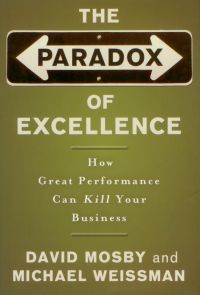
The Paradox of Excellence: How Great Performance Can Kill Your Business by David Mosby and Michael Weissman
When a company consistently provides excellent service it can become “invisible” to the client until something goes wrong. This book illustrates the problem through a parable about a trucking company. Their largest and most profitable customer has given notice to terminate their contract due to a botched delivery. Management is shocked, as there had been no previous problems with this client over the many years they have done business together.
The Laws of Simplicity: Design, Technology, Business, Life by John Maeda
Complex systems and information overload can drive us crazy. John Maeda explains the remedy. “Simplicity is about subtracting the obvious, and adding the meaningful.” The ten laws of simplicity are:
Reduce – The simplest way to achieve simplicity is through thoughtful reduction
Organize – Organization makes a system of many appear fewer.
Time – Savings in time feel like simplicity.
Learn – Knowledge makes everything simpler.
Differences – Simplicity and complexity need each other.
Context – What lies in the periphery of simplicity is definitely not peripheral.
Emotion – More emotions are better than less.
Trust – In Simplicity we trust.
Failure – Some things can never be made simple.
The One – Simplicity is about subtracting the obvious, and adding the meaningful.
Here’s my favorite line in the book: “While great art makes you wonder, great design makes things clear.” I think this thought applies to graphic design, product design, and even process design.
John Maeda is a graphic designer and computer scientist. He wrote this book while he was a professor at MIT Media Lab. Subsequently he was president of Rhode Island School of Design (RISD).
Maeda, John. The Laws of Simplicity: Design, Technology, Business, Life. Cambridge, Massachusetts: MIT, 2006. Buy from Amazon.com
Disclosure: As an Amazon Associate I earn from qualifying purchases.
It Worked For Me: In Life and Leadership by Colin Powell with Tony Koltz
Few people have the range of experiences of Colin Powell (1937-2021): from janitor of a Pepsi bottler to National Security Advisor, from Chairman of the Joint Chiefs to Secretary of State. In It Worked For Me he shares stories in a conversational style, many of which include a leadership lesson. And yes, he also includes a chapter on his infamous United Nation presentation, arguably the low point of his career.
It was interesting to hear what it was like to work with Ronald Reagan. In the chapter called Squirrels, Reagan seemed detached from the dilemma Powell was explaining to him (he seemed more interested in the squirrels outside his window), but upon reflection Powell figured out that Reagan wanted his subordinates to make their own decisions. In a separate incident involving a confrontation between U.S. and Iranian naval forces, Reagan was very decisive in his presidential decision when the matter required his approval.
Always Be Testing: The Complete Guide to Google Website Optimizer by Bryan Eisenberg and John Quarto -vonTivadar with Lisa T. Davis
Always Be Testing cuts straight to the chase. By the end of chapter two, you will understand how to set up a test.
The authors explain the difference between A/B tests (comparing the performance of two or more pages) and Multivariate tests (comparing the performance of multiple components within a page). But be aware that as of August 1, 2012, Google Website Optimizer has been replaced by Content Experiments and the multivariate functions are no longer available. More on that in a moment.
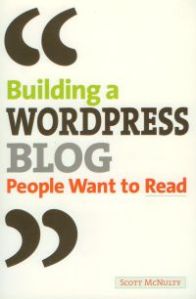
Building a WordPress Blog People Want to Read by Scott McNulty
This is a good book about setting up a blog using WordPress, but the title is misleading. It is not a book about content. It’s a guide to setting up, customizing, and maintaining the WordPress platform for blogging.
There are two main options for blogging with WordPress. You can set up a free blog hosted on wordpress.com. This is easier, but the functionality is limited. Or you can download free software from wordpress.org and install it on your own web server. The book concentrates on the latter approach.


 The Key Point