Agency


Agency: The Four Point Plan (F.R.E.E.) for All Children to Overcome the Victimhood Narrative and Discover Their Pathway to Power
by Ian V. Rowe

Neil Postman posed this question about public schools: “What kind of public does it create?” Ian Rowe addresses that pertinent question, arguing they are doing a disservice both to students and society, and offers a vision for getting back on track.

The author’s background will provide some context. Rowe immigrated to the United States from Jamaica with his parents and brother in 1968. He attended public schools in New York City, then earned an engineering degree from Cornell and an MBA from Harvard Business School. He worked on postsecondary education philanthropy at the Bill and Melinda Gates Foundation and was an executive in charge of public service campaigns for MTV. He then served as CEO of charter elementary schools in the South Bronx for 10 years before cofounding Vertex Partnership Academies charter high schools.

WHAT IS AGENCY? “My short definition is that it is the force of your free will guided by moral discernment. It is the force that closes the delta between… what is and what ought to be. It is the conviction that we are active players in our own story… Agency is learning to see ourselves not as victims of our circumstances, but rather as architects of our own better futures, and to do so even in the face of real obstacles.”

“However—and this is key—no human being acts alone. Agency is individually practiced, yet socially empowered.”

Continue reading “Agency”
The Art of Relevance

the-art-of-relevance


The Art of Relevance
by Nina Simon

This book explains how museums and other nonprofit organizations can expand audiences and build stronger connections with targeted communities. The author is executive director of the Santa Cruz Museum of Art & History (MAH).

“I believe relevance unlocks new ways to build deep connections with people who don’t immediately self-identify with our work. I believe relevance is the key to a locked room where meaning lives… Behind the door is a room that holds something powerful—information, emotion, experience, value… Relevance is the key to that door.”

“Instead of talking about ‘traditional’ approaches and ‘new’ ones, I find it more productive to talk about insiders and outsiders…”

Continue reading “The Art of Relevance”

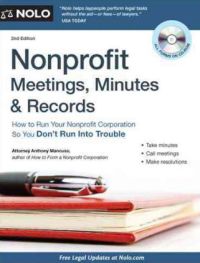
Nonprofit Meetings, Minutes & Records

nonprofit-meetings-minutes-records-nolo


Nonprofit Meetings, Minutes & Records: How to Run Your Nonprofit Corporation So You Don’t Run Into Trouble, Second Edition
by Anthony Mancuso

This book offers some good insights for anyone who serves on the board of a nonprofit organization, especially the board secretary. If the board of directors ignores its bylaws and state nonprofit laws, the organization could lose its tax-exempt status. Director liability is another concern.

Continue reading “Nonprofit Meetings, Minutes & Records”

The Five Most Important Questions You Will Ever Ask About Your Organization

the-five-most-important-questions


The Five Most Important Questions You Will Ever Ask About Your Organization
by Peter F. Drucker (1909-2005) et al

This book offers a strategic planning framework for nonprofit organizations. It can help board members set the direction by asking five questions.

What is our mission? The mission must reflect opportunities, competence, and commitment. Drucker cautions, “Never subordinate the mission in order to get money. If there are opportunities that threaten the integrity of the organization, you must say no.”

Continue reading “The Five Most Important Questions You Will Ever Ask About Your Organization”

How to Write Knockout Proposals

how-to-write-knockout-proposals


How to Write Knockout Proposals: What you must know (and say) to win funding every time.
by Joseph Barbato

The theme of this book boils down to one line on page 117: “Make it as easy as possible for them to give you money.”

Barbato emphasizes the importance of clear writing and attention to detail. He suggests a less-is-more approach: “Instead of offering four prosaic examples of how your project matters, tell one powerful story that drives home the potential of your work.”  A template is included in chapter 24, guiding the reader on how to structure a grant proposal.

The book is concise and well organized in 53 two-page chapters. I like this format, but I think more could have been written about cover letters.


Barbato, Joseph. How to Write Knockout Proposals: What You Must Know (and Say) to Win Funding Every Time. Medfield, Massachusetts: Emerson & Church, 2004. Buy from Amazon.com


Disclosure: As an Amazon Associate I earn from qualifying purchases.