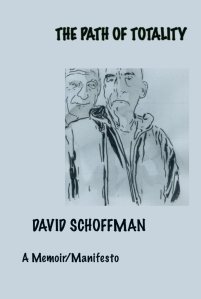
The Path of Totality: A Memoir/Manifesto by David Schoffman
With a nod to Socrates, David Schoffman writes, “The unexamined life is not worth drawing.” The author bares his soul as he reflects on the meaning of life as an artist. The book includes approximately 50 illustrations.
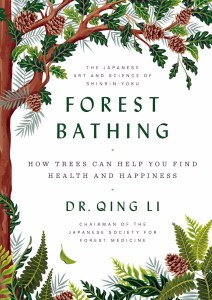
Forest Bathing: The Japanese Art and Science of Shinrin-Yoku by Qing Li, MD, PhD
“The concept that humans have a biological need to connect with nature has been called biophilia… The American biologist E.O. Wilson… believed that, because we evolved in nature, we have a biological need to connect with it.”
Qing Li is an immunologist and associate professor at Nippon Medical School in Tokyo who studies how spending time in the forest improves our health. In Japanese, shinrin (森林) means forest and yoku (浴) means bathing. “So shinrin-yoku means bathing in the forest atmosphere, or taking in the forest through our senses.” The term forest bathing is analogous to sunbathing, nikkou-yoku (日光浴) in Japanese.
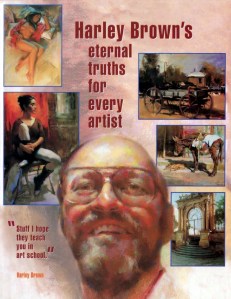
Harley Brown’s Eternal Truths for Every Artist by Harley Brown
Harley Brown is an artist and art instructor who works in pastel and oil paint. In this book he shares his advice on how to paint a variety of subjects with attention to designing an interesting composition with harmonious colors and the integration of light and shadow.
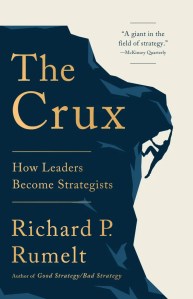
The Crux: How Leaders Become Strategists by Richard P. Rumelt
In rock climbing “there are many mountains and boulders, each promising a different mixture of difficulty and reward… Climbers call such boulders ‘problems’ and describe the toughest parts as ‘the crux’… The first climber said that he chooses the climb having the greatest expected reward and whose crux he believes he can solve.”
Rumelt observes that strategists do the same. “Whether facing problems or opportunities, they focused on the way forward promising the greatest achievable progress—the path whose crux was judged to be solvable.”
Mansfield and Dirksen: Bipartisan Giants of the Senate by Marc C. Johnson
In contrast to today’s polarized politics, the US Senate of the 1960s functioned with a great deal more civility and bipartisan cooperation, despite deep political divisions. This book is both a history lesson and a study in the leadership styles majority leader Michael Mansfield (Democrat) and minority leader Everett Dirksen (Republican).
Decisionscape: How Thinking Like an Artist Can Improve Our Decision-Making by Elspeth Kirkman
“Knowingly or not, we often draw on the logic of pictorial space as a metaphor for our decisions. We use phrases like getting things in perspective or blowing them out of proportion… And we implore one another to zoom out or see the big picture.”
Elspeth Kirkman is a behavioral scientist who uses the analogy of art making to explain the psychology of decision making. “I call this mental representation the decisionscape… The central idea of this book is that we could improve our decisions, whether personal or professional, by constructing and analyzing it deliberately, just as an artist approaches the canvas.”
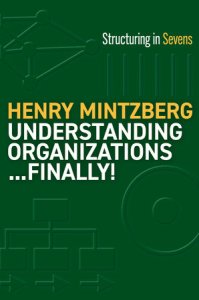
Understanding Organizations Finally! Structuring in Sevens by Henry Mintzberg
The four forms of organization are Personal (autocracy), Programmed (bureaucracy), Professional (meritocracy), and Project (adhocracy). Respectively, the coordinating mechanism of each form is direct supervision, standardization of work, standardization of skills, and mutual adjustment.
That last term should be defined before going further, as Mintzberg uses it throughout the book. “Coordination and control are two different concepts. Mutual adjustment is coordination without control… Currently, the literature of management gives considerable attention to teams, task forces, and networks, all manifestations of mutual adjustment.”
A Full Life: Reflections at 90 by Jimmy Carter (1924-2024)
Jimmy Carter was born on October 1, 1924 and was elected the 39th president of the United States in 1976. The world has changed a lot in the 100 years since Carter grew up in the segregated south. At the same time, many of the issues he writes about sound quite familiar, such as inflation, contested elections, and conflict in the Middle East.
I was surprised by Carter’s emphasis on fiscal discipline—something we haven’t seen in recent administrations. (At the end of the Carter administration, the national debt to GDP ratio was 32%. In 2022 it was 123%.) What also stands out is Carter’s cooperative relationships with presidents Gerald Ford and George H.W. Bush, in stark contrast to more recent polarization.
WCVB-TV Boston: How We Built the Greatest Television Station in America by Robert M. Bennett (1927-2016)
In this memoir, the highlight of television executive Bob Bennett’s career was launching and growing WCVB-TV, Channel 5 in Boston. A major theme is his commitment to locally-produced programming. Another theme is Bennett’s leadership style, whereby he encouraged new ideas and risk-taking from his lieutenants, and inspired a sense of pride which brought out the best in people at all levels of the organization. It’s also a high-risk, high-reward story that could have turned out very differently.
The book is comprised of Bennett’s recollections interspersed with commentary from former colleagues.
Composition: Understanding Line, Notan, and Color by Arthur Wesley Dow (1857-1922)
Composition is “the ‘putting together’ of lines, masses and colors to make a harmony. Design, understood in its broad sense, is a better word, but popular usage has restricted it to decoration.”
In the visual arts, “there are three structural elements with which harmonies may be built up” – line, notan, and color.