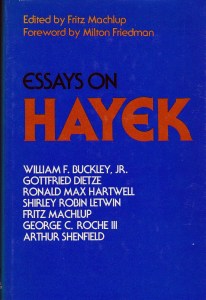
Friedrich Hayek (1899-1992) received the Nobel Prize in Economics on December 11, 1974 for his theory of business cycles and the effects of monetary and credit policies. The following year, the Mont Pelerin Society held a conference at Hillsdale College covering various aspects of Hayek’s work. This book is a collection of the papers presented and discussed.
I find it noteworthy that Hayek wrote The Road to Serfdom (1944) on the consequences of socialism in the same era that George Orwell wrote Animal Farm (1945) and 1984 (1949).
Intellectual Property and the Law of Ideas by Kurt M. Saunders, J.D., LL.M.
“Valuable ideas take many directions—ideas for new or improved products, marketing strategies, advertising slogans, manufacturing processes, television show formats and movie plots, to name a few.”
“The law of ideas is the area of law involving employees, customers, inventors, and authors, who submit ideas capable of being reduced to practical application to business. It is a somewhat amorphous amalgam of contract law, property law, and tort law precedents that has been stitched together by courts over the years.”
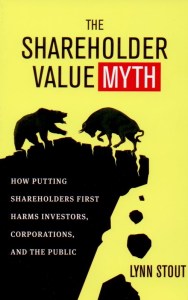
The Shareholder Value Myth: How putting shareholders first harms investors, corporations, and the public by Lynn Stout (1957-2018)
Business schools and law schools teach that the purpose of a corporation is to maximize shareholder wealth. “Shareholder wealth, in turn, is typically measured by share price—meaning share price today, not share price next year or next decade.” Lynn Stout (1957-2018), who was a business law professor at Cornell, makes the case that this is both untrue and harmful.
“United States corporate law does not, and never has, required directors of public corporations to maximize either share price or shareholder wealth… State statutes similarly refuse to mandate shareholder primacy… As long as boards do not use their power to enrich themselves, the [business judgment rule] gives them a wide range of discretion to run public corporations with other goals in mind, including growing the firm, creating quality products, protecting employees, and serving the public interest. Chasing shareholder value is a managerial choice, not a legal requirement.”
Nolo’s Quick LLC: All You Need to Know About Limited Liability Companies by Anthony Mancuso
“The limited liability company (LLC) is a relatively new business ownership structure that combines the best features of the corporation and the partnership. It gives small business owners corporate-style protection from personal liability while retaining the pass-through income tax treatment enjoyed by sole proprietorships (the legal term for one-person businesses) and partnerships.” LLC owners are called members.
To determine if an LLC is the best fit for your business, the author explains the advantages and disadvantages of various business structures in comparison to LLCs, including sole proprietorship, general partnership, limited partnership, C corporation, S corporation, RLLP, Series LLP, L3C, and benefit corporations.
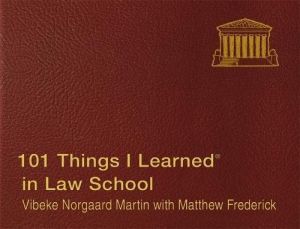
101 Things I Learned in Law School by Vibeke Norgaard Martin with Matthew Frederick
Vibeke Norgaard Martin is a lawyer who has practiced commercial litigation and civil rights law. She has also taught law at U.C. Berkeley. Here are some of her insights on how to think like a lawyer.
“Honesty and truthfulness are not the same thing. Being honest means not telling lies. Being truthful means actively making known the full truth of a matter. Lawyers must be honest, but they do not have to be truthful… Counsel may not deliberately mislead the court, but has no obligation to tell the defendant’s whole story.”
Urgent Care: 10 Cures for America’s Ailing Healthcare System by Minda Wilson, J.D.
As I write this in early 2017, there is much chatter about the potential repeal and replacement of the Patient Protection and Affordable Care Act (ACA) commonly known as Obamacare. I was motivated to read this book to get beyond the myopic hysteria and gain a deeper understanding of the problems and possible solutions presented by healthcare attorney Minda Wilson.
“The United States has the world’s highest [per-capita] healthcare cost, double that of Canada… The number one cause of personal bankruptcy in the United States is due to overbearing healthcare costs… A devastating illness means that, beyond your deductible, you could be responsible for a minimum of 30 percent of the medical bills incurred if you stay in-network. If you go outside of your network, then you could be responsible for between 50 percent and 100 percent of every bill.”
Wilson asks, “Why did the [ACA] focus on providing insurance and not healthcare?” I think this is the fundamental issue. The cost of insurance is a function of the cost of claims. So if the main focus is on subsidizing premiums, the law simply masked the underlying problem rather than solving it. “To be clear, deductibles, copays, and/or the costs of excluded care or limits on care were not included in this measure of affordability.”
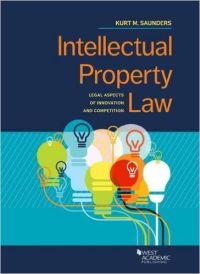
Intellectual Property Law: Legal Aspects of Innovation and Competition by Kurt M. Saunders, J.D., LL.M.
Intellectual Property Law covers trade secrets, patents, copyrights, trademarks, the right of publicity, protecting intellectual property internationally, and best practices for the handling of unsolicited ideas. Selected cases illustrate the legal theory with real-world conflicts, and explain the legal precedents established by the courts.
Although written as a business-school textbook, this book would also be a pertinent reference for professionals in a range of industries in the knowledge economy. Awareness of the law can help executives protect their rights and stay out of trouble.
In a global economy, how do you fight counterfeit products? What can you do about gray market sales? The chapter on international aspects explains the relevant treaties, notably the TRIPS Agreement, as well as the role of the WTO and the ITC.
What happens when a small business, which has been using a common law trademark for 50 years, is sued for infringement by a newer company which has registered the trademark with the USPTO? The answer is that concurrent use is allowed until the federal trademark owner competes directly. One of the purposes of trademark law is to prevent confusion in the mind of the consumer as to the origin of the product.
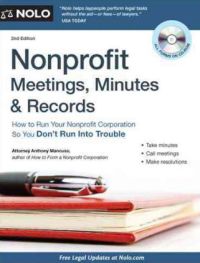
Nonprofit Meetings, Minutes & Records: How to Run Your Nonprofit Corporation So You Don’t Run Into Trouble, Second Edition by Anthony Mancuso
This book offers some good insights for anyone who serves on the board of a nonprofit organization, especially the board secretary. If the board of directors ignores its bylaws and state nonprofit laws, the organization could lose its tax-exempt status. Director liability is another concern.
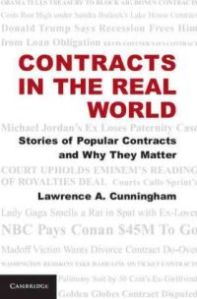
Contracts in the Real World: Stories of Popular Contracts and Why They Matter by Lawrence A. Cunningham, J.D.
In this highly-informative book, Lawrence Cunningham explains contract law by analyzing contemporary cases, many involving well-known names such as Lady Gaga, Conan O’Brien, Eminem, Michael Jordan, Frank and Jamie McCourt, JP Morgan Chase, and Sprint. The author is a law professor at George Washington University.

 The Key Point