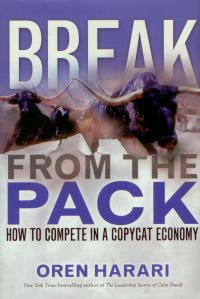
Break From the Pack: How to Compete in a Copycat Economy

break-from-the-pack


Break From the Pack: How to Compete in a Copycat Economy
by Oren Harari

Break-from-the-pack companies are analogous to the small cluster of runners at the front of a marathon. The Copycat Economy is analogous to the majority of runners who lag behind. In the words of former IBM CEO Sam Palmisano, “Either you innovate or you’re in commodity hell. If you do what everybody else does, you have a low-margin business.”

Continue reading “Break From the Pack: How to Compete in a Copycat Economy”
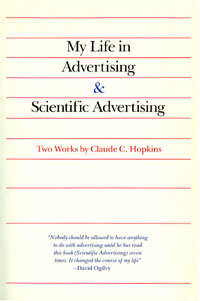
Scientific Advertising

scientific-advertising


My Life in Advertising and Scientific Advertising
by Claude C. Hopkins (1866-1932)

Claude C. Hopkins was a pioneer in the advertising industry. This volume consists of his two books: Scientific Advertising, written in 1923, and My Life in Advertising, written in 1927. NBC and CBS were founded around the time of Hopkins’ retirement, so his work predated the broadcasting era. The media of his time were newspapers, magazines, and direct mail.

“Salesmanship-in-print is exactly the same as salesmanship-in-person.” If the purpose of advertising is to sell, then its effectiveness can be measured by resulting sales volume. Hopkins tested ads on a small scale before risking money on a large-scale campaign. He also compared results using different headlines in order to discover the best performing approach.

Continue reading “Scientific Advertising”

The Experience Economy


The Experience Economy: Work is Theatre & Every Business is a Stage
by B. Joseph Pine II and James H. Gilmore

The Experience Economy is about the progression of economic value:

  • Commodities – coffee beans
  • Goods – ground coffee
  • Services – a cup of coffee at a diner
  • Experiences – cup of coffee at a fine restaurant or trendy café

“Commodities are fungible, goods are tangible, services intangible, and experiences memorable… The easiest way to turn a service into an experience is to provide poor service.”

Continue reading “The Experience Economy”

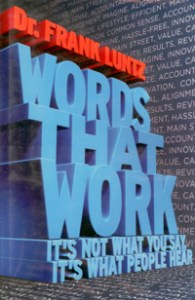
Words That Work


Words That Work: It’s not what you say, it’s what people hear
By Dr. Frank Luntz

Frank Luntz is a communication strategist for corporate and political clients. Although he’s done a lot of work for Republicans (including the Contract with America) this is not a book about political ideology. It’s about persuasive communication in political campaigns, product marketing, and labor disputes.

Words that work do not happen by chance. Luntz uses market research techniques (polls, focus groups, dial sessions) to test how audiences respond.

Continue reading “Words That Work”

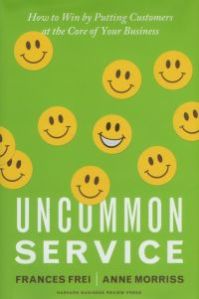
Uncommon Service


Uncommon Service: How to Win by Putting Customers at the Core of Your Business
by Frances Frei and Anne Morriss

Customer service is not an afterthought. In order to provide consistently excellent service, it must be baked in to the business model. In Uncommon Service, authors Frances Frei and Anne Morriss explain that great service is “made possible—profitable, sustainable, scalable—by designing a system that sets everyone up to excel.”

Continue reading “Uncommon Service”

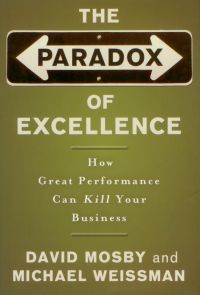
The Paradox of Excellence


The Paradox of Excellence: How Great Performance Can Kill Your Business
by David Mosby and Michael Weissman

When a company consistently provides excellent service it can become “invisible” to the client until something goes wrong. This book illustrates the problem through a parable about a trucking company. Their largest and most profitable customer has given notice to terminate their contract due to a botched delivery. Management is shocked, as there had been no previous problems with this client over the many years they have done business together.

Continue reading “The Paradox of Excellence”

Always Be Testing


Always Be Testing: The Complete Guide to Google Website Optimizer
by Bryan Eisenberg and John Quarto -vonTivadar with Lisa T. Davis

Always Be Testing cuts straight to the chase. By the end of chapter two, you will understand how to set up a test.

The authors explain the difference between A/B tests (comparing the performance of two or more pages) and Multivariate tests  (comparing the performance of multiple components within a page). But be aware that as of August 1, 2012, Google Website Optimizer has been replaced by  Content Experiments and the multivariate functions are no longer available. More on that in a moment.

Continue reading “Always Be Testing”