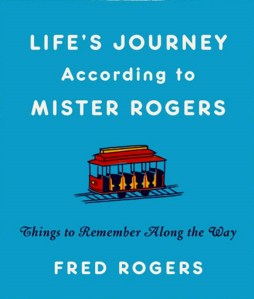
Life’s Journeys According to Mister Rogers: Things to Remember Along the Way by Fred Rogers (1928-2003)
And now a Thanksgiving palette cleanser.
Fred Rogers was the creator and host of the children’s television show Mister Rogers’ Neighborhood from 1968 to 2001. This short book is a posthumously published collection of his writing for adults.
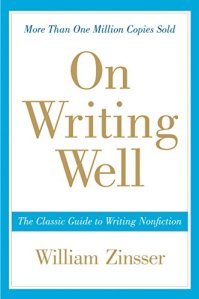
On Writing Well: An Informal Guide to Writing Nonfiction by William Zinsser (1922-2015)
William Zinsser taught nonfiction writing at Yale and he was editor of Book-of-the-Month Club. In a nutshell, the message is that good writing is clear, simple, and unpretentious. My father gave me a copy of the third edition of this book when I graduated from high school in the 1980s. While recently rereading it I was amused by Zinsser’s description of a new invention called a word processor—almost like someone describing their car as a horseless carriage. But otherwise the book stands up to the test of time (and there’s a newer edition available).
Although oriented towards helping U.S. government employees write clear regulations, the Federal Plain Language Guidelines offers great advice for any nonfiction writer. It includes a section on writing content for web sites.
Here are some highlights.
“Address one person, not a group. Remember that even though your document may affect a thousand or a million people, you are speaking to the one person who is reading it. When your writing reflects this… [it] has a greater impact.”
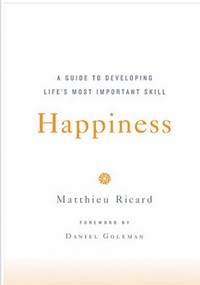
Happiness: A Guide to Developing Life’s Most Important Skill by Matthieu Ricard
Matthieu Ricard gave up a career in cellular genetics at the Institut Pasteur to study Buddhism in the Himalayas. In this book he shares his wisdom about happiness drawing from thirty-five years of studying Buddhism and psychology.
“A change, even a tiny one, in the way we manage our thoughts and perceive and interpret the world can significantly change our existence. Changing the way we experience transitory emotions leads to a change in our moods and to a lasting transformation of our way of being.”
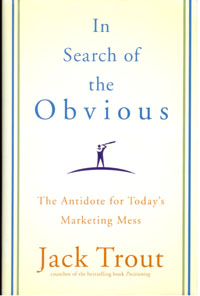
In Search of the Obvious: The Antidote for Today’s Marketing Mess by Jack Trout
Jack Trout (1935-2017) had been a marketing professional for over 40 years. This book is about how the marketing profession has gotten off course, and the importance of timeless fundamentals, simplicity, and common sense.
Trout is critical of Madison Avenue. “To me it’s creativity run amok…The fact is that creativity was always a misnomer. An agency isn’t creating something. The company or product or service already exists. What they are doing is figuring out what is the best way to sell it. That, simply stated, means to take that logical, differentiating argument and dramatize it.”
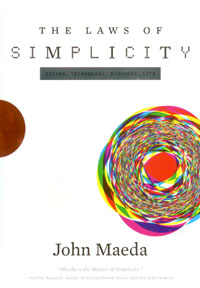
The Laws of Simplicity: Design, Technology, Business, Life by John Maeda
Complex systems and information overload can drive us crazy. John Maeda explains the remedy. “Simplicity is about subtracting the obvious, and adding the meaningful.” The ten laws of simplicity are:
Reduce – The simplest way to achieve simplicity is through thoughtful reduction
Organize – Organization makes a system of many appear fewer.
Time – Savings in time feel like simplicity.
Learn – Knowledge makes everything simpler.
Differences – Simplicity and complexity need each other.
Context – What lies in the periphery of simplicity is definitely not peripheral.
Emotion – More emotions are better than less.
Trust – In Simplicity we trust.
Failure – Some things can never be made simple.
The One – Simplicity is about subtracting the obvious, and adding the meaningful.
Here’s my favorite line in the book: “While great art makes you wonder, great design makes things clear.” I think this thought applies to graphic design, product design, and even process design.
John Maeda is a graphic designer and computer scientist. He wrote this book while he was a professor at MIT Media Lab. Subsequently he was president of Rhode Island School of Design (RISD).
Maeda, John. The Laws of Simplicity: Design, Technology, Business, Life. Cambridge, Massachusetts: MIT, 2006. Buy from Amazon.com
Disclosure: As an Amazon Associate I earn from qualifying purchases.
 The Key Point