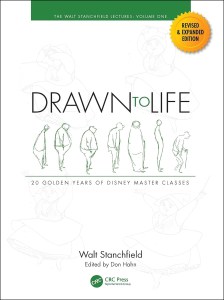
Drawn to Life: 20 Golden Years of Disney Master Classes by Walt Stanchfield (1919-2000). Edited by Don Hahn.
Walt Stanchfield began his animation career in 1937. In the 1980s and 90s he taught figure drawing classes for animators at Disney on Tuesday and Wednesday evenings. Disney producer Don Hahn compiled Stanchfield’s lecture notes and handouts into two volumes. The highlights below from Volume One capture some recurring themes.
The book includes drawings from Stanchfield and his students. This review includes more recent drawings by Brian Kennon, a former Disney artist who attended Stanchfield’s classes in the 1990s.
On Speaking Well: How to Give a Speech with Style, Substance, and Clarity by Peggy Noonan
Prior to writing columns for the Wall Street Journal and Time, Peggy Noonan was a speechwriter for Ronald Reagan and George H.W. Bush. In this book she shares her wisdom about speaking and speechwriting.
The Soft Edge: Where Great Companies Create Lasting Success by Rich Karlgaard
It is noteworthy that a prominent business journalist from Silicon Valley—where technology and IPOs dominate headlines—wrote a book about the human factors of business success. “The yin and yang of effective management has always been about the search for the right spot between data truth and human truth.”
“Hard-edge execution is all about managing exactly to the numbers. The people who live on the hard edge of business are good at making the trains run on time. They focus on profit. Their language is time, money, and numbers. Every company in the world needs these employees.”
“Soft-edge excellence—in trust, smarts, teams, taste, and story—tends to attract loyal customers and committed employees.” Karlgaard says the soft edge is “the heart and soul” of your company.
Story Mythos: A Movie Guide to Better Business Stories by Shane Meeker
“People are inspired and moved by stories…Story is about human emotions… Stories de-commodify your brand/product.” The premise of this book is that the same principles used by Hollywood filmmakers can be used to develop powerful brand stories. The author is the company historian and corporate storyteller at Procter & Gamble.
“What are your most powerful company stories, and how are you using them to inspire your people? How do you explain your purpose through different stories? What stories best demonstrate your company beliefs? How are you documenting and protecting the stories that matter? … How can you use a story to demonstrate a company’s culture?”
The Halo Effect and the Eight Other Business Delusions That Deceive Managers by Phil Rosenzweig
Many business books and articles have been written about what Phil Rosenzweig calls “the mother of all business questions… What leads to high performance?” This book explains why much of this analysis is “riddled with errors.”
Using the examples of Cisco, ABB, and others, the author demonstrates the phenomenon. When times were good—strong revenue growth and a soaring stock price—these companies were praised for their exemplary strategy, culture, and CEO. When financial performance fell, the same strategy, culture, and CEO were ripped apart as severely flawed.
Why does this happen? Because we love stories. “As long as Cisco was growing and profitable and setting records for its share price, managers and journalists and professors inferred that it had a wonderful ability to listen to its customers, a cohesive culture, and a brilliant strategy. And when the bubble burst, observers were quick to make the opposite attribution. It all made sense. It told a coherent story.”
“Yet there’s a bit more to it. Our desire to tell stories, to provide a coherent direction to events, may also cause us to see trends that do not exist or infer causes incorrectly. We may ignore facts because they don’t fit into our story.”
How does this happen? Introducing the Halo Effect.
Don’t Sell Me, Tell Me: How to use storytelling to connect with the hearts and wallets of a hungry audience by Greg Koorhan
Greg Koorhan’s main message is to “stop sounding like everyone else and tell your own, unique story.”
“A study by the Emory Institute in Atlanta… found that just thinking about an action triggers the same emotional and sensory area of the brain that performing the action does… So by telling a story associated with you or your business, you can trigger the emotions that make your customer feel, even for a brief moment, as if they’ve experienced the same benefit… Assuming it’s a good experience, don’t you think they’ll want more?”
“When looking at data, the language areas of the brain light up, but not the emotional and sensory areas. These areas are triggered only by stories. This means that your story can engage your audience in ways data can’t… When data and stories are used together, audiences are moved both emotionally and intellectually.”
“Your Story IS Your Brand… Your brand is actually tied closely to your values. And by nurturing your values, you develop a theme. And out of your theme grows your story… Start with your values, then your theme, character archetype and emotional tone. Once you’ve got the elements of your story in place, your entire marketing and advertising platform can grow out of it.”
101 Things I Learned in Film School by Neil Landau with Matthew Frederick
“In my… twenty years of teaching, screenwriting, and filmmaking, I have been continually struck by how the creative process of filmmaking is at once painstakingly deliberate and fortuitously experimental,” writes Neil Landau, who teaches at the UCLA School of Theater, Film, and Television.
Creating a film or television program entails a variety of skills including budgeting, screenwriting, directing, acting, and numerous technical proficiencies. Here’s a sampling of the insights shared by the author.
“Film is a director’s medium; television is a writer’s medium. A movie is a one-of-a-kind undertaking: The production team and actors come together for several weeks or months to create a unique world that disappears upon the completion of filming. A strong director is essential in defining this world—form its artistic details to its broad nuances, script approval to casting, set design to special effects, and lighting and equipment to the overall visual style. A successful television series, by comparison, is long running, and production becomes rather standardized during its first season. The greatest challenge becomes the generation of new material each week, giving the gifted writer a proportionately greater opportunity to shine.”
In this book, he computes valuation based on the business narrative. “One of the most important lessons I have learned is that a valuation that is not backed up by a story is both soulless and untrustworthy and that we remember stories better than spreadsheets.” Conversely, “when a storyteller has wandered into fantasyland, the easiest way to bring him or her back to Earth is with data that suggests the journey is either impossible or improbable.” Thus, “you need to bring both stories and numbers into play in investing and business, and valuation is the bridge between the two.”
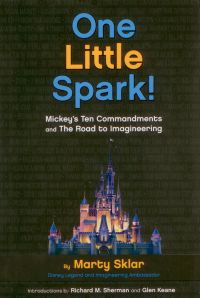
One Little Spark! Mickey’s Ten Commandments and The Road to Imagineering by Marty Sklar (1934-2017) with introductions by Richard M. Sherman and Glen Keane
Marty Sklar was hired by Walt Disney in 1955, prior to the opening of Disneyland. He rose through the ranks to president of Imagineering, the group responsible for Disney’s theme parks worldwide. He retired in 2009 after a 54-year career with the company.
The first part of the book explains Mickey’s Ten Commandments, guiding principles developed by Sklar in 1983. The second half of the book consists of career advice from 75 Imagineers. The most prominent recurring theme in this book is storytelling.
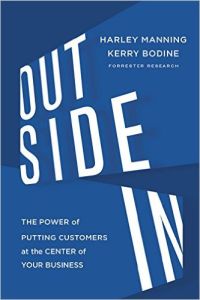
Outside In: The Power of Putting Customers at the Center of Your Business by Harley Manning and Kerry Bodine
“Customer experience is how your customers perceive their interactions with your company. Once you understand that, you can manage your business from the outside in… To achieve the full potential of customer experience as a business strategy… you must manage from the perspective of your customers, and you must do it in a systemic, repeatable, and disciplined way.”
The benefits of providing exceptional customer experience are “higher revenues resulting from better customer retention, greater share of wallet, and positive word of mouth, plus lower expenses due to happier customers who don’t run up your service costs.” One example from the book is a $1.7 billion per year savings in customer service costs and bill credits as a result of Sprint simplifying its confusing plan options.
 The Key Point