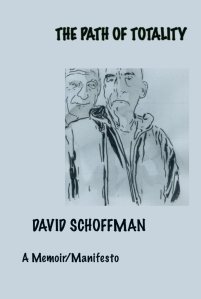
The Path of Totality: A Memoir/Manifesto
by David Schoffman
With a nod to Socrates, David Schoffman writes, “The unexamined life is not worth drawing.” The author bares his soul as he reflects on the meaning of life as an artist. The book includes approximately 50 illustrations.
THINKING ABOVE ONE’S WEIGHT. “I wish my head was like a clear, quiet lake where I could visualize my thoughts with beautiful and peaceful coherence. I imagine other people might be capable of this. In my gummy brain, I think of people like that as being ‘smart.’ By this I don’t mean people who can speak in fully formed paragraphs—I can do that fairly easily—it’s more those folks who have the ability to be both analytical and poetic at the same time.”
“But there is a legitimate place for gummed up thinking. There’s a place where gummed up thinking may even be a virtue. I know this because intuitively, I feel a kinship for thinkers that are constantly punching above their weight. There’s even a name for this type of thinker. They’re called artists.”
“I have several motives for reading. One is a response to the intellectual inferiority I carry with me like a rucksack. Like most autodidacts, I am chronically insecure about my intelligence… I don’t feel like a faker. I feel like someone trying to arrive at some kind of cogent state of understanding but constantly falling short.”
“In other words, I’m a visual artist, and when it comes to images or pictures, I think extremely clearly.” Or as Milton Glaser said, Drawing Is Thinking.
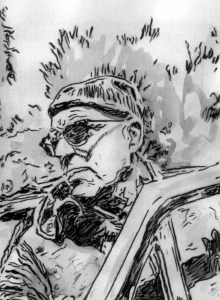
EARNING A LIVING. “I was supposed to become a famous painter. That was my plan. All I needed to do was to rent a studio, make beautiful and unusual paintings, behave ethically, remain patient and forthright, and success would follow like a dog on a leash. In an odd way, I still cling to this ridiculous fantasy.”
“Of course, the world does not always cooperate with dreams and as Yeats pointed out, ‘in dreams begin responsibilities.’”
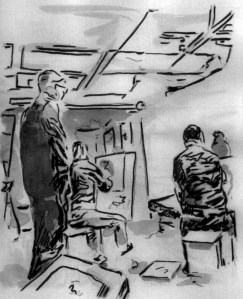
“And so, I teach. I teach drawing, life drawing, and painting… The best that could be said for all this thankless toil is that it has kept my draftman’s skills sharp.”
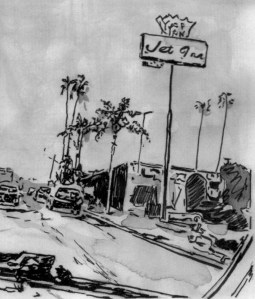
LOS ANGELES. “I don’t claim to love Los Angeles, but I certainly don’t hate it… Architecturally, though we’re not Paris, we also aren’t Pyongyang… The sum is a dog’s breakfast of stylistic promiscuity, making us the perfect iteration of postmodernism.”
“Nothing illustrates this idea more eloquently than the ridiculous ubiquity of palm trees… I love these trees. I love everything about them. I even love their broken, brown fronds that litter the streets after every storm.”
“All of our architectural misdemeanors are forgiven (and even embraced) by the comic governance of the palms… This is the unsung balm to the onus of driving. It gives me a wacky sense of peace, and the permission to invent… Which is what I really do for a living.”
HABIT IS THE BALLAST. “I’m either a creature or a victim of habit. Samuel Beckett described habit as ‘the ballast that chains the dog to his vomit.’ I wouldn’t go that far, but daily ritual seems like a stable albeit predictable point of departure for any human trying to navigate the complexities of living.”
“You have to go to the studio every day. Honestly, I never want to go to the studio… I’d rather pursue some version of happiness instead of hiding behind an obscure ideal of creative eudaimonia. But I can’t… It’s a form of madness.”
WHAT IT MEANS TO BE AN ARTIST. “Art is about ideas and the older and smarter one gets the more complex and subtle one’s work should become. If you’re honest, diligent, and keenly introspective, your work will grow. If you’re lazy or complacent, your work will descend into a decadent mannerism.”
“Art isn’t a career. Careers are measured by stature and achievement. Being an artist is like being left-handed, or red-headed, or clinically depressed, or hammer-toed. You have no choice and sometimes it feels like an affliction. If this sound romantic, I can assure you, that’s not my intention.”
“Take this book. When I made it, you were the last thing from my mind. It was compulsion that drove me to make it, not communication. When Hemingway was asked what kind of messages he hoped to convey in his stories he shot back that if he had messages he would have gone to Western Union.”
“All of this is to say that though I recognize the futility of art, I insist it is with our art that we measure our civilization. Nobody remembers Michelangelo’s dentist.”
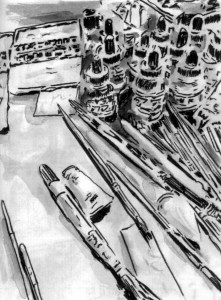
PERSONAL AGENCY. “The tools I prefer are the most primitive. Not because I have a righteous deference for tradition, but because working with simple, basic elements like paint, paper, pencils, canvas, and wood keeps me independent. I don’t need collaborators or technology or expensive machines. To me, living as an artist is the greatest expression of personal agency and I feel most free when I’m all alone making stuff with my hands.”
SEEKING APPROVAL. “I think of my father every day… He taught us to be uncompromisingly ethical though he never sufficiently warned us of the price this sort of probity exacts. Outside of Chagall, Modigliani, and Soutine, he knew next to nothing about art. When I told him of my plans to study painting in art school, he urged me to become an architect instead.”
“He was a genius and he was kind and he was loving and he was the perfect father. And I could never, even if I lived a thousand lifetimes, come close to his sublime nature. But for all his erudition, Abba never really got the artist thing. On his deathbed he told me I should buy a suit. I didn’t.”
Schoffman, David. The Path of Totality: A Memoir/Manifesto. Los Angeles, s.p., 2024. Buy from Amazon.com
Disclosure: As an Amazon Associate I earn from qualifying purchases. I received a review copy of this book.
Discover more from The Key Point
Subscribe to get the latest posts sent to your email.

 The Key Point