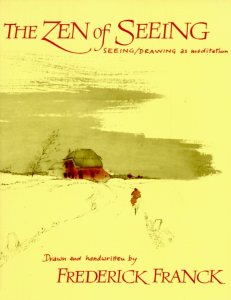
The Zen of Seeing: Seeing/Drawing as Meditation by Frederick Franck (1909-2006)
In our time of overstimulation and shrinking attention span, Franck’s message is even more relevant now than when the book was published in 1973: “We do a lot of looking: we look through lenses, telescopes, television tubes… Our looking is perfected every day—but we see less and less. Never has it been more urgent to speak of SEEING.”
“Drawing is the discipline by which I constantly rediscover the world. I have learned that what I have not drawn I have never really seen, and that when I start drawing an ordinary thing I realize how extraordinary it is, sheer miracle: the branching of a tree, the structure of a dandelion’s seed puff.”
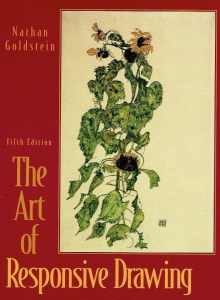
The Art of Responsive Drawing by Nathan Goldstein (1927-2013)
I was prompted to read this book after a discussion with an art professor about what makes a work of art compelling. I commented that spontaneous gesture drawings can capture an intangible quality—energy, attitude, spirit—that is often lost in more technically resolved drawings and paintings. How does an artist preserve the initial spark of interest in a more complete work?
Nathan Goldstein writes about the expressive character of a drawing—that is to say, its psychological appeal—grounded by the fundamentals of representational drawing: gesture, shape, line, value, perspective and foreshortening, volume, color, and composition.
“The best drawings always disclose a blend of facts and feelings, and to displace intuition and empathy with a dry intellectual examination of a subject’s structural condition upsets the necessary and delicate balance between discipline and indulgence that gives master drawings their individual character and spirit.”
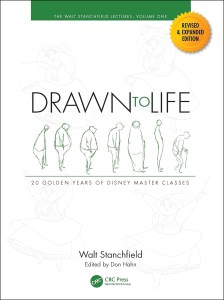
Drawn to Life: 20 Golden Years of Disney Master Classes by Walt Stanchfield (1919-2000). Edited by Don Hahn.
Walt Stanchfield began his animation career in 1937. In the 1980s and 90s he taught figure drawing classes for animators at Disney on Tuesday and Wednesday evenings. Disney producer Don Hahn compiled Stanchfield’s lecture notes and handouts into two volumes. The highlights below from Volume One capture some recurring themes.
The book includes drawings from Stanchfield and his students. This review includes more recent drawings by Brian Kennon, a former Disney artist who attended Stanchfield’s classes in the 1990s.
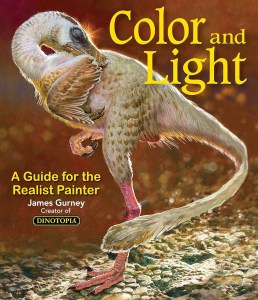
Color and Light: A Guide for the Realist Painter by James Gurney
James Gurney has a talent for explaining complicated topics in simple language. Each of 90 topics is explained on a 2-page spread, illustrated with the author’s plein air, portrait, and fantasy paintings—he is the creator of the Dinotopia series. Color harmony is a recurring theme.
“Viewers will see the subject, but feel the color and light.”
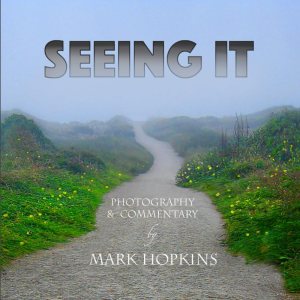
Seeing It: Photography and Commentary by Mark Hopkins (1932-2026)
As art professor Kit White has written, “Observation lies at the heart of the art process.” Learning to see is a fundamental skill taught in observational drawing classes. It’s also fundamental to fine art photography, as Mark Hopkins explains. The title Seeing It refers to being curious and looking beyond the obvious.
“Cameras do not see; that is the task of their owners. And seeing is what this book is about. In particular, it is about seeing opportunities to create worthy photographic images. It is meant to be inspirational, to show how one camera owner’s concentration on visual awareness has created a collection of photographs whose images others might have walked right past.”
“It is about seeing what you see. If by the end of the book you have a better appreciation of what I mean by that, then I will have fulfilled my goal.”
The Path of Totality: A Memoir/Manifesto by David Schoffman
With a nod to Socrates, David Schoffman writes, “The unexamined life is not worth drawing.” The author bares his soul as he reflects on the meaning of life as an artist. The book includes approximately 50 illustrations.
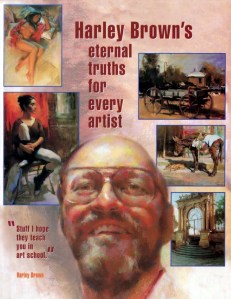
Harley Brown’s Eternal Truths for Every Artist by Harley Brown
Harley Brown is an artist and art instructor who works in pastel and oil paint. In this book he shares his advice on how to paint a variety of subjects with attention to designing an interesting composition with harmonious colors and the integration of light and shadow.
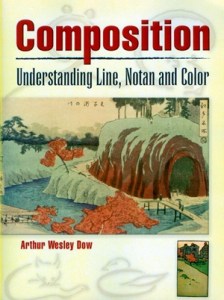
Composition: Understanding Line, Notan, and Color by Arthur Wesley Dow (1857-1922)
Composition is “the ‘putting together’ of lines, masses and colors to make a harmony. Design, understood in its broad sense, is a better word, but popular usage has restricted it to decoration.”
In the visual arts, “there are three structural elements with which harmonies may be built up” – line, notan, and color.
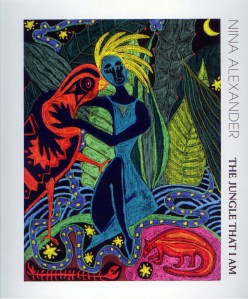
Nina Alexander has been making art for 60 years. Her work has transitioned from metal sculptures to photography, collage, and most recently, the pastels which are featured in this 10×10 inch book. Preceding the artwork is a brief biographical text. The psychology of creating art is a recurring theme.