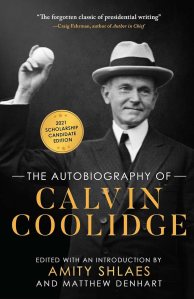
The Autobiography of Calvin Coolidge
by Calvin Coolidge (1872-1933) with introduction and footnotes by Amity Shlaes and Matthew Denhart
Calvin Coolidge became the 30th president of the United States on August 3, 1923 upon the death of President Warren G. Harding. He ran for reelection in 1924 and served one full term of his own. He did not seek reelection in 1928. To give some context of his time, Coolidge was the first president whose inauguration address was broadcast nationwide on the radio, and he was the first president to make a transatlantic telephone call.
GROWING UP IN RURAL VERMONT
Coolidge grew up in Plymouth Notch, Vermont. He attended boarding school in the town on Ludlow.
“During the long vacations from May until September I went home and worked on the farm. We had a number of horses so that I was able to indulge my pleasure in riding. As no one else in the neighborhood cared for this diversion I had to ride alone. But a horse is much company, and riding over the fields and along the country roads by himself, where nothing interrupts his seeing and thinking, is a good occupation for a boy. The silences of Nature have a discipline all their own.”
Coolidge learned about civics from a young age. “My father was nearly all his life a Constable or a Deputy Sheriff, and sometimes both, with power to serve civil and criminal process… As I went about with my father when he collected taxes, I knew that when taxes were laid some one had to work to earn the money to pay them. I saw that a public debt was a burden on all the people in a community, and while it was necessary to meet the needs of a disaster it cost much in interest and ought to be retired as soon as possible.”
AMHERST COLLEGE
“I found the course in history under Professor Anson D. Morse was very absorbing… The whole course was a thesis on good citizenship and good government. Those who took it came to a clearer comprehension not only of their rights and liberties but of their duties and responsibilities.”
PRACTICING LAW
“I had decided to enter the law and expected to attend a law school, but one of my classmates wrote me late in the summer that there was an opportunity to go into the office of Hammond and Field at Northampton, so I applied to them and was accepted… Soon after I entered the office Mr. Hammond was elected District Attorney and Mr. Field became Mayor of the city, so that I saw something of the working of the city government and the administration of criminal law.” Coolidge passed the Bar exam in 1897.
“Mr. Taft was the best lawyer I ever saw. If he was trying a case before a jury he was always the thirteenth juryman, and if the trial was before the court he was always advising the Judge.”
“One time he said to me: ‘Young man, when you can settle a case within reason you settle it. You will not make so large a fee out of some one case in that way, but at the end of the year you will have more money and your clients will be much better satisfied.’ This was sound advice and I heeded it. People began to feel that they could consult me with some safety and without the danger of being involved needlessly in long and costly litigation in court.”
MASSACHUSETTS STATE SENATE
“It was in my second term in the Senate that I began to be a force in the Massachusetts legislature… President Greenwood made me chairman of the Committee on Railroads… The bill came out for our trolley roads in Western Massachusetts and was adopted. [The Democratic Governor] vetoed this, and his veto was overridden by a large majority. It was altogether the most enjoyable session I ever spent with any legislative body.”
“It appeared to me in January 1914, that a spirit of radicalism prevailed which unless checked was likely to prove very destructive. It had been encouraged by the opposition and by a large faction of my own party.”
“In taking the chair as President of the Senate I therefore made a short address, which I had carefully prepared, appealing to the conservative spirit of the people. I argued that the government could not relieve us from toil, that large concerns are necessary for the progress in which capital and labor all have a common interest, and I defended representative government and the integrity of the courts. The address has since been known as ‘Have Faith in Massachusetts.’”
“The political complexion of the Senate was completely changed. From a bare majority of twenty-one the Republican strength rose to thirty-three, and the opposition was reduced to seven Democrats.”
“Massachusetts was beginning to suffer from a great complication of laws and restrictive regulations, from a multiplicity of Boards and Commissions, which had reached about one hundred, and from a large increase in the number of people on the public pay rolls, all of which was necessarily accompanied with a much larger cost of state government that had to be met by collecting more revenue from the taxpayers. The people began to realize that something was wrong and began to wonder whether more laws, more regulations, and more taxes, were really any benefit to them.”
“The Governor very much desired to be United States Senator… Finally he called me aside and told me to announce that I would run for Governor, which I did.” The editors note, “before the 17th Amendment was ratified in 1913, state legislatures chose U.S. senators.”
GOVERNOR OF MASSACHUSETTS
Governor Coolidge’s handling of the Boston Police strike was a defining moment in his political career.
“When the policemen’s union persisted in its course I was urged by a committee appointed by the Mayor to interfere and attempt to make Commissioner Curtis settle the dispute by arbitration. The Governor appoints the Commissioner and probably could remove him, but he has no more jurisdiction over his acts than he has over the Judges of the Courts; besides, I did not see how it was possible to arbitrate the question of the authority of the law, or of the necessity of obedience to the rules of the Department and the orders of the Commissioner. These principles were the heart of the whole controversy and the only important questions at issue. It can readily be seen how important they were and what the effect might have been if they had not been maintained. I decided to support them whatever the consequences might be. I fully expected it would result in my defeat in the coming campaign for reelection as Governor.”
“When it became perfectly apparent that the policemen’s union was acting in violation of the rules of the Department the leaders were brought before the Commissioner on charges, tried and removed from office, whereat about three-quarters of the force left the Department in a body at about five o’clock on the afternoon of Tuesday, September ninth. This number was larger than had been expected.”
“The Mayor had the same authority as the Governor to call out the Guard in the City of Boston…The Mayor, acting under a special law, had taken charge of the police force of the city, and by putting a Guard officer in command had virtually displaced the Commissioner, who came to me in great distress… I consulted the law as is my custom. I found a general statute that gives the Governor authority to call on any police officer in the state to assist him.”
“I issued a General Order restoring Mr. Curtis to his place as Commissioner in control of the police, and made a proclamation calling on all citizens to assist me in preserving order, and especially directing all police officers in Boston to obey the orders of Mr. Curtis.”
“Soon, [American Federation of Labor president] Samuel Gompers began to telegraph me asking the removal of Mr. Curtis and the reinstatement of the union policemen. This required me to make a reply in which I stated among other things that ‘There is no right to strike against the public safety by any body, any time, any where.’ This phrase caught the attention of the nation.”
It seems odd that the Governor would have involvement in appointing a municipal police chief, but in Massachusetts, Home Rule authority was not granted to cities and towns until 1966.
VICE PRESIDENT OF THE UNITED STATES
“No doubt it was the police strike in Boston that brought me into national prominence.”
“Senator Lodge came to me and voluntarily requested that he should present my name to the national Republican convention.”
“When the Republican National Convention met at Chicago [in June 1920]… Senator Warren G. Harding was nominated… I have always been of the opinion that this turned out to be much the best for me. I had no national experience… The Presidents who have gone to Washington without first having held some national office have been at great disadvantage. It takes them a long time to become acquainted with the Federal officeholders and the Federal Government.”
“I received about three-quarters of all the votes cast [for Vice President]. When this honor came to me I was pleased to accept, and it was especially agreeable to be associated with Senator Harding, whom I knew well and liked.”
“We discussed at length the plans for his administration. The members of his Cabinet were considered and he renewed the invitation to me, already publicly expressed, to sit with them… My experience in the Cabinet was of supreme value to me when I became president.”
The editors note, “President Harding’s invitation to Coolidge to join Cabinet meetings was rare. In fact, Coolidge was the first vice president to attend cabinet meetings on a regular basis.”
“As the president is not available for social dinners of course the next officer in rank is much sought after for such occasions… We found it a most enjoyable opportunity for getting acquainted and could scarcely comprehend how anyone who had the privilege of sitting at a table surrounded by representatives of the Cabinet, the Congress, the Diplomatic Corps and the Army and Navy would not find it interesting.”
“Presiding over the Senate was fascinating to me. That branch of the Congress has its own methods and traditions which may strike the outsider as peculiar… The power to compel due consideration is the distinguishing mark of a deliberative body.”
“Nothing is more dangerous to good governance than great power in improper hands… The fault lies back in the citizenship of the states. If the Senate does not function properly the blame is chiefly on them.”
PRESIDENT OF THE UNITED STATES
“On the night of August 2, 1923, I was awakened by my father coming up the stairs calling my name… President Harding had just passed away.”
“Meantime, I had been examining the Constitution to determine what might be necessary for qualifying by taking the oath of office. It is not clear that any additional oath is required beyond what is taken by the Vice-President when he is sworn into office. It is the same form as that taken by the President.
Having found this form in the Constitution I had it set up on the typewriter and the oath was administered by my father in his capacity as a notary public, an office he had held for a great many years. The oath was taken in what we always called the sitting room by the light of the kerosene lamp, which was the most modern form of lighting that had then reached the neighborhood.”
“Fate bestows its rewards on those who put themselves in the proper attitude to receive them.”
ECONOMY. “When I became President it was perfectly apparent that the key by which the way could be opened to national progress was constructive economy. Only by the use of that policy could the high rates of taxation, which were retarding our development and prosperity, be diminished, and the enormous burden of our public debt be reduced.”
“Without impairing the efficient operation of all the functions of the government, I have steadily and without ceasing pressed on in that direction. This policy has encouraged enterprise, made possible the highest rate of wages which has ever existed, returned large profits, brought to the homes of the people the greatest economic benefits they ever enjoyed, and given to the country as a whole an unexampled era of prosperity. This well-being of my country has given me the chief satisfaction of my administration.”
CABINET. “At ten-thirty on Tuesdays and Fridays the Cabinet meetings were held… There never ought to be and never were marked differences of opinion in my Cabinet. As their duties were not to advise each other, but to advise the President, they could not disagree among themselves. I rarely failed to accept their recommendations.”
“The President gets the best advice he can find, uses the best judgment at his command, and leaves the event in the hands of Providence.”
DELEGATING. “In the discharge of the duties of the office there is one rule of action more important than all others. It consists in never doing anything that some one else can do for you. Like many other good rules, it is proven by its exceptions. But it indicates a course that should be very strictly followed in order to prevent being so entirely devoted to trifling details, that there will be little opportunity to give the necessary consideration to polices of larger importance.”
“Like some other rules, this one has an important corollary which must be carefully observed in order to secure success. It is not sufficient to entrust details to some one else. They must be entrusted to some one who is competent. The Presidency is primarily an executive office. It is placed at the apex of our system of government. It is a place of last resort to which all questions are brought that others have not been able to answer. The ideal way for it to function is to assign to the various positions men of sufficient ability so that they can solve all the problems that arise under their jurisdiction.”
“I always felt they should make their own decisions and rarely volunteered any advice… I never hesitated to ask commissions to speed up their work and get their business done, but if they were not doing it correctly my remedy would be to supplant them with those who I thought would do better.”
SPIRIT OF GOOD FELLOWSHIP. “My personal social functions consisted of the White House breakfasts, which were fifteen to twenty-five members of the House and Senate and others, who gathered around my table at eight-thirty o’clock in the morning to partake of a meal which ended with wheat cakes and Vermont maple syrup. During the last session of the Congress I invited all the members of the Senate, all the chairmen and ranking Democratic members of the committees of the House, and finally had breakfast with the officers of both houses of the Congress… Although we did not undertake to discuss the matters of public business at these breakfasts, they were productive of a spirit of good fellowship which was no doubt a helpful influence to the transaction of public business.”
DIGNITY OF THE OFFICE. “It was my desire to maintain about the White House as far as possible an attitude of simplicity and not engage in anything that had an air of pretentious display. That was my conception of the great office. It carries sufficient power within itself, so that it does not require any of the outward trappings of pomp and splendor for the purpose of creating an impression. It has a dignity of its own which makes it self-sufficient. Of course, there should be proper formality, and personal relations should be conducted at all times with decorum and dignity, and in accordance with the best traditions of polite society. But there is no need of theatricals.”
POLITICAL APPOINTEES. “The supposition that no one should be appointed who has had experience in the field which he is to supervise is extremely detrimental to the public service… If he goes wrong it will not be because of former relations, but because he is a bad man.”
“The more experience I have had in making appointments, the more I am convinced that attempts to put limitations on the appointing power are a mistake. It should be possible to choose a well qualified person wherever he can be found. When restrictions are placed on residence, occupation, or profession, it almost always happens that some one is found who is universally admitted to be the best qualified, but who is eliminated by the artificial specifications. So long as the Senate has the power to reject nominations, there is little danger that a President would abuse his authority if he were given the largest possible freedom in his choices. The public service would be improved if all vacancies were filled by simply appointing the best ability and character that can be found. That is what is done in private business. The adoption of any other course handicaps the government in all its operations.”
LOBBYING. “It is because in their hours of timidity the Congress becomes subservient to the importunities of organized minorities that the President comes more and more to stand as the champion of the rights of the whole country.”
INCLUSION. “If all men are created equal, that is final.” The editors note in a photo caption, “The country overwhelmingly supported immigration restriction, and Coolidge signed the restrictive Immigration Act of 1924. But the president went out of his way to demonstrate deep appreciation for the contributions and sacrifices of Americans at home. Coolidge explicitly defended the rights of African Americans to run for office—rights that others challenged. He was the first president to seat a woman on the federal bench. He signed a law ensuring Native Americans citizenship.”
IMMIGRATION. The editors note, “A wave of anti-immigrant sentiment has led to passage of the Immigration Act… Coolidge signed the act, but not because he was anti-immigrant. Rather, he believed that the United States needed time to settle down after World War I to be able to absorb more immigrants in the future.”
APPENDIX — SELECTED SPEECHES
“It is not difficult for me to deliver an address. The difficulty lies in its preparation.” The editors note, “Coolidge was, in fact, the last president to write most of his own speeches.”
Have Faith in Massachusetts – January 7, 1914
“The people cannot look to legislation generally for success. Industry, thrift, character are not conferred by act or resolve.”
“Don’t hurry to legislate. Give administration a chance to catch up with legislation.” The editors note in the introduction, “Sometimes, Coolidge said, the problem was simply too many laws: ‘It is much more important to kill bad bills than to pass good ones,’ he wrote to his father once.”
The Limitations of the Law – August 10, 1922
“In a republic the law reflects rather than makes the standard of conduct and the state of public opinion. Real reform does not begin with a law; it ends with a law.”
Discriminating Benevolence – October 26, 1924
“Nobody is necessarily out merely because he is down. But, being down, nobody gets up again without honest effort of his own. The best help that benevolence and philanthropy can give is that which induces everybody to help himself.”
Inaugural Address – March 4, 1925
“We cannot permit ourselves to be narrowed and dwarfed by slogans and phrases… It is not the name of the action, but the result of the action, which is the chief concern.”
“The men and women of this country who toil are the ones who bear the cost of the government. Every dollar that we carelessly waste means that their life will be so much the more meager. Every dollar that we prudently save means that their life will be so much the more abundant. Economy is idealism in its most practical form.”
“The wise and correct course to follow in taxation and all other economic legislation is not to destroy those who have already secured success but to create conditions under which everyone will have a better chance to be successful.”
“The fundamental precept of liberty is toleration.”
Coolidge, Calvin. The Autobiography of Calvin Coolidge. Edited by Amity Shlaes and Matthew Denhart, Regnery Gateway, 2021. Buy from Amazon.com
Disclosure: As an Amazon Associate I earn from qualifying purchases.
Related reading:
Great Society by Amity Shlaes (2019)
The Forgotten Depression 1921: The Crash That Cured Itself by James Grant (2015)
Coolidge by Amity Shlaes (2014)
Why Coolidge Matters: Leadership Lessons from America’s Most Underrated President by Charles C. Johnson (2013)
The Forgotten Man: A New History of the Great Depression by Amity Shlaes (2008)
Calvin Coolidge: Our First Radio President by Jerry L. Wallace (2008)
The Provincial: Calvin Coolidge and His World, 1885-1895 by Hendrik V. Booraem (1995)
Discover more from The Key Point
Subscribe to get the latest posts sent to your email.

 The Key Point