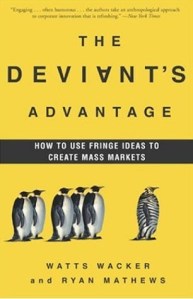
The Deviant’s Advantage: How to Use Fringe Ideas to Create Mass Markets
by Watts Wacker and Ryan Mathews
“Deviance is the source of all true innovation, growth, and indeed our collective survival. Deviance is defined by time, place, and circumstances.”
“Without deviance there would be no art, no scientific breakthroughs, no technological advances… Physical evolution is perhaps the perfect example of deviance in action. Without mutation—essentially deviance from an established DNA pattern—nature would remain static.”
“Don’t let the words deviant and deviance scare you. They’re being used in their purest definition—something or someone operating in a defined measure away from the norm.”
Wacker and Mathews coined a term—the devox—“to describe the voice, spirit, or incarnation of deviant ideas, products, and individuals.” This term is used extensively throughout the book.
Fringe → Edge → Realm of the Cool → Next Big Thing → Social Convention
“Markets of increasing size and profitability arise at every step of this journey; authenticity diminishes with every step toward broad-line Social Convention and may increase with every step past it.”
“By and large the commercial value of the devox at the point of its inception on the Fringe is zero… It’s so authentic, in fact, that it repels us.”
“As the devox, the voice of deviant ideas, evolves it gains in marketability and, by extension, commercial value. At each point along its journey from the outer Fringe of society to the heart of Social Convention, the devox becomes exponentially more commercially viable. Its market value increases in both absolute numbers and breadth, building and building until it gains maximum attention and acceptance.”
“The so-hip-it-hurts crowd generally first becomes aware of the devox as it exits the Fringe and enters a new stage—the Edge. During its sojourn across the Edge, the devox begins to build the embryonic trappings of a market; that is, supporters in the form of the congenitally early adopters.”
“The real Edge dwellers perform a valuable service for the rest of us: test-driving the devox into a vastly more communicable and inherently less threatening shadow of its former Fringe self. With that cultural honing comes the beginnings of rudimentary market formation. True avant-garde Edgers make markets even if they rarely harvest the fruits of their efforts.”
Social Convention → Cliché → Icon → Archetype → Oblivion
“At the Cliché stage the devox becomes a cultural building block. At the Icon stage it becomes a part of the culture. And at the Archetype stage it defines culture.”
“Generally, if the devox reaches the Icon stage, its journey is complete. Admittance to the next stage, Archetype, is open to only a few incarnations of the devox, those that come not to represent an aspect of culture but rather to define cultural standards… There are only a handful of true Archetypes, such as Coca-Cola, Rolls Royce, Adolph Hitler, and the Vatican.”
“The great irony is that once the devox has reached the Archetype point, it becomes the final standard by which deviancy is judged, the ultimate target for the deviant.”
Corporate Culture
“We have come to believe that there are no business problems, rather just dysfunctional business cultures.”
“Despite the fact that global businesses spend aggregate billions of dollars every year seeking out the Edge and Edge thinkers, very little of what they find or what they are told every gets accepted, disseminated, or executed.”
“In one American company after another, corporate culture acts as an organizational prophylactic, protecting business-as-usual businesses from being infected by new opportunities. Why? Corporate culture hates the devox and works tirelessly to eliminate deviant employees. Corporate culture works to discourage deviant ideas. Corporate culture punishes deviant behavior and attitudes. As a result, most large companies lose the opportunity to discover—or create—the future and therefore get to it first.”
“Remember, deviant employees ought to be one of your primary sources of innovative ideas… All opportunity springs from deviance. Opportunity is good. Therefore deviance ought to be good—but in reality it’s avoided at all cost.”
“Assuming your prescreen doesn’t filter out the devox, the initial interview usually does the trick… Now, if by some miracle the deviant actually gets hired, a whole network of secondary corporate antibodies goes to work… Turnover reports are one easy way to see exactly how devox friendly your workplace is.”
“The fastest way to encourage positive deviance is to build an affirmative culture that celebrates great experiments, even those that end in failure… In the epoch of the devox decisive actions are rewarded by great success and great failure. Mediocrity is the by-product of consistency.”
“All entrepreneurs are deviants in the best sense of the word, and deviants aren’t easy employees to retain or manage… It’s generally accepted that deviant employees are attracted to challenges and repelled by repetitive assignments.”
Diversity
“The hardest form of diversity to build in and maintain in your company is diversity of opinion… Building real diversity into your organization is all about ideas, perspectives, and sometimes good old-fashioned weirdness, not race, age, or gender.”
Managing the Edge
“Most of us learned to manage from the center, bringing everything into a stable environment where it can be standardized and processed… The real trick is to manage the Edge, not the center. The real deal is out there somewhere—raw, messy, and untamed. By the time the devox reaches the center, it’s a mere shadow of its formerly deviant self, stripped of authenticity and power and impact. This requires a constant exposure to ideas and people that are foreign and uncomfortable and, sometimes, downright hostile and threatening.”
“At some point, the fruits of deviance find their way to the public marketplace. There they are polished, trimmed, repositioned, and offered for sale—rarely, if ever, by the persons responsible for their creation.”
“More often than not the devox needs to escape the ownership (psychological, physical, and/or legal) of its creator. Fringe denizens just aren’t, as a rule, the most effective champions… That said, the right champion needs to be found… Fringe minds are in love with what they create; Edge minds begin to see a broader application.”
The authors introduce several deviant personas, including the Provocateur. Provocateurs “raise unholy possibilities, deflate pomposity, and expose hypocrisy and contradiction. The most damning question most Provocateurs ask, of course, is ‘If this is true, why don’t we…?’”
Leadership
“Here are a few hints you might find useful if you’re looking for a deviant leader: Recruit from the Edge by looking for people with unconventional backgrounds. Outsider perspectives can revolutionize a business… Seek out generalists rather than specialists. The problem with specialist leaders is that in moments of stress they always revert to their specialty, which may actually destroy a company.”
“In the era of the devox, authority isn’t an entitlement. It has to be earned or it doesn’t exist. As Visa founder and CEO emeritus Dee Hock has noted, ‘Leader presumes follower. Follower presumes choice. One who is coerced to the purposes, objectives, or preferences of another is not a follower in any true sense of the word, but an object of manipulation.’”
Mining the Deviant Core
Mining a deviant core is “the process of rigorously—and objectively—examining your business, identifying your true core competencies, and finding new, deviantly creative ways of deploying them… Organizations that constantly mine, evaluate, or institutionalize deviant core analysis should develop both tremendous primer-mover advantage over time and an institutional nimbleness or collective ability to roll with the punches.”
Brand Promise
As an alternative to meaningless vision statements, “an organization’s promise—the principle they guarantee will be present in everything they do—is significantly different from a more sweeping statement about who you aspire to be at some point in the future.”
Deviant Customers: Neotribes
“Once it has moved from the Fringe to the Edge, deviance, like nature, abhors a vacuum. Deviants seek out other deviants—this is how ‘scenes’ are formed and how ‘scenes’ eventually birth markets. The neotribe (a voluntary aggregation of individuals who join together to form communities, and create unique cultures, around common interests) is the social grouping of choice for the deviant consumer. There’s validation in numbers, and validation is remarkably marketable. So keep finding ways to covertly establish neotribes for your customers to join.”
Recap
“Innovation—all innovation, positive and negative—begins as a deviant idea germinating in the mind of a person dwelling on the Fringe of society. Slowly that idea, product, image, impulse—the thing we’ve labeled the devox—makes its way from the Fringe to the Edge and through a series of measured steps and stages until it is accepted at Social Convention. At each stage it loses authenticity, but gains market potential. Finally, at this moment of maximum market potential, the devox begins an equally inexorable trip, a dislinear journey that will take it toward Cliché, and result in the creation of a new Icon or Archetype or plunge it into Obilivion.”
“The endgame is that there is no endgame. The goal is permanent transformation, not onetime self-definition.”
“We are creatures of certitude forced to seek our fortunes adrift in a sea of complexity… To quote Charles Handy [1932-2024]… ‘Creativity is born in chaos.’”
Wacker, Watts and Ryan Mathews. The Deviant’s Advantage: How to Use Fringe Ideas to Create Mass Markets. Three Rivers Press, 2004. Buy from Amazon.com
Disclosure: As an Amazon Associate I earn from qualifying purchases.
Related Reading:
- Gods Of Management by Charles Handy (2020)
- Trickster Makes This World: Mischief, Myth, and Art by Lewis Hyde (2010)
- The Age of Heretics: A History of the Radical Thinkers Who Reinvented Corporate Management by Art Kleiner (2008)
- Weird Ideas That Work: How to Build a Creative Company by Robert I. Sutton (2007)
- Karaoke Capitalism: Daring to Be Different in a Copycat World by Jonas Ridderstråle and Kjell A. Nordström (2005)
- Understanding Organizations by Charles Handy (2005)
- The Myth of Excellence: Why Great Companies Never Try to Be the Best at Everything by Fred Crawford and Ryan Mathews (2003)
- The Tipping Point: How Little Things Can Make a Big Difference by Malcolm Gladwell (2002)
- The Cathedral & the Bazaar: Musings on Linux and Open Source by an Accidental Revolutionary by Eric S. Raymond (2001)
- Unleashing the Ideavirus by Seth Godin (2001)
- Funky Business: Talent Makes Capital Dance by Kjell A. Nordström and Jonas Ridderstråle (2000)
- Dealers of Lightning: Xerox PARC and the Dawn of the Computer Age by Michael A. Hiltzik (2000)
- Managing Interactively: Executing Business Strategy, Improving Communication, and Creating a Knowledge-Sharing Culture by Mary E. Boone (2000). “Communities of practice may cross physical and organizational boundaries, but the individuals within them share common professional interests.”
- The Complexity Advantage: How the Science of Complexity Can Help Your Business Achieve Peak Performance by Susanne Kelly and Mary Ann Allison (1999)
- The Age of Paradox by Charles Handy (1995)
- Cyberia: Life in the Trenches of Hyperspace by Douglas Rushkoff (1994)
- Future Shock by Alvin Toffler (1984)
- Naked Lunch by William Burroughs (1959)
Discover more from The Key Point
Subscribe to get the latest posts sent to your email.

 The Key Point