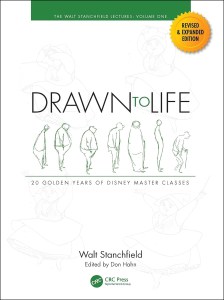
Drawn to Life: 20 Golden Years of Disney Master Classes
by Walt Stanchfield (1919-2000). Edited by Don Hahn.
Walt Stanchfield began his animation career in 1937. In the 1980s and 90s he taught figure drawing classes for animators at Disney on Tuesday and Wednesday evenings. Disney producer Don Hahn compiled Stanchfield’s lecture notes and handouts into two volumes. The highlights below from Volume One capture some recurring themes.
The book includes drawings from Stanchfield and his students. This review includes more recent drawings by Brian Kennon, a former Disney artist who attended Stanchfield’s classes in the 1990s.
STORYTELLING. “Your form of expression is one of storytelling… The ability to draw any character, from any viewpoint, in any kind of attitude, and in motion, all of this instantly readable by a general audience.”
“Animators are not just recorders of facts; they are storytellers, using their drawing vocabulary instead of words to spin a tale. They have at their disposal many exciting and dramatic ways to make expressive drawings, some of which are squash and stretch, twisting, contrast, angles, tension, perspective, and thrust. These are not physical things but they are what give life to physical things. (I emphasize ‘life’ because without those things in a drawing it would be stiff, dull, and as I often point out in the drawing class, ‘too straight up and down’).”
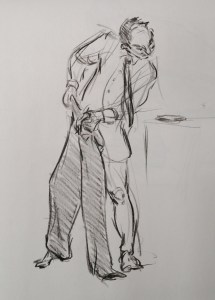
DRAW VERBS, NOT NOUNS. “A sure way to keep from making static, lifeless drawings is to think of drawing verbs instead of nouns. Basically, a noun names a person, place, or thing; a verb asserts or expresses action, a state of being, or an occurrence… Verbs would charge it with the life-giving qualities of bodily movement, rhythm, motion, and action allowing the viewer to participate vicariously.”
“Stand is a verb… It is utterly impossible for a person to do nothing… You must sometimes seek out very subtle nuances to capture the pose or gesture.”
“The most horrible fate any drawing can be subjected to is to have nothing to say… Most drawing problems are solved by the answer to, ‘What is it doing?’”
ADVERBS. “You can carry the thought a little further by adding an adverb. This will add character, personality, and acting style to your drawings or animation, because it tells how, where, when, or why… Just the how is indispensable in forming a good first impression for a gesture drawing and a great help executing it. For instance, instead of drawing a character just bending over, he could bend over gracefully, awkwardly, or using his knees because he was going to pick up something heavy, or obsequiously, as if bowing to a superior… Passively, disgustedly, happily, elatedly, sleepily? All those looks are different and have different meanings, and if you want your drawing to have meaning, you’ll have to pick the appropriate attitude and build your drawing around it.”
“The when, where, and why have more to do with staging, story, and reasons, but are never completely absent, especially in animation where they are integral parts of the story.”
GESTURE. “A scene of animation is more or less a series of gesture drawings… The goal is to find the essence of the gesture and make all the parts of the body contribute to and enhance that gesture.”
“There is an overwhelming tendency to draw the outline of the figure rather than the energy and thought within the body that is behind the move or the pose… When drawing gesture you are in another element, one that transcends ‘normal’ left-brain knowledge. You have to think gesture, think caricature, think exaggeration, think of manipulating the [anatomy] chart into an expressive gesture.”
“To arouse that sense of urgency to get the essence down, I often ask the class to imagine they are running to board a train that is about to leave the station. They see someone in a delightful pose that they have just got to sketch, so out comes the sketchbook. At that moment the conductor calls, ‘all aboard,’ and so they have just enough time to get the barest essence of the pose. If they get the essence down, then tomorrow it can be reconstructed, but if the essence is not there in the sketch—forget it.”
“The old silent movies are especially good because they were acted without the ‘crutch’ of dialog to carry the story, or the gags. The gestures had to be caricatured with pinpoint accuracy.”
For more on the topic of gesture drawing, see my review of Figure Drawing For Artists by Steve Huston.
DIRECTOR. “So as you draw, assume the role of director. Your drawings are the actors who are professionals and who are receptive, willing, responsive, adaptable, and even submissive to your expertise as a director. You are the one who reveals the true meaning of each action or pose.”
“I think Craig is a great model, nevertheless his poses are, as with all models, only the embryo of a storytelling drawing. We the director/artist have to take the stage and re-mold the pose to make sure it has all the necessary elements to put across the story.”
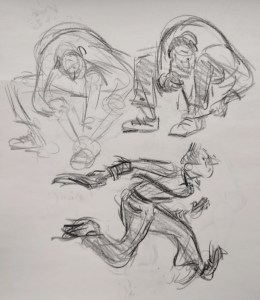
VARIATIONS OF THE POSE. “While working from a live model, I have found it is better to draw quickly and spontaneously, rather than slowly and overly careful. In the time it takes some artists to do one drawing (and that one often nowhere near completed) others have sketched in three or four tries. This encourages experimentation and looking for alternate interpretations of the gesture. Trying for variations of the pose will sharpen your observation and your hand-eye coordination, and help you seek out subtle nuances of the gestures. After all, if you had to draw several of the Disney characters in the same pose, you’d have to vary each one according to the personality of that character.”
FIRST IMPRESSION. “In animation you usually have one thing to say at a time, so everything on your drawing should relate to that one thing. Forming a good first impression will establish that one thing and keeping it in the forefront of your mind will keep you on the right path. Simplicity will prove to be one of your best allies, both in your concept of the gesture and in the process of drawing it.”
ABSTRACT. Stanchfield writes positively about the word abstract as a verb—to extract the essence—but eschews Abstract Art because ambiguity doesn’t fly in animation.
“The word abstract, as I use it, means to summarize, to make an abstract of—a brief statement of the essential elements of a pose. So take a moment to study the type of body build, forming an abstract shape of it in your mind, then do the same with the overall pose. It simply means dropping 90% of the detail, and seeing only that 10%—that abstract of the pose, that essence of the pose.”
“It helps to look for the abstract qualities of a pose. In a real sense that is what you do when you caricature something. To abstract means to ‘take out’; that is, ‘separate or isolate’. When drawing a gesture, whatever it happens to portray, you have to, right from the beginning, decide what it is that you are going to say about it (in your drawing). When drawing from a model, for instance, you must ‘isolate’ the important thing you need from the pose, subjugating all else to the role of support team. Ask yourself—better yet, tell yourself—what is going on there, what is the story behind the pose? You have to separate or isolate just the vital thing that needs to be told.”
“Some years ago I took a modern painting class at Valley College… ‘We’re going to try to be creative in this class. We’re not going to copy the old dewdrops on roses thing. We’re going to abstract the essences of color and shape and mood and design from nature and release ourselves from the old conventional ways of painting a picture…’ The effect on me was phenomenal. I felt a great weight fall from my back. I am still, 29 years later, impressed by that lesson.” The instructor must have been the art critic Fidel Danieli (1938-1988), and the class must have been in the 1960s, based on a Smithsonian biographical note stating that Danieli got his BA in 1960 and his MA in 1965, and taught at Los Angeles Valley College for 22 years.
That said, Stanchfield notes, “Abstract art is subject to personal interpretation and that is one of the charming things about it. In animation there is little room for the abstract. The audience must get the artwork pretty well interpreted for them by the artist or it will be hard for them to follow the story.”
CLARITY. “If the joke has to be explained it is a bad joke—the same goes for a drawing. If a drawing doesn’t ‘say’ what it means at first glance, it is a failure as a drawing… A good drawing or a good scene of animation should be easily ‘read’ even without the props, background, and dialog.”
“Caricature is the animator’s means of making sure there is no doubt in the viewer’s mind what is being portrayed.” As Strunk and White wrote in The Elements of Style, “When you say something, make sure you have said it.”
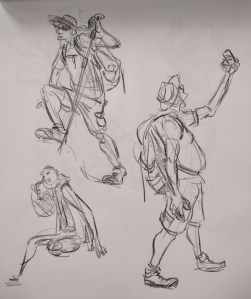
COSTUME. “In animation, costumes may run from simple to complex in style, but they are all handled in a simple manner when it comes to folds and wrinkles… Most Disney characters only have wrinkles at the joints, and then only when there is pressure applied by bending or squeezing. So they’ll occur at elbows and knees, and at the waist when seated… An excess of material will cause meaningless folds, bumps, and bulges.”
“The most logical approach when faced with a model that is clothed in a complicated costume is to lay in the basic pose with some simple elemental shapes. First study the pose for the gesture—you may have to add a little of your own thespianism—then look for weight distribution and overall abstract shape (silhouette), ignoring all particulars like muscles or other detail, and go for the general, overall gesture. This gives you the opportunity also to concentrate on relative proportions.”
PROPS. “I maintain that having a prop, a mannerism, or a story point to work with makes your drawing a lot easier (and more fun) … A prop (tool), be it part of the body or its adornment or some story-related object, should be considered an integral and inherent part of any drawing.” Fun fact: “Prop in theater jargon is short for property.”
THE WHOLE IS GREATER THAN THE SUM OF ITS PARTS. “The most evident roadblock standing in your way—starting with the parts… The mere assembling of parts, of course, results in a cold, lifeless diagram of a structure.”
“Earlier I mentioned body syntax. That’s a phrase worth coining. The non-grammatical meaning of syntax is ‘connected system of order; orderly arrangement.’ What is a pose or gesture but an orderly arrangement of body parts to display a mood, demeanor, attitude, mannerism, expression, or emotion.”
FEELING THE POSE. “I repeatedly harp on feeling the pose rather than merely looking at it… In feeling the pose you actually picture yourself as doing the pose. If you have to, stand up, put down your drawing board, and assume the pose. Feel which muscles pull or contract to get which stretch or squash. Feel where the weight falls, what is entailed to keep your balance. Feel the psychological attitude it imparts, i.e. if the head is dropped, does it evoke a sad or disappointing feeling; if the head is held high, do you feel proud or haughty or reverent—or what? So with the whole body impose some kind of attitude on it. Then you have that pose locked into your mind and can summon it up at will by simply seeing it in your mind and assuming that attitude.”
MOOD, PERSONALITY, ATTITUDE. Walt Disney said, “In most instances, the driving force behind the action is the mood, the personality, the attitude of the character—or all three.”
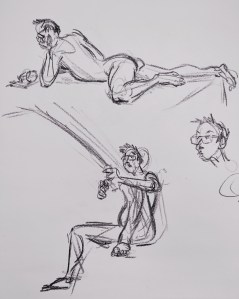
BODY LANGUAGE. “A study has shown that only 7% of what is communicated between people is transmitted through the words themselves. 38% comes through the tone of voice. 55% of communication, the largest part, is a result of… body language. In the case of drawing from the model, 100% of the communication is through body language. So it behooves us to slant things in the right direction, and get the whole 100% out of the pose.”
Stanchfield uses the word physiognomy, which Merriam-Webster defines as “inner character or quality revealed outwardly” or “the facial features held to show qualities of mind or character by their configuration or expression.”
CHEATING. “‘Cheating’ in drawing is a term used when some part of the figure is adjusted to help make the pose read more clearly… Very often in a classroom situation you will be stuck with a difficult angle where things that explain or complete the gesture are hidden from you. The challenge of adjusting the pose to better tell your story can be invigorating. The important thing is you are not bound to copy what is before you, but on the contrary, you are bound to tell the story of the gesture, even if you have to cheat to do it.”
DON’T COPY. “I approach drawing instruction by trying to change one’s method of seeing; that is, looking at a pose or gesture as a ‘story.’ This should encourage you to draw the idea behind the pose and not attempt to copy the model, line by line.”
DON’T STRAIGHTEN. “As I have pointed out many times in the drawing class, there is a compulsive urge to straighten up the model’s pose. The whole purpose of a gesture class is to nurture the ability to capture those subtle angles and tensions that make the pose enjoyable, picturesque, charming, and unique or whimsical and humorous or even sad or wretched.”
ANGLES. “The meaning of an angle of one part of the body will change as the angles of other parts of the body are altered. The relationships of angles can depict happiness, sadness, pain, fear, anger, etc. Yet many of the angles of the parts of the body are used in each of those emotions only in different combinations. The humor in a pose or action can be exploited by exaggeration or caricaturing those angles. As a matter of fact, a slight bit of caricature is absolutely necessary in animation.”
“One should never work one angle by itself… Observe people at play, at work, or at rest. There is a constant relationship between the joints and appendages… It is this relationship that creates the angles and tensions that are the tools of expressive gesture drawing.”
TENSION. “When people want to put a little spice in their gestures they add more tension, stress, or torque. Symmetry in architecture may give you a feeling of stability, but in drawing and in humor, symmetry becomes lifeless. Tension, in a sense, forces the gesture out of the body by means of opposing force, altered balance, or augmented energy through the use of angles, squash and stretch, and greater emphasis on the action.”
“Tension is simply the stretching, pulling, elastic force, pressure, or exertion that takes place in a pose or an action. So in effect, to capture the essence of this pose, we would not merely be drawing the left hand and left knee, but more important, the tension between them.”
PARALLEL LINES ARE STATIC. “Nothing will flatten your drawing better than parallel lines, shapes, and directions. Blatant verticals and horizontals are also undesirable. Add them to your unwelcome list.”
TANGENTS. “Tangents are the enemy of the illusion of depth and to avoided at all cost. Tangents occur when two or more lines converge… A simple example is two mountain shapes drawn with no overlap that automatically creates a tangent and destroys any illusion of depth whatsoever… The simple solution to this problem is to add overlap.”
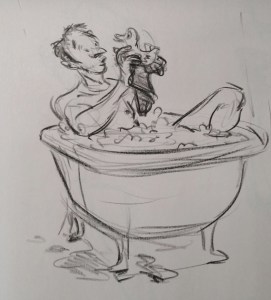
KEEP IT SIMPLE. “Simple shapes are easier to manipulate. You can stretch them, angle them, squash them, and modify them at will. The details you can add after the gesture has been ‘bagged.’”
“In animation, the symbols we use for noses are kept simple. The fewer lines there are the less chance of jitters, and when lines have no anchor point it is hard to keep them from ‘drifting.’”
MOVEMENT. “You’re probably all aware of how bland animation appears when photostats of live action are literally traced onto animation paper. Live action actors can get away with an amazingly minimal amount of movement. There can be two people talking for long periods with hardly more than eye blinks, but that goes over like a lead balloon in animation.”
“The movement from one pose to another is also important. Certainly, a person in a serene mood will not move jerkily or menacingly. Likewise, a person whose life is in danger will not waltz from one dungeon window to another to see if the man with the axe has arrived.”
PHASES. “Ideally there should be at least three poses to study each action:
- The Preparation: Telling the audience something is going to happen.
- The Anticipation: Gathering the forces to carry through with the action.
- The Action: Carrying out the intended action. Plus, of course, all the follow-through, overlap, and resulting residuals such as dust, smoke, wind, destroyed property, chaos… whatever.”
LOOSEN UP. “Holding the pen tightly right down near the nib plus trying to ‘draw’ all the parts of the figure… has a stiffening and stifling effect on drawing. I suggest holding the pen farther up on the shank and start drawing the action, i.e. the stretches, tilts, twists, and tensions.”
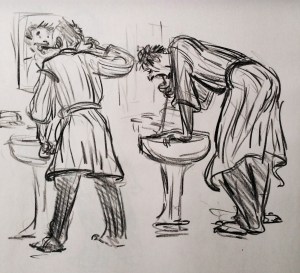
ANIMATION PRINCIPLES. “Here is a list of [principles] that appear in these drawings, most of which should appear in all scenes, for they comprise the basis for full animation: pose and mood, shape and form, anatomy, model or character, weight, line and silhouette, action and reaction, perspective, direction, tension, planes, solidity, arcs, squash and stretch, beat and rhythm, depth and volume, overlap and follow-through, timing, working from extreme to extreme, straights and curves, primary and secondary action, staging and composition, anticipation, caricature, details, texture, simplification, positive and negative shapes.”
“I’m not here to teach you how to draw like Rembrandt, Hogarth, or Milt Kahl, I’m here to help you form a creative attitude toward drawing.”
Stanchfield, Walt and Don Hahn. Drawn to Life: 20 Golden Years of Disney Master Classes. Focal Press, 2009. Buy from Amazon.com
Disclosure: As an Amazon Associate I earn from qualifying purchases. Drawings used with permission from the artist.
RELATED READING:
- Drawn to Life, Volume 2 by Walt Stanchfield, edited by Don Hahn (2009)
- Writing for Animation by Laura Beaumont and Paul Larson (2021)
- Ink & Paint: The Women of Walt Disney’s Animation (2017)
- Figure Drawing For Artists: Making Every Mark Count by Steve Huston (2016)
- The Nine Old Men: Lessons, Techniques, and Inspiration from Disney’s Great Animators: Lessons, Techniques, and Inspiration from Disney’s Great Animators by Andreas Deja (2015)
- The Animator’s Survival Kit: A Manual of Methods, Principles and Formulas for Classical, Computer, Games, Stop Motion and Internet Animators by Richard Williams (2012)
- Working with Walt: Interviews with Disney Artists by Don Peri (2008)
- Directing at Disney: The Original Directors of Walt’s Animated Films by Don Peri and Pete Docter, foreword by George Lucas (2004)
- Body Language: The Essential Secrets of Non-Verbal Communication by Julius Fast (1997)
- The Illusion of Life: Disney Animation by Ollie Johnston and Frank Thomas (1995)
- The Art of Animal Drawing: Construction, Action Analysis, Caricature by Ken Hultgren (originally published in 1993)
- The Art of Animation: The Story of the Disney Studio Contribution to a New Art by Bob Thomas and Don Graham (1958)
- The Human Figure in Motion by Eadweard Muybridge (1955)
- Principles of Figure Drawing by Alexander Dobin (originally published in 1948)
- Cartooning for Everybody by Lawrence Lariar (1941)
- The Art Spirit by Robert Henri (originally published in 1923)
Discover more from The Key Point
Subscribe to get the latest posts sent to your email.

 The Key Point