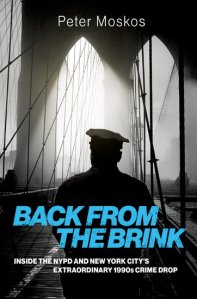
Back from the Brink: Inside the NYPD and New York City’s Extraordinary 1990s Crime Drop
by Peter Moskos
I have previously read Commissioner Bratton’s memoir Turnaround on the dramatic reduction in crime during the 1990s in New York City. Back from the Brink features many more perspectives on the subject. Criminal justice professor Peter Moskos interviewed 50 people at various levels of law enforcement and beyond. Besides these primary sources, the author’s extensive research includes a nine-page bibliography of secondary sources.
This book makes it evident that while superior management of the police department played a central role in crime reduction, this did not happen in a vacuum. There was support from politicians, prosecutors, the Bryant Park and Times Square business improvement districts, the leadership of Port Authority bus terminal, and FBI/NYPD task forces—all working toward a common goal making the city safer.
Crime was Out of Control
Lenny Levitt, reporter: “Under Dinkins and Police Commissioner Lee Brown, the place was a disaster.”
Derrick Bradley, police officer: “New York in the ‘80s was crime ridden… Even as a police officer it was very dangerous… It was territorial drug gangs. There were certain blocks in East New York, there were like three or four of them, that we were told by the boss not to even drive down unless we went there with at least two sector cars.”
Moskos: “In Midtown Manhattan more than half the robberies were committed by multiple offenders… The police and media started using the term ‘wolf packs.’”
Billy Gorta, lieutenant: “The goal was not to get robberies down, but to have 35 robbery arrests for every 100 robberies.”
Walter Burnes, police officer: “In those days, the entire system of arrest processing was totally out of control. Everybody was trying to keep the overtime money coming in. I made a lot of money in those days. You could get 14, 15 hours just sitting around waiting to get processed.”
Transit
Moskos: “In 1980, transit ridership decreased 20% compared to 1970. This was double the decline in NYC’s population… In 1966 there were 300 reported robberies. In 1970 there were 2,000. By 1990 there were nearly 10,000 reported subway robberies… One-third of polled riders said they went out of their way to avoid certain subway stations entirely due to fear, and nearly two-thirds were occasionally intimidated into giving money to beggars.”
Bob Davan, Transit police officer: “When Bratton came on Transit, April of ’90, there was a tremendous change.”
Jack Maple, Transit Police lieutenant: “I was commanding officer of Transit Central Robbery in March of 1990. Bratton gets appointed in April… I want to write a plan to knock down crime on the subway and give it to this guy. So I sat down with my exec and we wrote a plan that has everything from farebeating to turnstile jumpers, to debriefing prisoners, to going after accomplices, to the crime-analysis unit, up to the warrant squad to follow up on it. And I got it to Bratton… Bratton makes me a glorified detective lieutenant, his special assistant.”
Moskos: “In the last five months of 1990, one in six people stopped for fare evasion was wanted on an active warrant, and about one in eighty carried an illegal weapon. By October 1990, subway crime in every category had declined… In 1991… New York City’s 1.6% decline in robbery was due almost entirely to 1,600 fewer robberies in the subway. Pickpocketing and chain snatching also decreased 23%.”
“Ridership reached a nadir in 1991, but would rebound as crime began its long and unpredicted decline. Subway robberies decreased 35% in 1992 and multiple-assailant (‘wolf-pack’) robberies, once 1,200 a year, were virtually eliminated.”
C-POP – Community Policing
Moskos: “Commissioner Bejamin Ward served as police commissioner from 1983 to 1989. Community policing became the dominant paradigm of the NYPD, and community relations were prioritized over crime prevention.”
Joe Loughran, sergeant: “I was in a sector car from ’83 until ’90. And now we have this community policing, these C-POP beats, depleting our Patrol force numbers. In any given precinct there might have been 15 or 18 C-POP cops who cold make their own hours and do whatever they want. They all had either Friday and Saturday or Sunday and Monday off… And they’re just taking away from my ability to be effective. It was kind of demoralizing.”
Billy Gorta, lieutenant: “The whole thing with Lee Brown and Ray Kelly, for the brief time he was PC before Bratton, was ‘We’re going to do community police.’ … You were asking the cops to go and force the city agencies to do their job. There’s a garbage-strewn lot. The cop on the post has to go ask Sanitation to clean it up. But why not Sanitation just cleaning it up sua sponte, as they’re supposed to.”
John Miller, future deputy commissioner of public information: “The fundamental misunderstanding of community policing, which is largely based off kind of a Broken Windows theory, is that it didn’t apply in a war zone… This idea was based on zero logic and had an equal chance of success. Community policing has a place. It just wasn’t the time. The time was to take the ground back.”
Lenny Levitt, reporter: “Community policing? Nobody really knew what it was.”
Safe Streets Safe City
Ray Kelly, first deputy commissioner: “With the Safe Streets Safe City program, the NYPD received the authorization and money in 1990 to hire 5,000 cops.”
Joseph Giaclone, police officer: “A lot of people don’t give Dinkins enough credit, but he’s the one that really started the ball rolling with the hiring of the cops, and Rudy kind of benefitted from that. When I first got hired… it was right when that whole Safe Streets Safe City thing started. It was almost 4,000 of us in the academy.”
Moskos: “By 1994, the department had grown from 26,000 to 30,000 officers.”
Giuliani Elected
Moskos: “Giuliani ran again for mayor in 1993, making crime and quality of life the cornerstone of his campaign. This time he won.” He appointed Bill Bratton as police commissioner.
Compstat Changed the Culture
Moskos: “More than anything else, Compstat came to symbolize the cultural transformation of the NYPD into a proactive and aggressive crime-fighting organization. Conceptually, Compstat began after Jack Maple asked a simple question: how much crime did we have last week? Nobody knew.”
John Miller, deputy commissioner of public information: “Once Compstat became the measuring tool, it closed the loop between how it used to be done and how it’s being done now, and that the strategies were being followed uniformly across 77 commands. That was the difference. That’s the thing that made it work.”
Billy Gorta, lieutenant: “Before Compstat, there were typed reports that we sent up monthly.”
Deputy Commissioner Jack Maple wanted weekly crime numbers. He found Sgt. John Yohe in the chief of patrol’s office. Yohe received the robbery statistics from the precincts and consolidated them using primitive software and MS-DOS batch files. He understood Maple’s vision and told him he would work on getting weekly reports and expand the data to include the “the seven majors,” which are Part 1 crime categories of FBI Uniform Crime Reporting. The name COMPSTAT (for comparative statistics) was chosen to fit the eight-character limit for DOS file names.
John Yohe, sergeant: “I was quality control… Somebody got raped and sodomized. They would put it down as a sodomy. Why? Because sodomy wasn’t one of the seven majors. Well, no, it’s not going to work that way anymore… If we saw common assaults falling off or whatever, I would… print out hundreds of complaint reports. And I would read them—all of them. And if I saw that people were jerking the stuff around by knocking felony assaults down to misdemeanor assaults, or making robberies into grand larceny, any of that stuff, I flagged them… and I gave them to the chief… Anemone and Maple stood behind us. That’s why Compstat worked.”
Billy Gorta, lieutenant: “Bratton’s line was ‘No sharp pencils,’ which meant the numbers had to be honest. Bratton was very strict about that.”
Over time, the data collection got more sophisticated.
Johe Yohe, sergeant: “Then we would add parolees or warrants to the mapping, and they started to tie these in with areas of criminal activity. Well, this block here has an inordinate about of robberies. Yeah, but look, they also have 12 warrants right there on the block and 16 parolees in this one building. So now they would go in and target that. And again, things would tumble all the more, because they started to get to the real root causes of these crimes, the repeat offenders who were driving these crimes!”
Joanne Jaffe, captain: “The philosophy of Compstat is what really changed the direction of the ship. Many people thought of Compstat as a session or an event, but it’s a philosophy. It was a sea change. The philosophical shift was about holding commanders accountable and letting them take ownership of their command. Be a leader, be innovative and creative, and use good judgment. And obviously have a moral compass and do things with the highest level of integrity.”
Louis Anemone, chief of patrol: “Let’s use 1994 as an inflection point. So now in Compstat we’re inviting groups of peers—precinct commanders, Narcotics commanders, and detective commanders from specific geographical areas of the city—to come down as a group and problem-solve with us. Headquarters tried to become a tool, a red-tape cutter, a provider of logistical help or personnel help to the people out in the field who really wanted to do the job. That’s the most dramatic change that I’ve ever seen. It changed the culture.”
Organization
Arthur Storch, precinct commander: “Before Compstat, NYPD was like three separate police departments. We had the Patrol Police Department… We had a Narcotics Police Department… And we had a Detective Police Department.”
Jack Maple, deputy commissioner of operations: “The difficult part is making sure the strategy is relentlessly applied and that all the units are synchronized. Synchronization means that the uniforms are going to be in this location. The plainclothes are going to be in that location… The task force should be deployed at a time and location set by the precinct commander. They should all have accurate intelligence, all the crime data, and they should be told what they’re expected to do… The narcotics division should know everything about every shooting and every murder in that area, so that when they’re debriefing somebody, they can also debrief them about the shootings and the murders.”
Debriefing
Jack Maple, deputy commissioner of operations: “When you’re doing that interrogation on them, you say, look, we don’t really care about this crime. What we want to know is did you rob a hundred other people? Did you shoot a hundred people? Because if you did, you’re in a hundred times as much trouble. And they’ll say, ‘No, this is the only one.’ Now you have your first inculpatory statement, and that’s what you have to get trained for in the interrogation.”
Consistent Enforcement
Mike Julian, chief of personnel: “Louie and Jack proved what works for crime control: arrests. But the same crime drop could have been achieved with fewer quality-of-life arrests. Most honest people correct their bad behavior with a warning… The trick is constant enforcement, not once a week, on Friday nights, for overtime.”
Misunderstanding Broken Windows
Louis Anemone, chief of patrol. “The 77 Precinct in Brooklyn had a string of shootings by perpetrators on bicycles in a discrete two-block section of Nostrand Avenue… So we’re discussing this at Compstat.”
‘I’m going to do a checkpoint, Chief… a bicycle checkpoint. It’s a quality-of-life offense. You’re not allowed to ride a bicycle on the sidewalks in the city of New York. It’s a summonsable offense.’
“Well, he grabs six different guys on bicycles carrying guns on that same two-block stretch! That was the end of the shooting on that two-block stretch of Nostrand. He’s explaining it at the next meeting, and he gets kudos from me for doing this… We had representatives from every borough throughout the city at every meeting… And they all run back and tell their officers, ‘Oh, yeah, the Chief wants bicycle summonses!’ But that’s not the idea! So now we’ve got a guy in Forest Hills whose cops go out and start bicycle summonses for fathers and mothers with their kids riding bicycles on a Saturday or Sunday afternoon because they happen to be on a sidewalk. So that’s when you take this Broken Windows a little too far.”
Bill Bratton, commissioner: “I don’t use the term ‘zero tolerance’ for anything, other than corruption.”
John Miller, former deputy commissioner for public information: “When it came to Kelly [who become Police Commissioner a second time from 2002-2013 under Mayor Michael Blooomberg], with stop-and-frisk he didn’t understand the concept of over-winding his toys. The springs are going to pop.”
Federal Prosecutor
Elizaebth Glazer, US district attorney: Detective John O’Malley “and some of his colleagues, detectives from the Bronx, had a case that they had been working for a long time, and it had a lot of murders in it. And the Bronx DA’s office, because of state evidence rules and a bunch of other reasons, could not indict the case. In the federal system you can use accomplice testimony, meaning testimony of somebody who has been in the gang who maybe has committed murders. New York has very restrictive evidence rules on how you can use accomplice testimony.”
“In the state system, just crudely speaking, you try one incident at a time, which means if you have an accomplice testifying, that person has to testify in ten different trials, which is hard. Under the federal system, you see how many incidents you could put together in one case. Under a racketeering case, you can tell the entire story of the group, which is considered the enterprise, and all the different incidents that they were involved in over along period of time.”
“There are two other things that make it easier to go federal… In the state system, there is no hearsay testimony… In a federal grand jury, you can put an agent in or a police officer who can say, ‘Peter Moskos told me X, Y, and Z,’ and that’s sufficient. Obviously, the grand jury can challenge it, but that’s sufficient technically to get an indictment. [Second,] unlike New York State, in the federal system you can hold somebody before trial on the grounds that they pose a danger to the community. This is a very, very important thing to do. If, for example, you arrest a group in which people are terrorizing the neighborhood, for the neighborhood to know that they’re in jail encourages people to come forward, because they’re less worried that they’ll be retaliated against.”
“The Bronx DA’s office was a very important partner. One of the reasons why so many of our cases were in the Bronx and very few in Manhattan was that Morgenthau did not have that same view, not at all. I think there’s a sense of rivalry between the Manhattan DA’s office and the Southern District.”
Constraints on Growth
John Miller, former deputy commissioner for public information: “When Bratton left, Safir said, ‘I’m going to double to size of the Street Crime Unit.’ That was Safir. Timoney told us you couldn’t do that. He said, There’s 85 people in there. If you want to bring it up to 125, you can spread the new people out around the most experienced people in the teams. But when you double it, you had entire teams of guys who were all brand new.”
Learning from History
Moskos notes, “More than three decades have passed since the great crime drop began, and this story is buried in both historical misunderstanding and ignorance. Police can reduce crime, and this can be done legally and constitutionally, but it cannot happen without political leadership and support. The lessons of the crime drop serve as both a window into the past and a model for future policing.”
Moskos, Peter. Back from the Brink: Inside the NYPD and New York City’s Extraordinary 1990s Crime Drop. Oxford University Press, 2025. Buy from Amazon.com
Disclosure: As an Amazon Associate I earn from qualifying purchases. I received a review copy of this book.
Related Reading:
- Criminal (In)Justice: What the Push for Decarceration and Depolicing Gets Wrong and Who It Hurts Most by Rafael A. Mangual (2022)
- The Profession: a Memoir of Community, Race, and the Arc of Policing in America by William J. Bratton (2021)
- The Crime Fighter: How You Can Make Your Community Crime Free by Jack Maple (2000)
- Giuliani: Nasty Man by Ed Koch (1999)
- Turnaround: How America’s Top Cop Reversed the Crime Epidemic by William J. Bratton (1998)
- Fixing Broken Windows: Restoring Order and Reducing Crime in Our Communities by George L. Kelling and Catherine M. Coles (1997)
- Target Blue: An Insider’s View of the NYPD by Robert Daley (1973)
Discover more from The Key Point
Subscribe to get the latest posts sent to your email.

 The Key Point