This is the story of how a simple pencil is manufactured using numerous raw materials from all over the world, as told in the first person by the pencil itself. It was first published in 1958 to explain how free-market economies work and to discredit centrally-planned economies, such as the Soviet Union. While trade barriers are not expressly discussed in the story, the reader can infer potential consequences rippling through the supply chain.
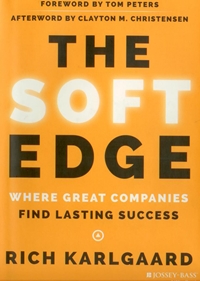
The Soft Edge: Where Great Companies Create Lasting Success by Rich Karlgaard
It is noteworthy that a prominent business journalist from Silicon Valley—where technology and IPOs dominate headlines—wrote a book about the human factors of business success. “The yin and yang of effective management has always been about the search for the right spot between data truth and human truth.”
“Hard-edge execution is all about managing exactly to the numbers. The people who live on the hard edge of business are good at making the trains run on time. They focus on profit. Their language is time, money, and numbers. Every company in the world needs these employees.”
“Soft-edge excellence—in trust, smarts, teams, taste, and story—tends to attract loyal customers and committed employees.” Karlgaard says the soft edge is “the heart and soul” of your company.
One Year Wiser: 365 Illustrated Meditations by Mike Medaglia
This book provides an illustrated thought to ponder for each day of the year. Each page features words of wisdom from a writer, poet, scientist, spiritual leader, or other historical figure. Pages are labeled January 1 through December 31, without a year so the book can be referred to indefinitely. Below are some sample quotes and illustrations.
“And the day came when the risk to remain tight in a bud was more painful than the risk it took to blossom.” – Anaïs Nin
“Reality is like a face reflected in the blade of a knife; its properties depend on the angle from which we view it.” – Master Hsing Yun
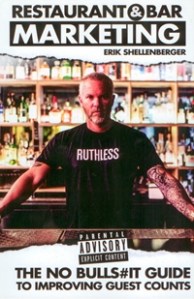
Restaurant & Bar Marketing: The No Bullshit Guide to Improving Guest Counts by Erik Shellenberger
Erik Shellenberger cuts through the hype and tells you what really works—and what doesn’t—to bring more customers into restaurants and bars. Before getting into the tactics, he presents his ocean versus fishbowl concept.
The fishbowl includes people who follow you on social media, who subscribe to your email list, etc. “The ocean—NOT the fishbowl—is where you improve guest counts… People who have no idea you exist. People who are looking to branch out and try new places to eat and drink in their home city… The tourist economy is almost exclusively an ocean environment. It includes the person using Google or online reviews to find a business like yours.”
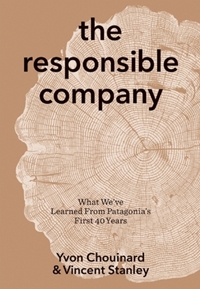
The Responsible Company: What We’ve Learned from Patagonia’s First 40 Years by Yvon Chouinard and Vincent Stanley
We hear a lot about sustainability, but the authors contend “no human economic activity is yet sustainable… Responsible seems to us the apt, more modest, word to use… The term itself is necessary shorthand; there is no responsible company, only responsible companies of varying degrees, who act strategically to do less harm while improving, not sacrificing, the health of the business.”
Doing good and seeking profit are not incompatible. Wal-Mart’s initial environmental efforts were motivated by reputation management, “but removing excess packaging from deodorant sticks, concentrating laundry detergent in small bottles, and installing auxiliary power units in their trucks to reduce idling time turned out to save them millions of dollars.”
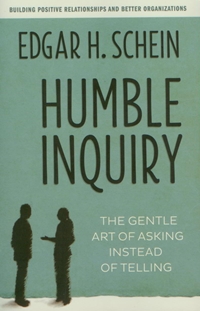
Humble Inquiry: The Gentle Art of Asking Instead of Telling by Edgar H. Schein (1928-2023)
Retired MIT Sloan School of Management professor Edgar Schein asserts, “Without good upward communication, organizations can be neither effective nor safe… Your organization may be underperforming because various employees or groups do not recognize the degree to which they are, in fact, interdependent.” The gist of this book is about creating a trusting environment with open communication across hierarchical boundaries. This entails less telling, more asking, and better listening.
“The U.S. culture is strongly built on the tacit assumptions of pragmatism, individualism, and status through achievement… Given those cultural biases, doing and telling are inevitably valued more than asking and relationship building. However, as tasks become more complex and interdependent, collaboration, teamwork, and relationship building will become more necessary. That, in turn, will require leaders to become more skilled in humble inquiry.”
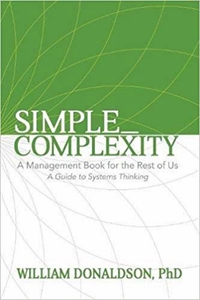
Simple Complexity: a Management Book for the Rest of Us, a Guide to Systems Thinking by William Donaldson
This book is about applying the principles of complexity and systems thinking to management. “Every organization is a system—in fact, a system of systems, perfectly designed to get the results it is getting today… Systems thinking is the unifying discipline that brings clarity to all of the other disciplines at work in your enterprise… The key, defining concept of systems thinking to remember is that nothing in the system is ever unconnected.”
Donaldson emphasizes the importance of context. “You have to ensure everyone has shared mental models of the enterprise and its management system… Remembering that context can enhance learning and comprehension by 50-100 percent, you must give employees context for both the part of the system they play a role in and the whole system.”
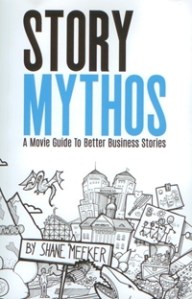
Story Mythos: A Movie Guide to Better Business Stories by Shane Meeker
“People are inspired and moved by stories…Story is about human emotions… Stories de-commodify your brand/product.” The premise of this book is that the same principles used by Hollywood filmmakers can be used to develop powerful brand stories. The author is the company historian and corporate storyteller at Procter & Gamble.
“What are your most powerful company stories, and how are you using them to inspire your people? How do you explain your purpose through different stories? What stories best demonstrate your company beliefs? How are you documenting and protecting the stories that matter? … How can you use a story to demonstrate a company’s culture?”
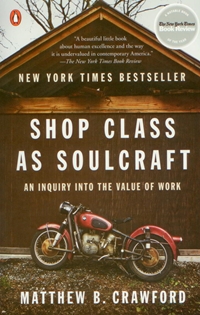
Shop Class as Soulcraft: An Inquiry into the Value of Work by Matthew B. Crawford
This book is primarily about restoring honor to the manual trades. Crawford writes about the “rich cognitive challenges and psychic nourishment” that come with “the experience of making things and fixing things.”
It makes sense to start with some context about the author’s career path. “I started working as an electrician’s helper shortly before I turned fourteen… When I couldn’t get a job with my college degree in physics, I was glad to have something to fall back on, and went into business for myself.” Later, Crawford went back to school and earned a Ph.D. in political philosophy. He took a job as executive director of a think tank, but he found the work dispiriting. “Despite the beautiful ties I wore, it turned out to be a more proletarian existence than I had known as a manual worker.” After only five months, he quit and opened a motorcycle repair shop. “Perhaps most surprising, I often find manual work more engaging intellectually.”
Read This If You Want to Take Great Photographs of People by Henry Carroll
“Don’t take pictures of people. Take pictures about people.”
Carroll explains the rules of thumb for a traditional portrait, but the book is mainly about moving beyond that. “Don’t suppress your subject’s physical nuances. This is what makes them who they are. There are rules in portraiture about how your subjects should stand, what they should do with their hands, and so on. These rules are fine for corporate headshots, because they’re designed to remove any trace of a person’s individuality. But that’s not what we’re about, right?”



 The Key Point