The Deviant’s Advantage


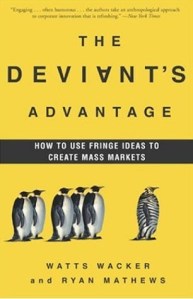
The Deviant’s Advantage: How to Use Fringe Ideas to Create Mass Markets
by Watts Wacker and Ryan Mathews

“Deviance is the source of all true innovation, growth, and indeed our collective survival. Deviance is defined by time, place, and circumstances.”

“Without deviance there would be no art, no scientific breakthroughs, no technological advances… Physical evolution is perhaps the perfect example of deviance in action. Without mutation—essentially deviance from an established DNA pattern—nature would remain static.”

“Don’t let the words deviant and deviance scare you. They’re being used in their purest definition—something or someone operating in a defined measure away from the norm.”

Continue reading “The Deviant’s Advantage”
Creativity: A Short and Cheerful Guide


Creativity: A Short and Cheerful Guide
by John Cleese

The central theme of this short book is tapping into your subconscious thoughts for ideas which you can then develop consciously and analytically. Cleese writes, “I began to realize that my unconscious was working on stuff all the time, without my being consciously aware of it.”

Continue reading “Creativity: A Short and Cheerful Guide”

Making Art Work


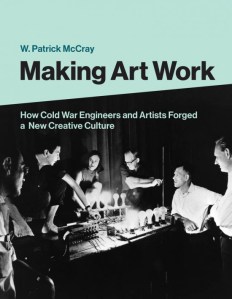
Making Art Work: How Cold War Engineers and Artists Forged a New Creative Culture
by W. Patrick McCray

This book picks up where C.P. Snow left off in his 1959 book The Two Cultures. Snow was a British chemist turned novelist who had scientist friends and literary friends, but he observed that these groups were two separate cultures who rarely communicated with each other. Patrick McCray is a history professor at UC Santa Barbara. In Making Art Work, he studies several endeavors to bridge this divide, primarily in the 1960s, but also more recently. Specifically the book is about collaborations between artists and engineers. 

Continue reading “Making Art Work”

Eat, Sleep, Innovate


Eat, Sleep, Innovate: How to Make Creativity an Everyday Habit Inside Your Organization
by Scott D. Anthony, Paul Cobban, Natalie Painchaud, Andy Parker

My grandfather used to tell me I was full of beans when I was being rambunctious. In contrast, this book is full of BEANS—behavior enablers, artifacts, and nudges—which are ways to encourage a new behavior.

The book is about developing a culture of innovation—not just for engineers and scientists, but throughout the organization. Three of the co-authors are with Innosight, a consulting firm co-founded by Harvard Business School professor Clayton Christensen (1952-2020), who wrote The Innovator’s Dilemma. Paul Cobban is Chief Data and Transformation Officer at DBS Bank, the largest bank in Singapore.

Continue reading “Eat, Sleep, Innovate”

Alchemy: The Dark Art and Curious Science of Creating Magic in Brands, Business, and Life


Alchemy: The Dark Art and Curious Science of Creating Magic in Brands, Business, and Life
by Rory Sutherland

In Alchemy—published simultaneously in the U.K. with a punchier subtitle: The Surprising Power of Ideas that Don’t Make Sense—Sutherland writes with a humorous style filled with wisdom about consumer behavior, innovation, branding, hiring, the weakness of market research, and more.

Continue reading “Alchemy: The Dark Art and Curious Science of Creating Magic in Brands, Business, and Life”

The Non-Designer’s Guide to Design Thinking


The Non-Designer’s Guide to Design Thinking: What a Marketer Learned in Design School
by Kunitake Saso

“The design thinking process is not a collection of steps… [It] is characterized by switching between four different modes as needed, and advancing work through short cycles… You go back and forth between the phases again and again, slowly raising the quality of your output; therefore, it is better to think of it as a compass than as a map.”

The Four Modes of Design Thinking:

  1. Research
  2. Analysis
  3. Synthesis
  4. Prototyping

The author says that 80% of the value is created in the synthesis and prototyping stages.

RESEARCH. The subjects of design research interviews are often “extreme users with strong preferences, or experts in the field and very familiar with the trends” rather than average users.

Continue reading “The Non-Designer’s Guide to Design Thinking”

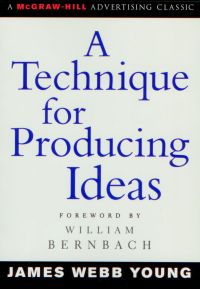
A Technique for Producing Ideas

a-technique-for-producing-ideas


A Technique for Producing Ideas
by James Webb Young

This concise booklet was first published in the 1940s by James Webb Young, who became vice president of the advertising firm J. Walter Thompson and the first chairman of The Advertising Council. He wrote it in response to the question, “How do you get ideas?”

Before explaining the process, Young presents two principles.

Continue reading “A Technique for Producing Ideas”

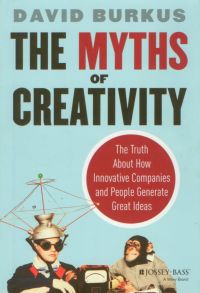
The Myths of Creativity

the-myths-of-creativity


The Myths of Creativity: The Truth About How Innovative Companies and People Generate Great Ideas
by David Burkus

“Creativity is the starting point for all innovation, and most organizations rely on innovation to create a competitive advantage.” In this interesting book, management professor David Burkus debunks 10 myths of creativity, citing academic research and examples from business.

Continue reading “The Myths of Creativity”