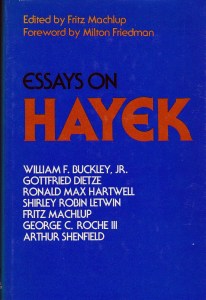
Essays on Hayek


Essays on Hayek
Edited by Fritz Machlup

Friedrich Hayek (1899-1992) received the Nobel Prize in Economics on December 11, 1974 for his theory of business cycles and the effects of monetary and credit policies. The following year, the Mont Pelerin Society held a conference at Hillsdale College covering various aspects of Hayek’s work. This book is a collection of the papers presented and discussed.

I find it noteworthy that Hayek wrote The Road to Serfdom (1944) on the consequences of socialism in the same era that George Orwell wrote Animal Farm (1945) and 1984 (1949).

Continue reading “Essays on Hayek”
HBR Guide to Buying a Small Business


HBR Guide to Buying a Small Business: Think big, buy small, own your own company
by Richard S. Ruback and Royce Yudkoff

This book provides a methodology to find, evaluate, finance, and acquire a small business. The autonomy of entrepreneurship is compelling to many, but the failure rate of start-ups is high—more than two-thirds of them never deliver a positive return to investors. In contrast, this approach seeks to buy and manage an existing “enduringly profitable” business. The authors teach a course in entrepreneurship through acquisition at Harvard Business School.

Continue reading “HBR Guide to Buying a Small Business”

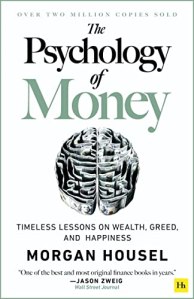
The Psychology of Money


The Psychology of Money: Timeless Lessons on Wealth, Greed, and Happiness
by Morgan Housel

Financial success is a soft skill, writes Morgan Housel, “where how you behave is more important than what you know.” This is a book about developing the mindset of a long-term investor, with a realistic attitude towards risk and reward. The book is conspicuously free of financial jargon and math. Here are some key points.

Continue reading “The Psychology of Money”

How Finance Works


How Finance Works: The HBR Guide to Thinking Smart About the Numbers
by Mihir A. Desai

This is an outstanding book which presents some complicated topics in a clear, well-organized manner with real-world examples. The author, a professor of finance and taxation at Harvard Business School and Harvard Law School, includes some sidebar commentary from two CFOs, an investment banker, and a hedge fund manager.

Continue reading “How Finance Works”

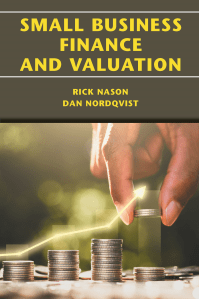
Small Business Finance and Valuation


Small Business Finance and Valuation
by Rick Nason and Dan Nordqvist

A finance professor and a CPA have teamed up to explain finance and risk management concepts specifically for small business, defined as assets under $5 million. They acknowledge that the objectives of small business owners often differ from those of a Fortune 500 CFO, whose focus is typically maximizing shareholder value. Freedom, peace of mind, and other quality of life issues may be more important to a small business owner.

Continue reading “Small Business Finance and Valuation”

An interview with Alastair Thomson author of Cash Flow Surge

After posting more than 250 book reviews, I decided to try something new: an author interview on YouTube. I am grateful to Alastair Thomson for graciously sharing his wisdom on managing small and medium-sized businesses. Alastair has an accounting background, but this conversation is not about debits and credits. It’s about improving your business from the perspective of an experienced CEO and CFO. We cover cash flow, profit, customer experience, metrics, business ethics, marketing, quality, continuous improvement, front-line employees, growth, margins, inventory, and receivables.


An interview with Alastair Thomson, author of Cash Flow Surge
July 16, 2020 – 1 hour – Book ReviewAmazon


Transcript

Continue reading “An interview with Alastair Thomson author of Cash Flow Surge”

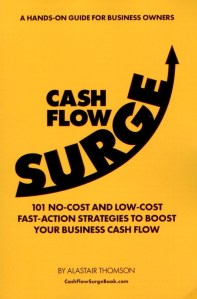
Cash Flow Surge: 101 No-Cost and Low-Cost Fast-Action Strategies to Boost Your Cash Flow


Cash Flow Surge: 101 No-Cost and Low-Cost Fast-Action Strategies to Boost Your Business Cash Flow
by Alastair Thomson (interview)

In college I took a course called Small Business Finance. The main thing I remember from this course is the emphasis on “cash flow, cash flow, cash flow.” Alastair Thomson is an accountant who has been a CFO and CEO of several businesses in the U.K., across variety of industries. He wrote this book for owners of small and medium-size businesses. While cash flow and profit are not the same thing, many of the ideas in the book can improve both.

The 101 chapters cover suppliers and expenses, customers and revenue, staffing and procedures, communication, insurance, logistics, contracts, and technology. Here are some snippets:

Continue reading “Cash Flow Surge: 101 No-Cost and Low-Cost Fast-Action Strategies to Boost Your Cash Flow”

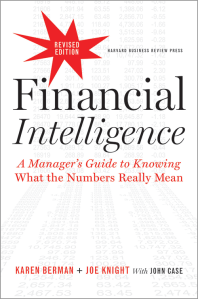
Financial Intelligence: A Manager’s Guide to Knowing What the Numbers Really Mean


Financial Intelligence: A Manager’s Guide to Knowing What the Numbers Really Mean
by Karen Berman and Joe Knight

This outstanding book teaches corporate financial literacy to nonfinancial employees. There are 33 short chapters grouped into sections covering the income statement, the balance sheet, cash, ratios, return on investment, and working capital. “You’ll learn how to decipher the financial statements, how to identify potential biases in the numbers, and how to use the information in the statements to do your job better.”

Continue reading “Financial Intelligence: A Manager’s Guide to Knowing What the Numbers Really Mean”

I, Pencil


I, Pencil
by Leonard E. Read

This is the story of how a simple pencil is manufactured using numerous raw materials from all over the world, as told in the first person by the pencil itself.  It was first published in 1958 to explain how free-market economies work and to discredit centrally-planned economies, such as the Soviet Union. While trade barriers are not expressly discussed in the story, the reader can infer potential consequences rippling through the supply chain.

Continue reading “I, Pencil”

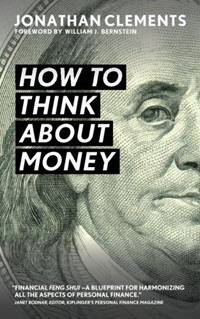
How to Think About Money


How to Think About Money
by Jonathan Clements (1963-2025)

Jonathan Clements, a personal-finance columnist at The Wall Street Journal for some 20 years, advises how to think about work, debt, investments, and insurance at various stages of life. He puts an emphasis on preparing for retirement, starting at a young age.

“Chronologically, retirement might be our final financial goal, but we should always put it first. Amassing enough for a comfortable retirement is our life’s great financial task.” Given longer life expectancy, “we need to get ourselves on the right financial track as early in our adult life as possible, so we quickly achieve some measure of financial freedom.”

Continue reading “How to Think About Money”