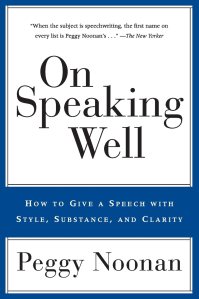
On Speaking Well: How to Give a Speech with Style, Substance, and Clarity by Peggy Noonan
Prior to writing columns for the Wall Street Journal and Time, Peggy Noonan was a speechwriter for Ronald Reagan and George H.W. Bush. In this book she shares her wisdom about speaking and speechwriting.
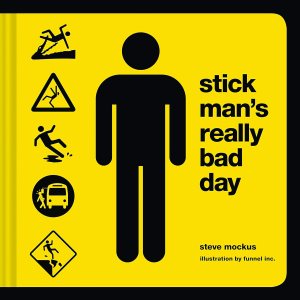
Whenever you think you’re having a bad day, remember it could be worse. You could be Stick Man. “If something can go wrong, it probably will for him. But he also seems to have amazing recuperative powers, and he never gives up, no matter what mishap may befall him next.”
A graphic novel of sorts, this book chronicles a day in the life of Stick Man in the form of 125 signs.
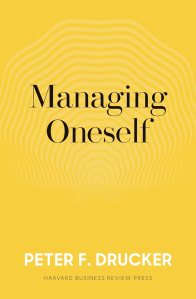
Managing Oneself and What Makes an Effective Executive by Peter F. Drucker (1909-2005)
Peter Drucker is often referred to as the leading management thinker of the 20th century. His seminal works include Concept of the Corporation (1946) and The Practice of Management (1954). This short volume includes two of Drucker’s articles: “Managing Oneself” and “What Makes an Effective Executive.” Here are some highlights.
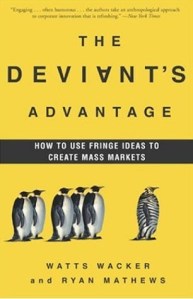
The Deviant’s Advantage: How to Use Fringe Ideas to Create Mass Markets by Watts Wacker and Ryan Mathews
“Deviance is the source of all true innovation, growth, and indeed our collective survival. Deviance is defined by time, place, and circumstances.”
“Without deviance there would be no art, no scientific breakthroughs, no technological advances… Physical evolution is perhaps the perfect example of deviance in action. Without mutation—essentially deviance from an established DNA pattern—nature would remain static.”
“Don’t let the words deviant and deviance scare you. They’re being used in their purest definition—something or someone operating in a defined measure away from the norm.”
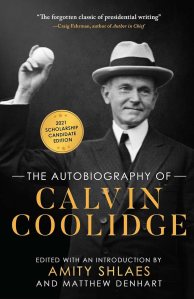
The Autobiography of Calvin Coolidge by Calvin Coolidge (1872-1933) with introduction and footnotes by Amity Shlaes and Matthew Denhart
Calvin Coolidge became the 30th president of the United States on August 3, 1923 upon the death of President Warren G. Harding. He ran for reelection in 1924 and served one full term of his own. He did not seek reelection in 1928. To give some context of his time, Coolidge was the first president whose inauguration address was broadcast nationwide on the radio, and he was the first president to make a transatlantic telephone call.
Seeing It: Photography and Commentary by Mark Hopkins (1932-2026)
As art professor Kit White has written, “Observation lies at the heart of the art process.” Learning to see is a fundamental skill taught in observational drawing classes. It’s also fundamental to fine art photography, as Mark Hopkins explains. The title Seeing It refers to being curious and looking beyond the obvious.
“Cameras do not see; that is the task of their owners. And seeing is what this book is about. In particular, it is about seeing opportunities to create worthy photographic images. It is meant to be inspirational, to show how one camera owner’s concentration on visual awareness has created a collection of photographs whose images others might have walked right past.”
“It is about seeing what you see. If by the end of the book you have a better appreciation of what I mean by that, then I will have fulfilled my goal.”
Slow Productivity: The Lost Art of Accomplishment Without Burnout by Cal Newport
Slow Productivity is “a philosophy for organizing knowledge work efforts in a sustainable and meaningful manner, based on the following three principles: 1. Do fewer things; 2. Work at a natural pace; 3. Obsess over quality.”
Newport defines knowledge work as “the economic activity in which knowledge is transformed into an artifact with market value through the application of cognitive effort.”
“Concrete productivity metrics of the type that shaped the industrial sector will never properly fit the more amorphous knowledge work setting… In knowledge work… individuals are often wrangling complicated and constantly shifting workloads… In this setting, there’s no clear, single output to track.”
Life’s Journeys According to Mister Rogers: Things to Remember Along the Way by Fred Rogers (1928-2003)
And now a Thanksgiving palette cleanser.
Fred Rogers was the creator and host of the children’s television show Mister Rogers’ Neighborhood from 1968 to 2001. This short book is a posthumously published collection of his writing for adults.
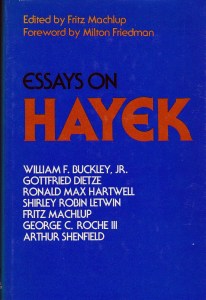
Friedrich Hayek (1899-1992) received the Nobel Prize in Economics on December 11, 1974 for his theory of business cycles and the effects of monetary and credit policies. The following year, the Mont Pelerin Society held a conference at Hillsdale College covering various aspects of Hayek’s work. This book is a collection of the papers presented and discussed.
I find it noteworthy that Hayek wrote The Road to Serfdom (1944) on the consequences of socialism in the same era that George Orwell wrote Animal Farm (1945) and 1984 (1949).

 The Key Point