Why Can’t You Just Give Me The Number?


Why Can’t You Just Give Me the Number? An Executive’s Guide to Using Probabilistic Thinking to Manage Risk and Make Better Decisions
by Patrick Leach

Decisions can be based on a deterministic calculation only in conditions of certainty, that is to say the input parameters are known quantities. But strategic decisions are often made in a context of uncertainty and complexity, where a definite answer is unknowable, so we must turn to probabilistic thinking.

Uncertainty. “I make the case that all value generated by business executives comes—directly or indirectly—from how they manage uncertainty. Without uncertainty, a share of a company’s stock is effectively a bond, with guaranteed future cash flows. Guaranteed bonds don’t need management. But stocks (or rather, companies issuing stock) certainly do.”

Continue reading “Why Can’t You Just Give Me The Number?”
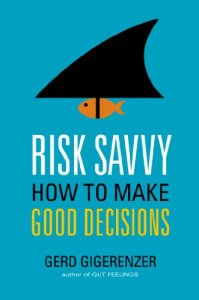
Risk Savvy: How to Make Good Decisions


Risk Savvy: How to Make Good Decisions
by Gerd Gigerenzer

Gigerenzer makes a distinction between risk and uncertainty. He uses the term risk “for a world where all alternatives, consequences, and probabilities are known… Most of the time, however, we live in a changing world where some of these are unknown: where we face unknown risks, or uncertainty. The world of uncertainty is huge compared to that of risk… We have to deal with ‘unknown unknowns.’”

Continue reading “Risk Savvy: How to Make Good Decisions”

Risk: Why We Fear the Things We Shouldn’t


Risk: Why We Fear the Things We Shouldn’t—and Put Ourselves in Greater Danger
by Dan Gardner

“One of the most consistent findings of risk perception research is that we overestimate the likelihood of being killed by the things that make the evening news and underestimate those that don’t. What makes the evening news? The rare, vivid, and catastrophic killers. Murder, terrorism, fire, and flood. What doesn’t make the news is the routine cause of death that kills one person at a time and doesn’t lend itself to strong emotions and pictures. Diabetes, asthma, heart disease.” 

Continue reading “Risk: Why We Fear the Things We Shouldn’t”

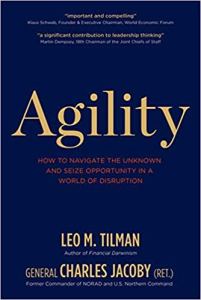
Agility: How to Navigate the Unknown and Seize Opportunity in a World of Disruption


Agility: How to Navigate the Unknown and Seize Opportunity in a World of Disruption
by Leo M. Tilman and Gen. Charles Jacoby (Ret.)

“The need for agility in business, government and warfare arises precisely from the uncertainty and complexity of the competitive environment.”

I imagine both co-authors of Agility have some battle scars—Tilman from Bear Stearns during the 2008 financial industry crisis and Jacoby from his career in the U.S. Army where he achieved the rank of 4-star general. Kidding aside, this book goes beyond military metaphors and presents a fusion of military and business thinking about risk intelligence and uncertainty as well as a leadership approach that emphasizes truth (as opposed to assumptions), trust, clear communication, and executional dexterity throughout the organization.

Complex adaptive systems “are constantly changing and evolving. They lack centralized control. They are inhabited by a multitude of stakeholders driven by distinct objectives, risk tolerances and modes of operation. These players interact in dynamic tension with one another, alternating between the urge to recoil from and engage in risk-taking and aggression. Their actions and adaptations lead to entirely unpredictable patterns and outcomes.”

Continue reading “Agility: How to Navigate the Unknown and Seize Opportunity in a World of Disruption”

Rethinking Risk Management: Critically Examining Old Ideas and New Concepts


Rethinking Risk Management: Critically Examining Old Ideas and New Concepts
by Rick Nason

Rick Nason challenges the status quo of risk management which mindlessly follows third-party frameworks and does too little independent thinking. He argues that risk management acts as “The Department of No” while ignoring upside risk. He envisions risk management as a strategic player in value creation rather than a cost center.

Continue reading “Rethinking Risk Management: Critically Examining Old Ideas and New Concepts”