Words That Work: It’s not what you say, it’s what people hear By Dr. Frank Luntz
Frank Luntz is a communication strategist for corporate and political clients. Although he’s done a lot of work for Republicans (including the Contract with America) this is not a book about political ideology. It’s about persuasive communication in political campaigns, product marketing, and labor disputes.
Words that work do not happen by chance. Luntz uses market research techniques (polls, focus groups, dial sessions) to test how audiences respond.
The Thank You Economy is about connecting with customers through social media, but it is not a book about Facebook, Twitter, or any other specific technology. It’s about creating a culture of caring relationships, like when your great-grandmother shopped with local merchants. Those relationships disappeared as the economy evolved from mom-and-pop shopkeepers to big box stores, but social media offers a means of restoring that human touch in a scalable way.
18 Minutes: Find Your Focus, Master Distraction, and Get the Right Things Done by Peter Bregman
Peter Bregman writes, “The world doesn’t reward perfection. It rewards productivity.” 18 Minutes is a book about choosing your priorities and getting things done.
The author suggests finding your focus based on your strengths, weaknesses, differences, and passions. “Assert your differences… Don’t waste your year trying to blend in… Understand your obsessions and you will understand your natural motivation.”
Idiocracy DVD starring Luke Wilson, directed by Mike Judge, 84 minutes.
Idiocracy, a portmanteau of idiot democracy, is a satirical look at the future of American culture and politics. What makes this funny is that it is grounded in contemporary reality, just pushed to an (even more) absurd level.
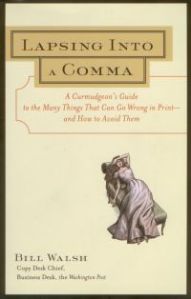
Lapsing Into a Comma: A Curmudgeon’s Guide to the Many Things That Can Go Wrong in Print—and How to Avoid Them by Bill Walsh
The Internet and print-on-demand technology have enabled almost everyone to become a publisher. In traditional media, professional journalists and authors have their writing cleaned up by copy editors before it is published. The average blogger does not have this luxury. In Lapsing Into a Comma, Bill Walsh shares his advice on how to handle many common problems that he has encountered as copy editor of the business section at the Washington Post.
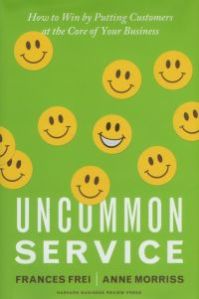
Uncommon Service: How to Win by Putting Customers at the Core of Your Business by Frances Frei and Anne Morriss
Customer service is not an afterthought. In order to provide consistently excellent service, it must be baked in to the business model. In Uncommon Service, authors Frances Frei and Anne Morriss explain that great service is “made possible—profitable, sustainable, scalable—by designing a system that sets everyone up to excel.”
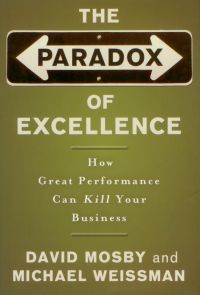
The Paradox of Excellence: How Great Performance Can Kill Your Business by David Mosby and Michael Weissman
When a company consistently provides excellent service it can become “invisible” to the client until something goes wrong. This book illustrates the problem through a parable about a trucking company. Their largest and most profitable customer has given notice to terminate their contract due to a botched delivery. Management is shocked, as there had been no previous problems with this client over the many years they have done business together.
The Laws of Simplicity: Design, Technology, Business, Life by John Maeda
Complex systems and information overload can drive us crazy. John Maeda explains the remedy. “Simplicity is about subtracting the obvious, and adding the meaningful.” The ten laws of simplicity are:
Reduce – The simplest way to achieve simplicity is through thoughtful reduction
Organize – Organization makes a system of many appear fewer.
Time – Savings in time feel like simplicity.
Learn – Knowledge makes everything simpler.
Differences – Simplicity and complexity need each other.
Context – What lies in the periphery of simplicity is definitely not peripheral.
Emotion – More emotions are better than less.
Trust – In Simplicity we trust.
Failure – Some things can never be made simple.
The One – Simplicity is about subtracting the obvious, and adding the meaningful.
Here’s my favorite line in the book: “While great art makes you wonder, great design makes things clear.” I think this thought applies to graphic design, product design, and even process design.
John Maeda is a graphic designer and computer scientist. He wrote this book while he was a professor at MIT Media Lab. Subsequently he was president of Rhode Island School of Design (RISD).
Maeda, John. The Laws of Simplicity: Design, Technology, Business, Life. Cambridge, Massachusetts: MIT, 2006. Buy from Amazon.com
Disclosure: As an Amazon Associate I earn from qualifying purchases.
It Worked For Me: In Life and Leadership by Colin Powell with Tony Koltz
Few people have the range of experiences of Colin Powell (1937-2021): from janitor of a Pepsi bottler to National Security Advisor, from Chairman of the Joint Chiefs to Secretary of State. In It Worked For Me he shares stories in a conversational style, many of which include a leadership lesson. And yes, he also includes a chapter on his infamous United Nation presentation, arguably the low point of his career.
It was interesting to hear what it was like to work with Ronald Reagan. In the chapter called Squirrels, Reagan seemed detached from the dilemma Powell was explaining to him (he seemed more interested in the squirrels outside his window), but upon reflection Powell figured out that Reagan wanted his subordinates to make their own decisions. In a separate incident involving a confrontation between U.S. and Iranian naval forces, Reagan was very decisive in his presidential decision when the matter required his approval.