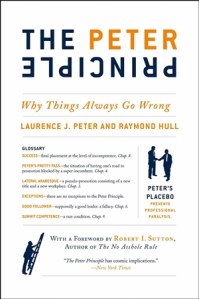
The Peter Principle: Why Things Always Go Wrong by Laurence J. Peter (1919-1990) and Raymond Hull (1919-1985)
For anyone who is frustrated with the dysfunction of a bureaucracy, this satirical study of hierarchiology—the social science of hierarchies—will shed some light. The Peter Principle states, “In a hierarchy, everyone tends to rise to his level of incompetence.”
Why Can’t You Just Give Me the Number? An Executive’s Guide to Using Probabilistic Thinking to Manage Risk and Make Better Decisions by Patrick Leach
Decisions can be based on a deterministic calculation only in conditions of certainty, that is to say the input parameters are known quantities. But strategic decisions are often made in a context of uncertainty and complexity, where a definite answer is unknowable, so we must turn to probabilistic thinking.
Uncertainty. “I make the case that all value generated by business executives comes—directly or indirectly—from how they manage uncertainty. Without uncertainty, a share of a company’s stock is effectively a bond, with guaranteed future cash flows. Guaranteed bonds don’t need management. But stocks (or rather, companies issuing stock) certainly do.”
HBR Guide to Buying a Small Business: Think big, buy small, own your own company by Richard S. Ruback and Royce Yudkoff
This book provides a methodology to find, evaluate, finance, and acquire a small business. The autonomy of entrepreneurship is compelling to many, but the failure rate of start-ups is high—more than two-thirds of them never deliver a positive return to investors. In contrast, this approach seeks to buy and manage an existing “enduringly profitable” business. The authors teach a course in entrepreneurship through acquisition at Harvard Business School.
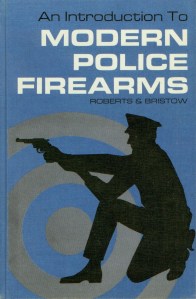
An Introduction to Modern Police Firearms by Duke Roberts and Allen P. Bristow
I purchased this textbook for 50 cents at a college library book sale. The distinctive smell of a vintage library book adds to the nostalgic appeal. The book was published in 1969 during the Adam-12 era. This was about 20 years before American police departments made the switch from revolvers to semiautomatic pistols, although the book covers both. There is a chapter on the police shotgun, but nothing about rifles. Other topics include safety, maintenance, ballistics, marksmanship, chemical agents, the legal and ethical use of firearms, and sample Use of Deadly Force policies.
The Psychology of Money: Timeless Lessons on Wealth, Greed, and Happiness by Morgan Housel
Financial success is a soft skill, writes Morgan Housel, “where how you behave is more important than what you know.” This is a book about developing the mindset of a long-term investor, with a realistic attitude towards risk and reward. The book is conspicuously free of financial jargon and math. Here are some key points.
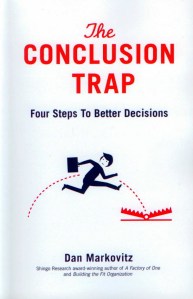
The Conclusion Trap: Four Steps to Better Decisions by Dan Markovitz
As a management consultant, Dan Markovitz has seen too many executives waste money on “Ready, Fire, Aim” decisions which yield no benefit—and sometimes even make things worse. “Frankly, I’m tired… of seeing leaders jump to conclusions and taking action without really understanding their problem.” This concise 67-page book resonates with me and I think it applies not only to business, but also more broadly to political policy on many of society’s complex issues, such as education and healthcare.
Nina Alexander has been making art for 60 years. Her work has transitioned from metal sculptures to photography, collage, and most recently, the pastels which are featured in this 10×10 inch book. Preceding the artwork is a brief biographical text. The psychology of creating art is a recurring theme.
Assemblage: The Art and Science of Brand Transformation by Emmanuel Probst
“Assemblage is a French word that refers to the art and science of blending different eaux-de-vies (brandies) before bottling cognac. It is the craft of the maître de chai (also known as the master blender or cellar master) to select brandies from dozens of samples and craft a unique cognac… Assemblage is also a metaphor for building successful brands.”
Four Thousand Weeks: Time Management for Mortals by Oliver Burkeman
We live in an era where appliances and software supposedly make our lives easier. “Yet, paradoxically, you only feel busier, more anxious… And becoming ‘more productive’ just seems to cause the belt to speed up.”
We all have a finite amount of time in our lives—in the neighborhood of 4,000 weeks, assuming an 80-year lifespan and rounding to 50 weeks per year. “Our limited time… what Heidegger calls our ‘finitude’… isn’t just one among various things we have to cope with; rather, it’s the thing that defines us, as humans.”
“The world is bursting with wonder, and yet it’s the rare productivity guru who seems to have considered the possibility that the ultimate point of all our frenetic doing might be to experience more of that wonder.”