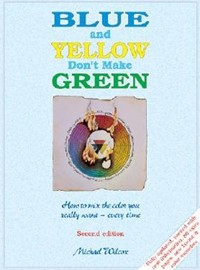
Blue and Yellow Don’t Make Green


Blue and Yellow Don’t Make Green: How to mix the color you want—every time
by Michael Wilcox

“Have you ever wondered why it is so difficult to mix the exact colors that you need? And why it is so easy to mix dull, grayed colors, commonly known as mud?… In order to obtain a wider range of colors we purchase a variety of reds, yellows and blues, together with several greens, oranges, violets, browns, and grays. Painting starts to become expensive and confusing.”

The main premise of this book is that the three-primary color system needs to be abandoned in favor a six-color system. To begin, we need to understand how portions of the color spectrum are either absorbed or reflected by a surface. A surface appears black because it absorbs all colors. A surface appears white if it reflects all colors.

So what happens if you mix pure yellow and pure blue?

Continue reading “Blue and Yellow Don’t Make Green”
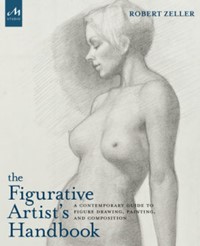
The Figurative Artist’s Handbook: A Contemporary Guide to Figure Drawing, Painting, and Composition


The Figurative Artist’s Handbook: A Contemporary Guide to Figure Drawing, Painting, and Composition
by Robert Zeller

Unlike other figure drawing instruction books, this one begins with a 67-page crash course in art history. “Figurative art always conveys a narrative, a point of view. At the present, it is considered vital for a figurative artist to have his or her own artistic voice, and to exhibit some originality. How can you hope to be original, to continue the conversation, if you do not listen to the past, to those who have come before you?”

The instructional chapters of the book are divided by pose category: Standing Figure, Front View; Standing Figure, Back View; Reclining Figure; Portrait Drawing; and Portrait Painting. Here are some of the common themes.

“Gesture is a river of movement, energy, and rhythm that flows through the figure in any given pose… Once you understand gesture you will be able to see the essential rhythm of a pose, which will allow you to properly plan your drawing. Think of gesture as a conceptual road map. Before you start drawing with your hand, first learn to draw with your eyes… Begin by scanning the entire figure for gestures that flow through the various forms, learning to see how all of the parts of the figure are connected… Learn to see this axis of energy first so that when you draw, you will be able to forge greater unity among the various parts of the figure.”

Continue reading “The Figurative Artist’s Handbook: A Contemporary Guide to Figure Drawing, Painting, and Composition”

101 Things to Learn in Art School


101 Things to Learn in Art School
by Kit White

“Artists assimilate a whole range of psychological, aesthetic, political, and emotional data points, and they then make forms to organize and give meaning to them. That takes skill and practice, working in tandem with intelligence and keen observation… Basic form-giving skills help the student make the bridge between thought and embodiment.”

Kit White is an associate professor in the MFA program at Pratt Institute. Here’s a sample of his insights:

“Art is continuing a dialogue that stretches back through thousands of years. What you make is your contribution to that dialogue. Therefore, be conscious of what has come before you and the conversation that surrounds you. Try not to repeat what has already been said. Study art history and stay alert to the dialogue of your moment.”

“Composition is the foundation of image making. It is the spatial relationships between all of the parts in an image. Whether a drawing, a painting, a sculpture, a photograph, a video, or an installation, how a thing is composed determines its look, its feel, and its meaning. Compositional variation, like musical tunes, is limitless.”

Continue reading “101 Things to Learn in Art School”

101 Things I Learned in Film School


101 Things I Learned in Film School
by Neil Landau with Matthew Frederick

“In my… twenty years of teaching, screenwriting, and filmmaking, I have been continually struck by how the creative process of filmmaking is at once painstakingly deliberate and fortuitously experimental,” writes Neil Landau, who teaches at the UCLA School of Theater, Film, and Television.

Creating a film or television program entails a variety of skills including budgeting, screenwriting, directing, acting, and numerous technical proficiencies. Here’s a sampling of the insights shared by the author.

Film is a director’s medium; television is a writer’s medium. A movie is a one-of-a-kind undertaking: The production team and actors come together for several weeks or months to create a unique world that disappears upon the completion of filming. A strong director is essential in defining this world—form its artistic details to its broad nuances, script approval to casting, set design to special effects, and lighting and equipment to the overall visual style. A successful television series, by comparison, is long running, and production becomes rather standardized during its first season. The greatest challenge becomes the generation of new material each week, giving the gifted writer a proportionately greater opportunity to shine.”

Continue reading “101 Things I Learned in Film School”

101 Things I Learned in Fashion School


101 Things I Learned in Fashion School
by Alfredo Cabrera with Matthew Frederick

“In my years of teaching, I have found that the greater obstacle… is not the acquiring of technical proficiency… but in accepting the need to design for real people… It took me years as a working designer to realize the importance of identifying a real living customer and recognizing what he or she will and won’t wear. Far from being anti-creative, it was for me the beginning of true creativity. For what is creativity if it isn’t to take something existing in one’s head and give it relevance in the real world?”

Alfredo Cabrera has taught and critiqued at Parsons The New School for Design, Fashion Institute of Technology, and Pratt Institute. Here’s a sampling of the insights he shares in the book.

“Simple clothes aren’t simple to design. When superfluous design elements are eliminated from a garment, more subtle considerations—proportion, line, fit—are magnified. This calls for a refined understanding of anatomy (e.g. how the neckline sits in relation to the clavicle), geometry, balance, positive and negative space, and the harmony of parts to whole.”

Continue reading “101 Things I Learned in Fashion School”

101 Things I Learned in Architecture School


101 Things I Learned in Architecture School
by Matthew Frederick

Matthew Frederick presents 101 concepts in his “primer of architectural literacy.” Here is a sampling of his insights.

“Our experience of an architectural space is strongly influenced by how we arrive in it. A tall, bright space will feel taller and brighter if counterpointed by a low-ceilinged, softly lit space. A monumental or sacred space will feel more significant when placed at the end of a sequence of lesser spaces. A room with south-facing windows will be more strongly experienced after one passes through a series or north-facing spaces.”

Continue reading “101 Things I Learned in Architecture School”

The Truth About Art: Reclaiming Quality

the-truth-about-art


The Truth About Art: Reclaiming Quality
by Patrick Doorly

“A bad work of art is an oxymoron, like bad skill,” writes Patrick Doorly, art history professor at Oxford University. “Art is high-quality endeavor.”

“Quality is not a thing but an event. When the subject [viewer] becomes aware of the object [art], quality describes the relationship that binds them… Beauty does not lie in the eye of the beholder, but that eye and the mind behind it form one half of the dynamic relationship we experience as beauty.”

The quality experience is preverbal. “It operates prior to intellectualization.”

Continue reading “The Truth About Art: Reclaiming Quality”

The Art of Seeing

the-art-of-seeing


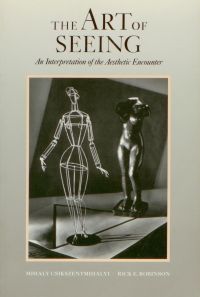
The Art of Seeing: An Interpretation of the Aesthetic Encounter
by Mihaly Csikszentmihalyi and Rick E. Robinson

This book explores the enjoyment of viewing art within the framework of flow, the psychology of optimal experience. Flow is an intrinsically rewarding feeling of total involvement in an activity. To be fully engaged in a state of flow, one must be skilled and challenged. The author studied museum professionals as a proxy for the more general art viewing population.

“The experience is one of an initial perceptual hook followed by a more detached, intellectual appreciation that returns the viewer to the work with a deeper understanding.”

“The best examples of objects containing such challenges are works whose meaning appears to be inexhaustible.” As one respondent put it, “‘A good painting will never be used up.’”

Four dimensions of aesthetic experience are explored: cognitive, perceptual, emotional, and communicative.

Continue reading “The Art of Seeing”

Figure Drawing For Artists

figure-drawing-for-artists-steve-huston


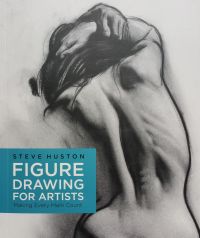
Figure Drawing For Artists: Making Every Mark Count
by Steve Huston

The two most fundamental concepts in Steve Huston’s approach to figure drawing are structure and gesture—the parts and the relationship between the parts.

“To understand and use the idea of structure well, it’s best to think like a sculptor, meaning we build our drawing and painting (as in sculpture) through a series of constructed forms… Think of it as the scaffold on which to hang your designs and rendering techniques.”

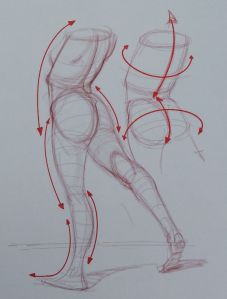
“Constructed forms automatically feel three dimensional when done well because the lines move over the form. Another way to think of it is that every mark we make, whether carefully rendered or loosely sketched, should act as a visual arrow.”

figure-drawing-for-artists-steve-huston-p45

“Gesture is the connection, the relationship between the shapes… Gesture is the lifeline embedded inside any living form… This gestural idea makes your art look natural… It keeps our drawings from looking stiff, mechanical, and pieced together. It’s what gives the subject a lively and organic quality.”

Gesture is the long axis curve of the structure. “Gesture is defined by the long axis because all body parts connect end to end… Any artist who just focuses on the pieces ends up with pieced-together results. Art’s job is to orchestrate life into something powerful, effecting, and meaningful—something greater than the individual parts… Gesture is the chef’s secret sauce.”

“The longer and more graceful the gestural curve, the more smoothly the eye moves over the various forms… Always err on the side of the more dynamic. That means, if the gesture is curved, make it more curved. If the shadow is dark, make it a little darker.”

Continue reading “Figure Drawing For Artists”

A Gallery Without Walls

a-gallery-without-walls


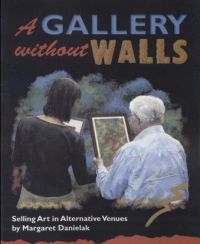
A Gallery Without Walls: Selling Art in Alternative Venues
by Margaret Danielak

“This book is about selling art in alternative venues and in innovative, cost-effective ways” based on the author’s experience as an artist’s representative. What I like most about this book is that it opens the door to nontraditional sales channels, so you are not competing in the same sandbox with everyone else.

Continue reading “A Gallery Without Walls”