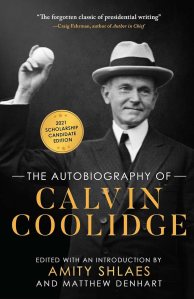
The Autobiography of Calvin Coolidge by Calvin Coolidge (1872-1933) with introduction and footnotes by Amity Shlaes and Matthew Denhart
Calvin Coolidge became the 30th president of the United States on August 3, 1923 upon the death of President Warren G. Harding. He ran for reelection in 1924 and served one full term of his own. He did not seek reelection in 1928. To give some context of his time, Coolidge was the first president whose inauguration address was broadcast nationwide on the radio, and he was the first president to make a transatlantic telephone call.
A Full Life: Reflections at 90 by Jimmy Carter (1924-2024)
Jimmy Carter was born on October 1, 1924 and was elected the 39th president of the United States in 1976. The world has changed a lot in the 100 years since Carter grew up in the segregated south. At the same time, many of the issues he writes about sound quite familiar, such as inflation, contested elections, and conflict in the Middle East.
I was surprised by Carter’s emphasis on fiscal discipline—something we haven’t seen in recent administrations. (At the end of the Carter administration, the national debt to GDP ratio was 32%. In 2022 it was 123%.) What also stands out is Carter’s cooperative relationships with presidents Gerald Ford and George H.W. Bush, in stark contrast to more recent polarization.
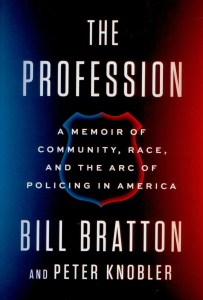
The Profession: a Memoir of Community, Race, and the Arc of Policing in America by Bill Bratton with Peter Knobler
Bill Bratton was sworn in as a Boston police officer in 1970 and rose to become chief or commissioner of six major police departments in three different states. He deserves a lot of credit for dramatically reducing crime, most notably as New York City Transit Police chief in the early 1990s and as commissioner of the NYPD in the mid-1990s.
Chapters two through six cover Bratton’s career through his first stint as NYPD commissioner until his falling out with Mayor Giuliani—basically a retelling of Bratton’s first book, Turnaround. Chapter seven covers his years as chief of LAPD; the writers were sloppy with the details in this chapter. Chapter eight is about Bratton’s second turn as NYPD commissioner under Mayor de Blasio.
The remainder of the book deals with contemporary issues related to race, implicit bias, terrorism, and the defund-the-police movement. I imagine Bratton wrote this book out of frustration with the anti-police climate and the resulting unraveling of 25+ years of crime reduction. It is extremely informative and he offers a valuable perspective. I read all 476 pages with great interest.
Always Look on the Bright Side of Life: A Sortabiography by Eric Idle
This is an autobiography of a very funny writer and performer. The book includes many stories of how Monty Python projects came to be. But it is also the story of friendships and the healing power of comedy.
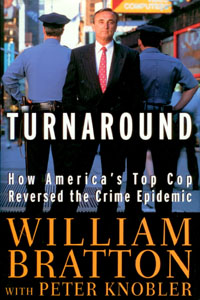
Turnaround: How America’s Top Cop Reversed the Crime Epidemic by William J. Bratton
I think of Turnaround as a management book by a highly-accomplished chief executive (police) officer. The book reads like an autobiography, from Bill Bratton’s childhood in Boston, until after his falling out with Rudy Guiliani. Through his experiences, I learned a lot about police work and his management style
It Worked For Me: In Life and Leadership by Colin Powell with Tony Koltz
Few people have the range of experiences of Colin Powell (1937-2021): from janitor of a Pepsi bottler to National Security Advisor, from Chairman of the Joint Chiefs to Secretary of State. In It Worked For Me he shares stories in a conversational style, many of which include a leadership lesson. And yes, he also includes a chapter on his infamous United Nation presentation, arguably the low point of his career.
It was interesting to hear what it was like to work with Ronald Reagan. In the chapter called Squirrels, Reagan seemed detached from the dilemma Powell was explaining to him (he seemed more interested in the squirrels outside his window), but upon reflection Powell figured out that Reagan wanted his subordinates to make their own decisions. In a separate incident involving a confrontation between U.S. and Iranian naval forces, Reagan was very decisive in his presidential decision when the matter required his approval.


 The Key Point