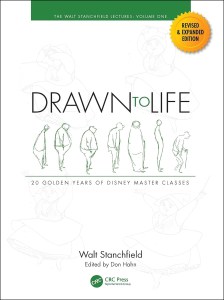
Drawn to Life: 20 Golden Years of Disney Master Classes by Walt Stanchfield (1919-2000). Edited by Don Hahn.
Walt Stanchfield began his animation career in 1937. In the 1980s and 90s he taught figure drawing classes for animators at Disney on Tuesday and Wednesday evenings. Disney producer Don Hahn compiled Stanchfield’s lecture notes and handouts into two volumes. The highlights below from Volume One capture some recurring themes.
The book includes drawings from Stanchfield and his students. This review includes more recent drawings by Brian Kennon, a former Disney artist who attended Stanchfield’s classes in the 1990s.
Composition: Understanding Line, Notan, and Color by Arthur Wesley Dow (1857-1922)
Composition is “the ‘putting together’ of lines, masses and colors to make a harmony. Design, understood in its broad sense, is a better word, but popular usage has restricted it to decoration.”
In the visual arts, “there are three structural elements with which harmonies may be built up” – line, notan, and color.
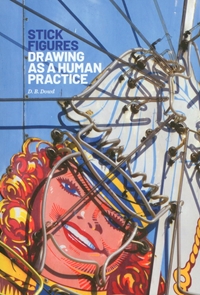
An Interview with D.B. Dowd, author of Stick Figures: Drawing as a Human Practice. The discussion topics are primarily from chapters 5-7 of the book.
[01:05] Drawing as a human practice. Drawing as nonlinear thinking. Salience. Tacit Knowledge.
[26:58] Reconceiving art education. Drawing is usually taught as an antecedent for painting. This is fine for people who want to paint. But most people use drawing as a tool for thinking, planning, and communication. Drawing as a way of understanding structures, e.g. in science classes. How STEAM relates to innovation.
[47:45] Illustration and cartooning as part of cultural history.
Stick Figures: Drawing as a Human Practice by D.B. Dowd (interview)
D.B. Dowd, professor of art and American culture studies at Washington University and faculty director of the D.B. Dowd Modern Graphic History Library, writes that drawing is above all else a tool for learning. This beautifully printed book covers drawing as a means of discovery and communication, confusion between visual modes, a nostalgic look at the field of illustration, and musings about the teaching of art.
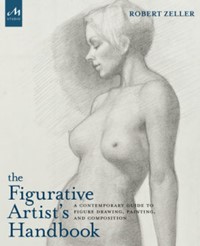
The Figurative Artist’s Handbook: A Contemporary Guide to Figure Drawing, Painting, and Composition by Robert Zeller
Unlike other figure drawing instruction books, this one begins with a 67-page crash course in art history. “Figurative art always conveys a narrative, a point of view. At the present, it is considered vital for a figurative artist to have his or her own artistic voice, and to exhibit some originality. How can you hope to be original, to continue the conversation, if you do not listen to the past, to those who have come before you?”
The instructional chapters of the book are divided by pose category: Standing Figure, Front View; Standing Figure, Back View; Reclining Figure; Portrait Drawing; and Portrait Painting. Here are some of the common themes.
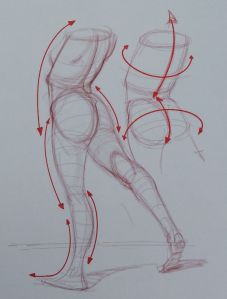
“Gesture is a river of movement, energy, and rhythm that flows through the figure in any given pose… Once you understand gesture you will be able to see the essential rhythm of a pose, which will allow you to properly plan your drawing. Think of gesture as a conceptual road map. Before you start drawing with your hand, first learn to draw with your eyes… Begin by scanning the entire figure for gestures that flow through the various forms, learning to see how all of the parts of the figure are connected… Learn to see this axis of energy first so that when you draw, you will be able to forge greater unity among the various parts of the figure.”
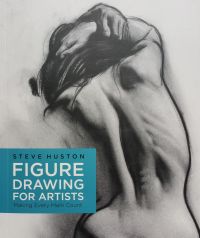
Figure Drawing For Artists: Making Every Mark Count by Steve Huston
The two most fundamental concepts in Steve Huston’s approach to figure drawing are structure and gesture—the parts and the relationship between the parts.
“To understand and use the idea of structure well, it’s best to think like a sculptor, meaning we build our drawing and painting (as in sculpture) through a series of constructed forms… Think of it as the scaffold on which to hang your designs and rendering techniques.”
“Constructed forms automatically feel three dimensional when done well because the lines move over the form. Another way to think of it is that every mark we make, whether carefully rendered or loosely sketched, should act as a visual arrow.”
“Gesture is the connection, the relationship between the shapes… Gesture is the lifeline embedded inside any living form… This gestural idea makes your art look natural… It keeps our drawings from looking stiff, mechanical, and pieced together. It’s what gives the subject a lively and organic quality.”
Gesture is the long axis curve of the structure. “Gesture is defined by the long axis because all body parts connect end to end… Any artist who just focuses on the pieces ends up with pieced-together results. Art’s job is to orchestrate life into something powerful, effecting, and meaningful—something greater than the individual parts… Gesture is the chef’s secret sauce.”
“The longer and more graceful the gestural curve, the more smoothly the eye moves over the various forms… Always err on the side of the more dynamic. That means, if the gesture is curved, make it more curved. If the shadow is dark, make it a little darker.”
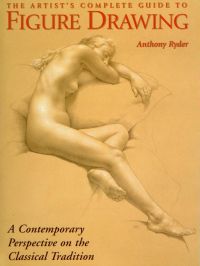
The Artist’s Complete Guide to Figure Drawing: A Contemporary Perspective on the Classical Tradition by Anthony Ryder
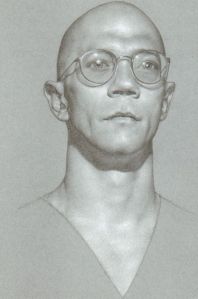
Anthony Ryder presents a thorough and meticulous process for drawing the human figure. This is definitely not a quick sketch approach. “On average, I put in about twelve three-hour sessions for each finished drawing.” Ryder works with either pencil on white paper or pencil and white charcoal on toned paper.
This book starts out with a 13-page interview with Milton Glaser by Peter Mayer followed by 188 pages of Glaser’s art.
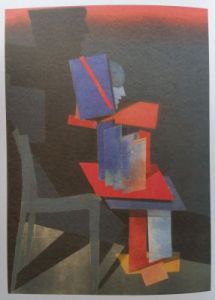
A recurring theme in the short text is ambiguity. “I have always been aware of the need to provoke the mind when communicating ideas because that is the only way that you prod someone into understanding anything. That is why ambiguity is such a useful tool… Why are we unmoved by many of the skills of academic painting? Because their information is complete and unambiguous, so you have nothing to add. The philosophy of modernism suggests that the viewer completes the work.”
Milton Glaser is best known as the graphic designer who created the I Love NY logo in 1975. He has also designed and illustrated album covers, book jackets, advertisements, posters, magazines and newspapers, and architectural interiors.
This is a highly informative book about observational drawing. One of the recurring themes is the distinction between what you see (percepts) and what you know (concepts). “There is meaningful conflict between what is perceived (convergence of parallel tracks) and our traditional rational understanding (Euclid’s theorem that parallel lines never meet)… To prevent your concepts from distorting your perceptions you must record the proportion you see, not the proportion you know.”