The Autobiography of Calvin Coolidge


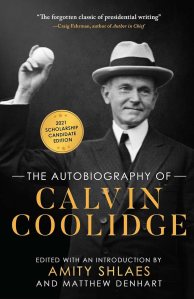
The Autobiography of Calvin Coolidge
by Calvin Coolidge (1872-1933) with introduction and footnotes by Amity Shlaes and Matthew Denhart

Calvin Coolidge became the 30th president of the United States on August 3, 1923 upon the death of President Warren G. Harding. He ran for reelection in 1924 and served one full term of his own. He did not seek reelection in 1928. To give some context of his time, Coolidge was the first president whose inauguration address was broadcast nationwide on the radio, and he was the first president to make a transatlantic telephone call.

Continue reading “The Autobiography of Calvin Coolidge”

Mansfield and Dirksen: Bipartisan Giants of the Senate


Mansfield and Dirksen: Bipartisan Giants of the Senate
by Marc C. Johnson 

In contrast to today’s polarized politics, the US Senate of the 1960s functioned with a great deal more civility and bipartisan cooperation, despite deep political divisions. This book is both a history lesson and a study in the leadership styles majority leader Michael Mansfield (Democrat) and minority leader Everett Dirksen (Republican).

Continue reading “Mansfield and Dirksen: Bipartisan Giants of the Senate”

A Full Life: Reflections at 90


A Full Life: Reflections at 90
by Jimmy Carter (1924-2024)

Jimmy Carter was born on October 1, 1924 and was elected the 39th president of the United States in 1976. The world has changed a lot in the 100 years since Carter grew up in the segregated south. At the same time, many of the issues he writes about sound quite familiar, such as inflation, contested elections, and conflict in the Middle East.

I was surprised by Carter’s emphasis on fiscal discipline—something we haven’t seen in recent administrations. (At the end of the Carter administration, the national debt to GDP ratio was 32%. In 2022 it was 123%.) What also stands out is Carter’s cooperative relationships with presidents Gerald Ford and George H.W. Bush, in stark contrast to more recent polarization.

Continue reading “A Full Life: Reflections at 90”

WCVB-TV Boston: How We Built the Greatest Television Station in America


WCVB-TV Boston: How We Built the Greatest Television Station in America
by Robert M. Bennett (1927-2016)

In this memoir, the highlight of television executive Bob Bennett’s career was launching and growing WCVB-TV, Channel 5 in Boston. A major theme is his commitment to locally-produced programming. Another theme is Bennett’s leadership style, whereby he encouraged new ideas and risk-taking from his lieutenants, and inspired a sense of pride which brought out the best in people at all levels of the organization. It’s also a high-risk, high-reward story that could have turned out very differently.

The book is comprised of Bennett’s recollections interspersed with commentary from former colleagues.

Continue reading “WCVB-TV Boston: How We Built the Greatest Television Station in America”

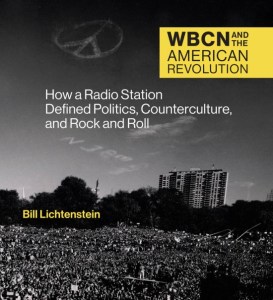
WBCN and the American Revolution


WBCN and the American Revolution: How a Radio Station Defined Politics, Counterculture, and Rock and Roll
by Bill Lichtenstein  

WBCN was a Boston rock and roll radio station from 1968 to 2009. It was instrumental (pun intended) in launching the careers of major bands. It was also part of the social fabric of the Boston college scene. This book and a companion video documentary tell the story of the early years of the station in the context of the era.

Continue reading “WBCN and the American Revolution”

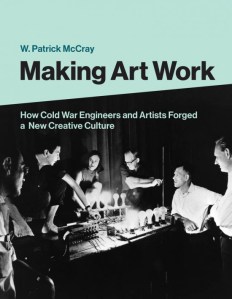
Making Art Work


Making Art Work: How Cold War Engineers and Artists Forged a New Creative Culture
by W. Patrick McCray

This book picks up where C.P. Snow left off in his 1959 book The Two Cultures. Snow was a British chemist turned novelist who had scientist friends and literary friends, but he observed that these groups were two separate cultures who rarely communicated with each other. Patrick McCray is a history professor at UC Santa Barbara. In Making Art Work, he studies several endeavors to bridge this divide, primarily in the 1960s, but also more recently. Specifically the book is about collaborations between artists and engineers. 

Continue reading “Making Art Work”

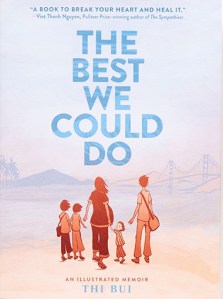
The Best We Could Do: An Illustrated Memoir


The Best We Could Do: An Illustrated Memoir
by Thi Bui

Thi Bui was born in Vietnam and immigrated to the United States as a child in 1978. Based largely on oral history from family members, she has written and illustrated their story, telling the history of Vietnam from 1943-1978 along the way. It is an engaging story presented in the style of a graphic novel.

Continue reading “The Best We Could Do: An Illustrated Memoir”

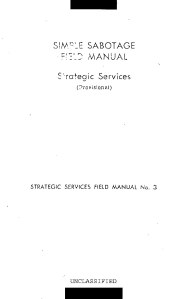
Simple Sabotage Field Manual


Simple Sabotage Field Manual
Office of Strategic Services
William J. Donovan, Director (1883-1959)

The Office of Strategic Services (OSS) was the predecessor of the Central Intelligence Agency (CIA), operating during World War II. This 32-page manual instructs OSS officers on numerous ways citizen-saboteurs can be trained to gum up the works. “Simple sabotage is more than malicious mischief, and it should always consist of acts whose results will be detrimental to the materials and manpower of the enemy.”

“Simple sabotage does not require specially prepared tools or equipment; it is executed by an ordinary citizen who may or may not act individually and without the necessity for active connection with an organized group; and it is carried out in such a way as to involve a minimum danger of injury, detection, and reprisal… Try to commit acts for which large numbers of people could be responsible.” 

Continue reading “Simple Sabotage Field Manual”

Fart Proudly

fart-proudly


Fart Proudly: Writings of Benjamin Franklin You Never Read in School
Compiled and Edited by Carl Japikse

Benjamin Franklin is well known as an important figure in American history. He was a printer, publisher, postmaster, inventor, and ambassador. He helped draft the Declaration of Independence and the Constitution. But he also had a sense of humor. This book contains a collection of his humorous writing, including hoaxes and political satire. Much of these works were written anonymously or under pseudonyms, such as a Richard Saunders, publisher of Poor Richard’s Almanack.

Here are some excerpts.

A Letter to the Royal Academy, 1781. The Royal Academy of Brusselles held a contest in which scientists submitted solutions to a given theoretical problem. Franklin submitted this suggestion for a contest theme with more practical value: “My Prize Question therefore should be, To discover some Drug wholesome and not disagreeable, to be mixed with our common Food, or Sauces, that shall render the Natural Discharges of Wind from our Bodies, not only inoffensive, but agreeable as Perfumes.”

Continue reading “Fart Proudly”