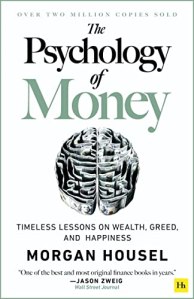
The Psychology of Money: Timeless Lessons on Wealth, Greed, and Happiness by Morgan Housel
Financial success is a soft skill, writes Morgan Housel, “where how you behave is more important than what you know.” This is a book about developing the mindset of a long-term investor, with a realistic attitude towards risk and reward. The book is conspicuously free of financial jargon and math. Here are some key points.
How Finance Works: The HBR Guide to Thinking Smart About the Numbers by Mihir A. Desai
This is an outstanding book which presents some complicated topics in a clear, well-organized manner with real-world examples. The author, a professor of finance and taxation at Harvard Business School and Harvard Law School, includes some sidebar commentary from two CFOs, an investment banker, and a hedge fund manager.
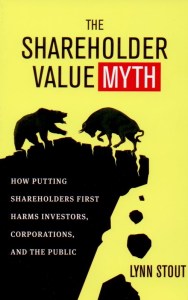
The Shareholder Value Myth: How putting shareholders first harms investors, corporations, and the public by Lynn Stout (1957-2018)
Business schools and law schools teach that the purpose of a corporation is to maximize shareholder wealth. “Shareholder wealth, in turn, is typically measured by share price—meaning share price today, not share price next year or next decade.” Lynn Stout (1957-2018), who was a business law professor at Cornell, makes the case that this is both untrue and harmful.
“United States corporate law does not, and never has, required directors of public corporations to maximize either share price or shareholder wealth… State statutes similarly refuse to mandate shareholder primacy… As long as boards do not use their power to enrich themselves, the [business judgment rule] gives them a wide range of discretion to run public corporations with other goals in mind, including growing the firm, creating quality products, protecting employees, and serving the public interest. Chasing shareholder value is a managerial choice, not a legal requirement.”
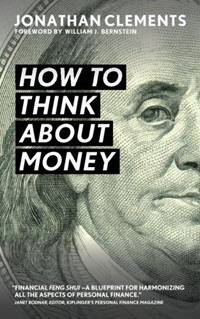
How to Think About Money by Jonathan Clements (1963-2025)
Jonathan Clements, a personal-finance columnist at The Wall Street Journal for some 20 years, advises how to think about work, debt, investments, and insurance at various stages of life. He puts an emphasis on preparing for retirement, starting at a young age.
“Chronologically, retirement might be our final financial goal, but we should always put it first. Amassing enough for a comfortable retirement is our life’s great financial task.” Given longer life expectancy, “we need to get ourselves on the right financial track as early in our adult life as possible, so we quickly achieve some measure of financial freedom.”
The Most Important Thing: Uncommon Sense for the Thoughtful Investor by Howard Marks
Howard Marks is the co-founder and co-chairman of Oaktree Capital Management and he ranks #374 on the 2017 Forbes 400 list of wealthiest Americans. In this book he covers 20 topics: second-level thinking; market efficiency and its limitations; intrinsic value; the relationship between price and value; understanding risk; recognizing risk; controlling risk; market cycles; the pendulum; combating negative influences; contrarianism; finding bargains; patient opportunism; knowing what you don’t know; having a sense for where we stand; appreciating the role of luck; investing defensively; avoiding pitfalls; adding value; and pulling it all together.
Can you guess which one is the most important thing?
The Laws of Wealth: Psychology and the Secret to Investing Success by Daniel Crosby
Psychologist Daniel Crosby works in the field of behavioral finance. “Given that you, as a member of the human family, have tendencies toward impatience, arrogance and a fetish for complexity, it is very likely that you will screw this up… At my last count, psychologists and economists had documented 117 biases capable of obscuring lucid financial decision-making.”
Crosby presents 10 rules of behavioral self-management.
Rule #1 – You Control What Matters Most. “The behavior gap measures the loss that the average investor incurs as a result of emotional responses to market conditions.” As an example, the author notes that the best performing mutual fund during the period 2000-2010 was CGM Focus, with an 18.2% annualized return; however the average investor in the fund had a negative return! The reason is that they tended to buy when the fund was soaring and sell in a panic when the price dipped. More on volatility later…
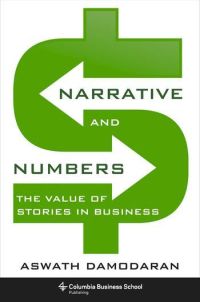
In this book, he computes valuation based on the business narrative. “One of the most important lessons I have learned is that a valuation that is not backed up by a story is both soulless and untrustworthy and that we remember stories better than spreadsheets.” Conversely, “when a storyteller has wandered into fantasyland, the easiest way to bring him or her back to Earth is with data that suggests the journey is either impossible or improbable.” Thus, “you need to bring both stories and numbers into play in investing and business, and valuation is the bridge between the two.”
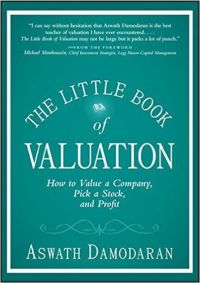
The Little Book of Valuation: How to Value a Company, Pick a Stock, and Profit by Aswath Damodaran
How do you determine if a stock is overpriced or a bargain? NYU finance professor Aswath Damodaran explains.
“There are dozens of valuation models but only two valuation approaches: intrinsic and relative… The intrinsic value of an asset is determined by the cash flows you expect that asset to generate over its life and how uncertain you feel about these cash flows. Assets with high and stable cash flows should be worth more than assets with low and volatile cash flows… In relative valuation, assets are valued by looking at how the market prices similar assets.”
The Interpretation of Financial Statements: The Classic 1937 Edition by Benjamin Graham and Spencer B. Meredith. New Introduction by Michael F. Price
Benjamin Graham (1894-1976) was a pioneer in the field of value investing. He is most famous for being Warren Buffet’s teacher at Columbia Business School. The Interpretation of Financial Statements was originally published in 1937. This 122-page book focuses on the balance sheet and income statement. Graham also wrote Security Analysis, first published in 1934, and The Intelligent Investor, first published in 1949.
Debunkery: Learn It, Do It, and Profit From It—Seeing Through Wall Street’s Money-Killing Myths By Ken Fisher
Investors often rely on intuition and conventional wisdom, but Ken Fisher explains that “markets are inherently counterintuitive” and things “everyone knows” are often unreliable. Flawed assumptions lead to overconfidence or fear.



 The Key Point