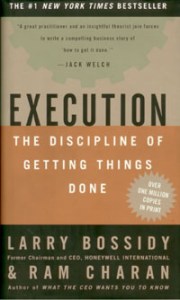
Execution: The Discipline of Getting Things Done by Larry Bossidy and Ram Charan
Execution is about linking people, strategy, and operations. “Execution is not just tactics—it is a discipline and a system. It has to be built into a company’s strategy, its goals, and its culture. And the leader of the organization must be deeply engaged in it.” A significant portion of this book deals with managing people, including recognizing and developing future leaders.
Good to Great: Why Some Companies Make the Leap… and Others Don’t by Jim Collins
Jim Collins previously co-authored Built to Last, which studied common attributes of enduringly great companies. Good to Great studies companies which made a transition to greatness: 15 years of lagging stock performance followed by 15 years of cumulative stock returns 3 times the overall market.
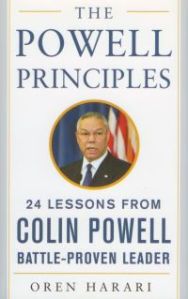
The Powell Principles: 24 Lessons From Battle-Proven Leader Colin Powell
by Oren Harari
Business professor Oren Harari (1949-2010) encapsulated Colin Powell’s (1937-2021) lessons of leadership in 24 three-page chapters. “The Powell Principles constitute a clear, strategic, philosophical, value-based, and ethical blueprint. The blueprint guides Powell, but the blueprint has enormous flexibility and opportunism built into it.” The 24 lessons are:
It Worked For Me: In Life and Leadership by Colin Powell with Tony Koltz
Few people have the range of experiences of Colin Powell (1937-2021): from janitor of a Pepsi bottler to National Security Advisor, from Chairman of the Joint Chiefs to Secretary of State. In It Worked For Me he shares stories in a conversational style, many of which include a leadership lesson. And yes, he also includes a chapter on his infamous United Nation presentation, arguably the low point of his career.
It was interesting to hear what it was like to work with Ronald Reagan. In the chapter called Squirrels, Reagan seemed detached from the dilemma Powell was explaining to him (he seemed more interested in the squirrels outside his window), but upon reflection Powell figured out that Reagan wanted his subordinates to make their own decisions. In a separate incident involving a confrontation between U.S. and Iranian naval forces, Reagan was very decisive in his presidential decision when the matter required his approval.


 The Key Point