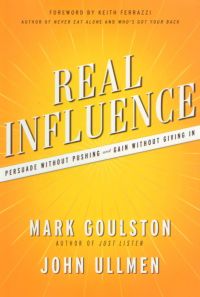
Real Influence

real-influence


Real Influence – Persuade Without Pushing and Gain Without Giving In
by Mark Goulston and John Ullmen

This book is about the “connected influence model.”  Disconnected influence is about “getting what I want.”  It’s adversarial and focused on the short-term.  Connected influence is oriented around understanding the other party’s situation and “viewing your current actions as a springboard for future relationships, reputation, and results… In the real world, interactions are never isolated. Anything you do might affect your relationships, as well as your reputation, for a long time to come.”

Continue reading “Real Influence”

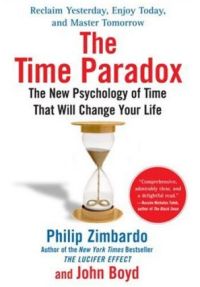
The Time Paradox

the-time-paradox


The Time Paradox: The New Psychology of Time That Will Change Your Life
by Philip Zimbardo and John Boyd

This book is about time perspective.  The authors say that time-balanced people are “more successful in work and career and happier in relationships with family and friends… [and] live more fully in the here and now. Such a person is able to tie the past and the future to the present in meaningful continuity.”

Continue reading “The Time Paradox”

Learned Optimism

learned-optimism


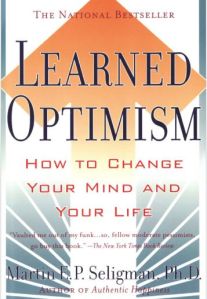
Learned Optimism
by Martin E. P. Seligman

“Explanatory style” is the way we think about life’s events.  We can have either an optimistic or a pessimistic explanatory style.  Seligman’s research found that changing pessimism into optimism relieves depression.

A pessimistic explanatory style frames negative events in terms that are personal, permanent, and pervasive—I’m a failure, This always happens to me, This screws up my whole life.  Seligman offers the ABCDE technique to reframe explanatory style. The letters stand for adversity, belief, consequences, dispute (your negative beliefs), and energize.

Continue reading “Learned Optimism”

The Emotional Intelligence Quick Book

the-emotional-intelligence-quick-book


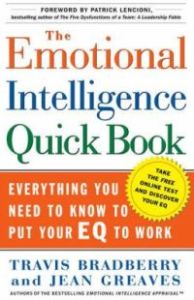
The Emotional Intelligence Quick Book
by Travis Bradberry and Jean Greaves

The Emotional Intelligence Quick Book is a concise and easy to absorb introduction to the topic. “Emotional intelligence is the product of two main skills: personal and social competence. Personal competence focuses more on you as an individual, and is divided into self-awareness and self-management. Social competence focuses more on how you behave with other people, and is divided into social awareness and relationship management.” The authors credit Daniel Goleman with introducing the four-skill model in the book Primal Leadership.

Continue reading “The Emotional Intelligence Quick Book”