Systems Thinking for Business and Management


Systems Thinking for Business and Management
by Umit S. Bititci and Agnessa Spanellis

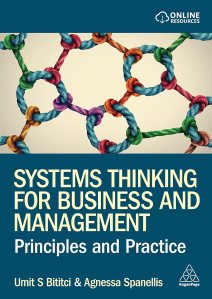
Organizations, markets, and economies are systems, analogous to ecosystems. This clearly-written, 278-page textbook written by professors from Edinburgh Business School and the University of Edinburgh introduces key concepts in systems thinking, including methods for modeling them and analyzing their behavior.

It is said that the purpose of higher education is to teach students to think. In this spirit, I believe future decisionmakers and policymakers would be well served by a course in systems thinking. I think every business school should include this subject in its curriculum.

“To understand the real value of systems thinking, we need to recognize that nothing in this world exists in isolation and that everything is connected to something else. Everything is affected by something and potentially affects something else. With systems thinking, one can begin to understand, explain, and predict why complex systems such as organizations, people, and societies behave the way they do.”

Continue reading “Systems Thinking for Business and Management”
The Crux: How Leaders Become Strategists


The Crux: How Leaders Become Strategists
by Richard P. Rumelt

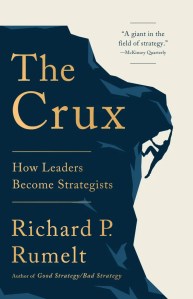
In rock climbing “there are many mountains and boulders, each promising a different mixture of difficulty and reward… Climbers call such boulders ‘problems’ and describe the toughest parts as ‘the crux’… The first climber said that he chooses the climb having the greatest expected reward and whose crux he believes he can solve.”

Rumelt observes that strategists do the same. “Whether facing problems or opportunities, they focused on the way forward promising the greatest achievable progress—the path whose crux was judged to be solvable.”

Continue reading “The Crux: How Leaders Become Strategists”

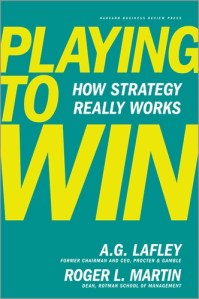
Playing to Win: How Strategy Really Works


Playing to Win: How Strategy Really Works
by A.G. Lafley and Roger L. Martin

Former P&G chairman A.G. Lafley and former dean of University of Toronto’s Rotman School of Management Roger Martin explain, “in our terms, a strategy is a coordinated and integrated set of five choices: a winning aspiration, where to play, how to win, core capabilities, and management systems.” 

Continue reading “Playing to Win: How Strategy Really Works”

2021 Castlin Manifesto: Strategy in Polemy


2021 Castlin Manifesto: Strategy in Polemy
by JP Castlin

JP Castlin is a strategic thinker and consultant based in Sweden. Major themes in his Manifesto are complexity and emergent strategy. In the chapter on marketing, he is not shy about challenging prominent figures. The paper is 71 pages including an impressive 9-page bibliography with academic papers, articles, and books cited throughout the text.

Continue reading “2021 Castlin Manifesto: Strategy in Polemy”

Only the Paranoid Survive


Only the Paranoid Survive: How to Exploit the Crisis Points that Challenge Every Company
by Andrew S. Grove (1936-2016)

“A strategic inflection point is a time in the life of a business when its fundamentals are about to change. The change can mean an opportunity to rise to new heights. But it may just as likely signal the beginning of the end.”

Andy Grove (1936-2016), former chairman of Intel, describes six categories of 10X changes: competition, technology, customers, suppliers, complementors, and regulation. “When a Wal-Mart moves into a small town, the environment changes for every retailer in that town. A 10X factor has arrived. When the technology for sound in movies became popular, every silent actor and actress personally experienced the 10X factor of technological change. When container shipping revolutionized sea transportation, a 10X factor reordered the major ports around the world.”

Continue reading “Only the Paranoid Survive”

Stragility

stragility


Stragility: Excelling at Strategic Changes
by Ellen R. Auster and Lisa Hillenbrand

“Tragically, more than 70 percent of change efforts fail and in most cases the organization emerges weaker—exhausted, demoralized, and confused.”  To combat this, authors Auster and Hillenbrand have coined the portmanteau word “Stragility” to represent a skill set for “strategic, agile, people-powered change… Without ongoing agility, even good strategies will fail.”

Continue reading “Stragility”

Marketing Above the Noise

marketing-above-the-noise


Marketing Above the Noise: Achieve Strategic Advantage with Marketing that Matters
by Linda J. Popky

Grounded in fundamentals and guided by strategic objectives, Linda Popky puts the hype around social media and big data in perspective. “It’s time to move the discussion away from today’s latest hot marketing tools and tactics to what really counts: convincing customers to trust you with their business—not just once, but time and time again.”

Continue reading “Marketing Above the Noise”

The Five Most Important Questions You Will Ever Ask About Your Organization

the-five-most-important-questions


The Five Most Important Questions You Will Ever Ask About Your Organization
by Peter F. Drucker (1909-2005) et al

This book offers a strategic planning framework for nonprofit organizations. It can help board members set the direction by asking five questions.

What is our mission? The mission must reflect opportunities, competence, and commitment. Drucker cautions, “Never subordinate the mission in order to get money. If there are opportunities that threaten the integrity of the organization, you must say no.”

Continue reading “The Five Most Important Questions You Will Ever Ask About Your Organization”

Execution

execution-the-discipline-of-getting-things-done


Execution: The Discipline of Getting Things Done
by Larry Bossidy and Ram Charan

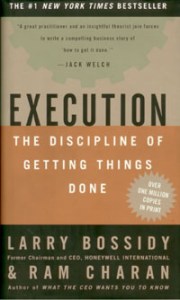
Execution is about linking people, strategy, and operations. “Execution is not just tactics—it is a discipline and a system. It has to be built into a company’s strategy, its goals, and its culture. And the leader of the organization must be deeply engaged in it.” A significant portion of this book deals with managing people, including recognizing and developing future leaders.

Continue reading “Execution”