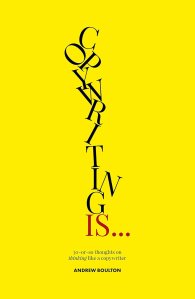
Copywriting Is… 30-or-So Thoughts on Thinking Like a Copywriter
by Andrew Boulton
Andrew Boulton is an advertising copywriter, lecturer, and columnist from the U.K. He is clearly a man of letters, but apparently not a numbers guy: this book has neither chapter numbers nor page numbers. I counted 36 chapters and 220 pages in which Boulton reflects on the creative practice of copywriting. Here are some highlights.
“We are in the business of purposeful attention—getting noticed, of course, but then doing something meaningful with that attention…The very nature of the job is to be, not the loudest voice, but the most compelling—to say something conventional and familiar in a way that feels extraordinary and unavoidable.”
Limitations. “Our craft is about… the ability to tell entire stories to people who have neither the time nor the interest to hear them. And five startling words will do a far better job of arresting your audience than two hundred words of any standard.”
Immediacy. “There is a temptation secreted deep in a copywriter’s bones toward the exposition—to set the scene, to plug every gap and anticipate every question. It is as understandable as it is fatal, and is easily the most well-intentioned way to bore your audience to death.”
Quiet. Boulton is interested in “redefining what a productive working state looks like for a creative… In particular, I’m fascinated by the conditions that govern the most intangible part of our work: the creative state… allowing your mind to wander.”
“In a great book on the mind’s strange workings called Auto Pilot, Andrew Smart perfectly describes how people, and entire business cultures, misunderstand the habits and process of creative work: ‘We categorize adults who sit in contemplative moods as flaky, spacey or lazy. But for your brain to do its best work, you need to be idle.’” See also Slack: Getting Past Burnout, Busywork, and the Myth of Total Efficiency.
Waiting. “Waiting is fundamental to the copywriting process. Waiting for a good idea to come. Waiting for a good idea to reveal itself as a bad idea in a clever disguise. There is a strange alchemy in copywriting that only takes place when a line sits for a while in a closed drawer.” John Cleese makes a similar point in his book Creativity about allowing time for your subconscious to work on ideas.
“But regardless of how tight the timings, how stretched the studio or how shouty the client, copywriting can rarely be done both very thoughtfully and very quickly.”
Effortless. “What gives most ads and marketing messages away is the sour, trembling panic of their words. The ferocious need to be noticed gushes from these headlines like hot sick from a bin pigeon. They are obvious, insincere, intrusive, and invariably, ignored.”
“While most advertising language is designed to shove its way into your line of sight, effortless copy invites your eyes to come closer. The first is a business of clamor and obstacles, but the second is a tantalizing orbit of naked human curiosity.”
“A dead giveaway for a failed bid at effortless writing is the piss-stink of the thesaurus on your page.”
Having the confidence to get it wrong. “It is not ok to make mistakes as a copywriter—it is essential.”
“The likelihood of you arriving at the perfect solution at the first time of asking is beyond slim. The tricky part is not letting these missteps feel like failures but rather necessary steps to a better solution.”
“The key to effective copywriting is to remember that writing and editing are separate processes. They cannot overlap… Today’s you is in charge only of splattering the walls with imagination. Tomorrow you is the one who has to tidy it up.”
Rhythm. “In Stephen Fox’s classic exploration of advertising, The Mirror Makers, he talks about copywriters learning ‘to write for the ear’. In Fox’s day this was due to the emergence of radio advertising as the dominant form, and he describes how ‘simple, conventional language, repetitive and over punctuated, with short sentences and few pronouns’ was the most effective way to arrest and engage a listener.”
“And, although radio is just one of many mediums for our words these days, what Fox describes is a fundamental principle of everything you write—rhythm… Flowing, rhythmic writing is more pleasurable to read and therefore more likely to be read and remembered.”
Choosing your words ruthlessly. ”In copywriting, every word must be chosen to do a job that no other word can do.”
Big Words. “For a copywriting point of view, writing with the Hemingway technique—or at least the common understanding of it—will almost certainly produce better ads than mimicking a writer who sacrifices immediacy and familiarity for something longer, prettier and not especially more useful.”
“There is an exercise drummed into many of us that demands us to replace every word we write with something shorter, simpler, and more familiar. And this is excellent advice—providing we retain the ability to discern when longer, stranger, and more surprising words can add value to what we are trying to say.”
Zombie words. “Zombie words are a common toxin in modern copywriting. Trapped in our own habits and comforts, copywriters often don’t notice when a word that used to mean something now feels tired and implausible… Words like ‘Amazing’, ‘Genuine’, and ‘Discover’ are the most frequent and formidable victims.
Control. “Words can be steered, even as they tumble out of you, but sometimes it’s better to submit to the diversions they want to take.”
Silly. “Creativity, I believe, requires play. It demands an atmosphere of fearless nonsense—permission to express your oddest observations without hesitation or filtration.”
The perils of certainty. “Copywriting should not follow the path, but scale the cliff. It may take more time and you may accumulate more bruises, but that’s the price for forging a route rather than following one… You may not arrive immediately at the best answer, but at least you will be further away from the safe, and therefore forgettable, territory,”
Originality. “The simple, the familiar and the everyday are potent stores of imaginative potential. It’s just a matter of seeing the things we see all the time in the way we never have before.”
Meaning. “It is that link, that fundamental connection between suggester and receiver that will define the quality and effectiveness of your copy far more than the elegance of your phrasing.”
“By reserving meaning for the people who read the ad rather than squandering it all on the people who paid for it, you can elevate your copy from elegantly immemorable to persuasively beautiful.”
Complicated. “In what we may conservatively describe as one of the most important books on advertising ever written, The Theory and Practice of Advertising [1904], psychologist Walter Dill Scott has this to say about how your audience may respond to ads that ask them to do something… ‘We are perfectly willing to obey as long as we are unconscious of the fact. But let anyone see that he has been commanded and his attitude is changed; he becomes obstinate instead of pliant.’”
“Dill also notes that ‘it is but rarely that the ordinary person weighs all the evidence before he acts. After he has acted, he may think over the motives which might have prompted him, and may even deceive himself into thinking that he acted because he weighed the evidence, when, in fact, no such motives entered his mind at the time of action.’”
Criticism. “Anyone entering the business of paid creativity has to be able to strangle the instinct to flee from, or fight against, criticism… Because feedback is pretty much the only gift of value this industry can provide.”
Finishing. “Michael Baldwin’s advice on finishing a story is ‘to get out of it quickly’. Copywriting can be viewed the same way. Finishing what you’re writing cannot feel like a drawn out, tearful farewell on a picturesque train platform. It is a leap from a window, possibly without taking the time to open it first.”
“The most satisfying and effective way to step out of your copy is through a line that feels beautifully final. As if writing anything beyond that point would feel, at best, unnecessary and, at worst, destructive.”
Boulton, Andrew. 2021. Copywriting Is… 30-or-So Thoughts on Thinking Like a Copywriter. Gasp! Books. Buy from Amazon.com
Disclosure: As an Amazon Associate I earn from qualifying purchases. Note: I have modified the spelling to appease my American spellchecker.
Books mentioned:
- Hey Whipple, Squeeze This: The Classic Guide to Creating Great Advertising by Luke Sullivan (2022)
- Daily Rituals: How Great Minds Make Time, Find Inspiration, and Get to Work by Mason Curry (2020)
- Brief Lessons in Creativity by Frances Ambler (2019)
- The Art of the Click: How to Harness the Power of Direct-Response Copywriting and Make More Sales by Glenn Fisher (2018)
- Devotion (Why I Write) by Patti Smith (2018)
- Draft No. 4: On the Writing Process by John McPhee (2018)
- The Myth Gap: What Happens When Evidence and Arguments Aren’t Enough? by Alex Evans (2018)
- Autopilot: The Art & Science of Doing Nothing by Andrew Smart (2017)
- On Tyranny : Twenty Lessons from the Twentieth Century by Timothy Snyder (2017)
- How to Have Great Ideas: A Guide to Creative Thinking by John Ingledew (2016)
- Zen in the Art of Writing by Ray Bradbury (2015)
- The Organized Mind: Thinking Straight in the Age of Information Overload by Daniel Levitan (2015)
- Into the Woods: A Five-Act Journey Into Story by John Yorke (2015)
- Read Me: 10 Lessons for Writing Great Copy by Gyles Lingwood and Roger Horberry (2014)
- The Art of Mistakes: Unexpected Painting Techniques and the Practice of Creative Thinking by Melanie Rothschild (2014)
- Do Purpose: Why Brands with a Purpose Do Better and Matter More by David Hieatt (2014)
- Think by Simon Blackburn (2013)
- The Writing Life by Annie Dillard (2013)
- Little Bets: How Breakthrough Ideas Emerge from Small Discoveries by Peter Sims (2013)
- Everyone is Creative by Michael Atavar (2013)
- The Art of Speeches and Presentations: The Secrets of Making People Remember What You Say by Philip Collins (2012)
- Copywriting: Successful Writing for Design, Advertising and Marketing by Mark Shaw (2012)
- Being Wrong: Adventures in the Margin of Error by Kathryn Schulz (2011)
- How to Live: Or A Life of Montaigne in One Question and Twenty Attempts at an Answer by Sarah Bakewell (2011)
- How to be a Graphic Designer Without Losing Your Soul by Adrian Shaughnessy (2010)
- The Decisive Moment by Jonah Lehrer (2009)
- Simplexity: Why Simple Things Become Complex (and How Complex Things Can Be Made Simple) by Jeffrey Kluger (2008)
- How Novels Work by John Mullan (2008)
- The Laws of Simplicity by John Maeda (2006)
- The Creative Brain: The Science of Genius by Nancy C. Andreasen (2006)
- Status Anxiety by Alain De Botton (2005)
- Radical Honesty: How to Transform Your Life by Telling the Truth by Brad Blanton (2005)
- In Praise of Slowness: Challenging the Cult of Speed by Carl Honoré (2005)
- On Creativity by David Bohm (2004)
- Language in Danger by Andrew Dalby (2003)
- On Writing: A Memoir of the Craft by Stephen King (2001)
- How We Write: Writing as Creative Design by Mike Sharples (1998)
- The King’s English: A Guide to Modern Usage by Kingsley Amis (1998)
- The Mirror Makers: A History of American Advertising and Its Creators by Stephen Fox (1997)
- Writing to Sell by Scott Meredith (1996)
- Life Without Armour by Alan Sillitoe (1995)
- Bird by Bird: Some Instructions on Writing and Life by Anne Lamott (1995)
- Show Don’t Tell: A Writer’s Guide by William Noble (1993)
- The Way to Write Short Stories by Michael Baldwin (1986)
- Becoming a Writer by Dorothea Brande (1981)
- The Use of Lateral Thinking by Edward de Bono (1971)
- Wake Up Your Mind by Alex Osborn (1964)
- The Theory and Practice of Advertising by Walter Dill Scott (1904)
Discover more from The Key Point
Subscribe to get the latest posts sent to your email.

 The Key Point