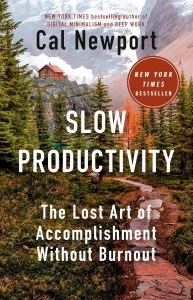
Slow Productivity: The Lost Art of Accomplishment Without Burnout
by Cal Newport
Slow Productivity is “a philosophy for organizing knowledge work efforts in a sustainable and meaningful manner, based on the following three principles: 1. Do fewer things; 2. Work at a natural pace; 3. Obsess over quality.”
Newport defines knowledge work as “the economic activity in which knowledge is transformed into an artifact with market value through the application of cognitive effort.”
“Concrete productivity metrics of the type that shaped the industrial sector will never properly fit the more amorphous knowledge work setting… In knowledge work… individuals are often wrangling complicated and constantly shifting workloads… In this setting, there’s no clear, single output to track.”
“Most of us don’t do just one thing… The sine qua non of knowledge work is instead the juggling of many different objectives.”
“Slow productivity… sidesteps the hurry and ever-expanding workloads generated by pseudo-productivity.”
“To embrace slow productivity… is to reorient your work to be a source of meaning instead of overwhelm, while still maintaining the ability to produce valuable output.”
OVERHEAD TAX
“In knowledge work, when you agree to a new commitment, be it a minor task or a large project, it brings with it a certain amount of ongoing administrative overhead: back-and-forth email threads needed to gather information, for example, or meetings scheduled to synchronize with your collaborators. This overhead tax activates as soon as you take on a new responsibility. As your to-do list grows, so does the total amount of overhead tax you’re paying. Because the number of hours in the day is fixed, these administrative chores will take more time away from your core work, slowing down the rate at which these objectives are accomplished.”
“This feedback loop can quickly spiral out of control, pushing your workload higher and higher until you find yourself losing your entire day to overhead activities: meeting after meeting conducted against a background hum of unceasing email and chat. Eventually the only solution becomes to push actual work into ad hoc sessions added after hours—in the evenings and early mornings, or over the weekend—in a desperate attempt to avoid a full collapse of all useful output. You’re as busy as you’ve ever been, and yet hardly get anything done.”
“Small tasks, in sufficient quantity, can act like productivity termites, destabilizing the whole foundation of what you’re trying to build. It’s worth going to great lengths to tame them.”
DO FEWER THINGS
“It’s easy to mistake ‘do fewer things’ as a request to ‘accomplish fewer things.’ But this understanding gets things exactly backward… Doing fewer things makes us better at our jobs; not only psychologically, but also economically and creatively. Focusing intensely on a small number of tasks, waiting to finish each before bringing on something new, is objectively a much better way to use our brains to produce valuable output.”
“Real progress accrues, while anxiety is subdued.”
PULL WORKFLOWS
“I’ve become convinced in recent years that pull workflows are a powerful tool to avoid overload in the knowledge work setting.”
Newport presents the case of Broad Institute switching their gene sequencing process from a push model to a pull model. “Shifting to a pull-based operation made backlogs impossible: the pace of the pipeline would adapt to whatever stage was running slowest. The transparency, in turn, helped the workers identify places where the system was out of balance. ‘A perpetually full pull box means either the downstream task is moving too slowly or the upstream one is moving too quickly,’ write the authors.”
“The improvements yielded by this approach were quantifiable. The usage rate of the institute’s expensive sequencing machines more than doubled, while the average time to process each sample fell by more than 85 percent.”
Following this success, the IT development group adopted pull-based workflow. “An engineer could only pull in new work if they had sufficient spare capacity, a status that was easy to determine by surveying how often their name came up on the wall. Overload became impossible.”
“The total number of projects underway in the technology development group fell by almost 50 percent, while the rate at which projects were completed notably increased.”
“When a new project is pushed toward you, place it in the holding-pen section of your list. There is no bound to the size of your holding tank… The active position of the list, by contrast, should be limited to three projects at most. When scheduling your time, you should focus your attention only on the projects on your active list. When you complete one of these projects, you can remove it from your list. This leaves open a free slot that you can fill by pulling in a new project from the holding tank.”
“Recall, when I say ‘projects,’ I mean something substantial enough to require multiple sessions to complete.”
WORK AT A NATURAL PACE
“Don’t rush your most important work. Allow it instead to unfold along a sustainable timeline, with variations in intensity, in settings conducive to brilliance.”
“Working with unceasing intensity is artificial and unsustainable… A more natural, varied pace to work is the foundation of true productivity in the long term.”
“A key tenet of slow productivity is that grand achievement is built on the steady accumulation of modest results over time. This path is long… When it comes to our understanding of productivity, timescale matters.”
SEASONAL APPROACH
“Schedule slow seasons… For this idea to work, you should, if possible, arrange for major projects to wrap up before your simulated offseason begins, and wait to initiate major new projects until after it ends.”
Basecamp cofounder and CEO Jason Fried wrote a book titled It Doesn’t Have to Be Crazy at Work. “One of Basecamp’s more striking policies is the consolidation of work into ‘cycles.’ Each such cycle lasts from six to eight weeks. During those weeks, teams focus on clear and urgent goals. Crucially, each cycle is then followed by a two-week ‘cool-down’ period in which employees can recharge while fixing small issues and deciding what to tackle next.”
“This strategy embraces the natural seasonality of human effort. If Basecamp demanded that employees work with focus and urgency without break, their overall intensity would drop as exhaustion set in. When they instead regularly take time off between cycles, the work completed within the cycles achieves a higher level of quality… It’s also more sustainable for the employees involved.”
OBSESS OVER QUALITY
“The advantage of doing fewer things… is about more than just increasing the raw number of hours dedicated to useful activity; the quality of these hours also increases. When you approach a project without the hurried need to tend to many barely contained fires, you enjoy a more expansive sense of experimentation and possibility. Maybe you’re able to identify a clever new business strategy, devise an elegant algorithm, or come up with a bold advertising campaign that would have eluded you in a more fragmented state of attention… Our brains work better when we’re not rushing.”
“Obsessing over quality often demands that you slow down, as the focus required to get better is simply not compatible with busyness.” See also Slack: Getting Past Burnout, Busywork, and the Myth of Total Efficiency.
RITUALS
“The more striking and notable the behaviors, the better chance they have of inducing useful changes. Mary Oliver’s long walks through the woods provide a good case study… The ritual of the long walk was as necessary as its setting to spark her creativity.”
CONCLUSION
“Slowing down isn’t about protesting work. It’s instead about finding a better way to do it.”
“What’s needed is more intentional thinking about what we mean by ‘productivity’ in the knowledge sector—seeking ideas that start from the premise that these efforts must be sustainable and engaging for the actual humans doing the work.”
“Slow productivity, more than anything else, is a plea to step back from the frenzied activity of the daily grind. It’s not that these efforts are arbitrary: our anxious days include tasks and appointments that really do need to get done. But once you realize… that this exhausted scrambling is often orthogonal to the activities that matter, your perspective changes. A slow approach to work is not only feasible, but is likely superior to the ad hoc pseudo-productivity that dictates the professional lives of so many today.”
Newport, Cal. Slow Productivity: The Lost Art of Accomplishment Without Burnout. New York: Portfolio/Penguin, 2024. Buy from Amazon.com
Disclosure: As an Amazon Associate I earn from qualifying purchases.
Selected books mentioned:
- Free Time: Lose the Busywork, Love Your Business by Jenny Blake (2022)
- Laziness Does Not Exist by Devon Price (2022)
- Cinema Speculation by Quentin Tarantino (2022)
- Four Thousand Weeks: Time Management for Mortals by Oliver Burkeman (2021)
- Can’t Even: How Millennials Became the Burnout Generation by Anne Helen Petersen (2020)
- Do Nothing: How to Break Away from Overworking, Overdoing, and Underliving by Celeste Headlee (2020)
- Company Of One: Why Staying Small Is the Next Big Thing for Business by Paul Jarvis (2019)
- It Doesn’t Have to Be Crazy at Work by Jason Fried and David Heinemeier Hansson (2018)
- Draft No. 4: On the Writing Process by John McPhee (2018)
- Overwhelmed: Work, Love, and Play When No One Has the Time by Brigid Schulte (2014)
- Daily Rituals: How Artists Work by Mason Currey (2013)
- Book of Ages: The Life and Opinions of Jane Franklin by Jill Lepore (2013)
- Desperate Networks by Bill Carter (2006)
- Thinking for a Living: How to Get Better Performance Results from Knowledge Workers by Tom Davenport (2005)
- In Praise of Slowness: Challenging the Cult of Speed by Carl Honoré (2005)
- The Scientists: A History of Science Told Through the Lives of Its Greatest Inventors by John Gribbin (2004)
- The Great Movies by Roger Ebert (2002)
- Bird by Bird: Some Instructions on Writing and Life by Anne Lamott (1994)
- The Effective Executive by Peter Drucker (originally published in 1967)
Other Books by Cal Newport:
- A World Without Email: Reimagining Work in an Age of Communication Overload (2021)
- Digital Minimanlism: Choosing a Focused Life in a Noisy World (2019)
- Deep Work: Rules for Focused Success in a Distracted World (2016)
- So Good They Can’t Ignore You: Why Skills Trump Passion in the Quest for Work You Love (2012)
- How to Be a High School Superstar: A Revolutionary Plan to Get into College by Standing Out (Without Burning Out) (2010)
- How to Become a Straight-A Student: The Unconventional Strategies Real College Students Use to Score High While Studying Less (2006)
- How to Win at College: Surprising Secrets for Success from the Country’s Top Students (2005)
Discover more from The Key Point
Subscribe to get the latest posts sent to your email.

 The Key Point
One thought on “Slow Productivity: The Lost Art of Accomplishment Without Burnout”
Comments are closed.