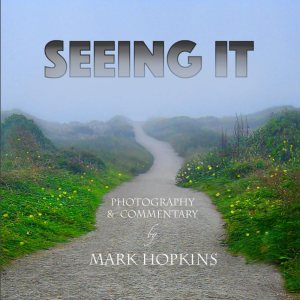
Seeing It: Photography and Commentary
by Mark Hopkins (1932-2026)
As art professor Kit White has written, “Observation lies at the heart of the art process.” Learning to see is a fundamental skill taught in observational drawing classes. It’s also fundamental to fine art photography, as Mark Hopkins explains. The title Seeing It refers to being curious and looking beyond the obvious.
“Cameras do not see; that is the task of their owners. And seeing is what this book is about. In particular, it is about seeing opportunities to create worthy photographic images. It is meant to be inspirational, to show how one camera owner’s concentration on visual awareness has created a collection of photographs whose images others might have walked right past.”
“It is about seeing what you see. If by the end of the book you have a better appreciation of what I mean by that, then I will have fulfilled my goal.”
“The photographs in this book are the result of my curiosity about this world… Curiosity kicks in at waking and outlasts the day, anywhere that one is.”
For his first gallery exhibition, Hopkins was asked to prepare an artist’s statement. The essence of his submission was, “Visual art must stand on its own without the crutch of an accompanying verbal explanation. Suffice it, then, that my photographs are my statement.”
The curator was not amused. “No, no, no… You have to define for viewers your objectives and intentions.”
“But the message I was hearing was not lost on me: viewers of art want to be told what they are seeing and why they are being shown it. They want guidance. And reassurance. And they appreciate the effort when forthcoming.”
“So, while planning my last exhibition, I wondered: what if I help each photograph speak for itself? … The idea was born, and each photograph was accompanied by a label presenting a 60-90 word caption. The result was beyond my expectations.”
“Now, about that artist’s statement. I gave it many more tries… They all ended up discards. Then I came upon a lovely poem by a contemporary American poet and discovered in it lines that with just 12 words said exactly what I had struggled so long to write. The poem is called Sometimes. And these four lines from it, with endless thanks to the genius of Mary Oliver, have been my credo ever since.
Instructions for living a life:
Pay attention.
Be astonished.
Tell about it.”
As an aside, it is a coincidence that Mary Oliver was also mentioned in the book I read just prior to this one. See the Rituals header in the review of Slow Productivity.
Seeing It contains 160 photos, including many from the author’s travel to 40 countries. But those that stood out to me are mainly reflections, close-ups, and creatures. Here are some samples along with their accompanying descriptions.
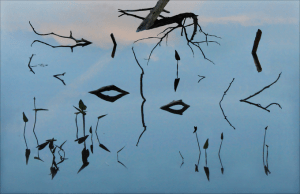
“Sometimes the summertime water level of one of my favorite Adirondack lakes will drop nearly a foot owing to abnormal weather conditions. It is then that bizarre shapes emerge and, on placid days, silhouette themselves starkly against the reflective lake surface. This photo so reminded me of the work of a great Catalan surrealist painter that I titled it Remembering Joan Miró.”
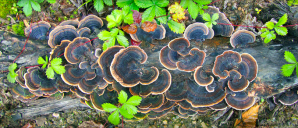
“What a trailside treat: a bloom of turkey mushrooms adorning a patch of wild strawberry. When I shared this image with a photographer friend a few days later, he said, ‘I walked past that very same spot with my camera just yesterday but must have missed it; I guess the image didn’t speak to me,’ prompting me to reply, ‘Of course it spoke to you. It’s just that your eyes weren’t listening.’”
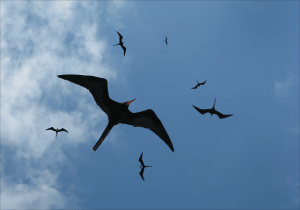
While this photo of circling birds stands on its own, the description adds some intriguing context. “Lightweight and with enormous wingspans, magnificent frigatebirds spend most of their lives circling at sea, watching for feeding opportunities. They never swim, swooping down and snatching prey to consume it in the air. Scientists label them kleptoparasites, reflecting their preference for stealing fish from smaller seabirds. Graceful flyers, they have been known to remain airborne for weeks without landing, sleeping as they soar.”
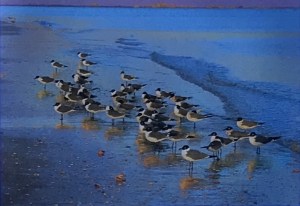
This photo fascinates me because it looks like a painting. “Studying art in my youth, I wondered why Vincent Van Gogh raved so about the light in southern France. Isn’t light just light? Adventures with a camera helped me grasp what he so clearly understood. This was taken in the moments before a Florida sundown, with the gaggle of laughing gulls gathered for the night, imbued with the soft hues of evening and framed by the urban skyline above.”
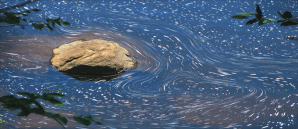
“On a stretch of the Cedar River shortly before it conjoins the south-flowing Hudson in the central Adirondack forest, rambunctious rapids churn the water into froth and foam. Just below them is a quiet pool where twisting traces of that turmoil circle endlessly, gently splitting their flow around a submerged rock. Year after year I returned to this remote spot and found the scene enduring without change.”
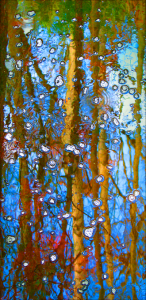
“The forests and fields behind our home are generous with the visual surprises… Today, it was fall colors rendered asunder by the reflections of a local pond, the scene punctuated by bubbly white patches of foam sent wandering by the breeze. New England’s changing seasons may be challenging, but they seldom disappoint.”
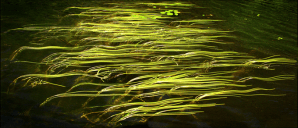
“I always smile to recall how this photo came about. We were cruising along the lake shore returning from fishing when I spotted this patch of eelgrass and shouted, ‘Stop!’ As I jumped onto the skiff’s seat with my camera pointed downward, my partner, whose sole use for photography was posing with trophy fish, peered at me incredulously from the stern and growled: ‘What in hell are you taking a picture of?’ Well, the subject of my madness turned out to be one of my favorites, thus justifying (I guess) my momentary dementia.”
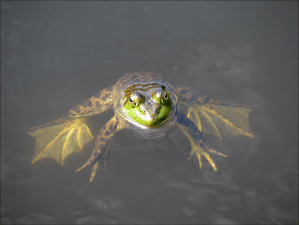
“He reigned over a tiny, hidden pond in a Berkshire forest, a domain where all things edible gave him a wide berth. Being edible himself, he had mastered both vigilance and caution. I was photographing the pond when he surfaced from nowhere, taking my measure. I snapped this picture, glanced down to adjust for another one, looked up… and he was gone. One cannot be too careful where humans are afoot.”
Hopkins is in good company with his enthusiasm for “seeing what you see.” Leonardo da Vinci called it saper vedere—Italian for “knowing how to see.” Aside from its application in visual art, we could apply this idea more broadly, along the lines of what Howard Marks calls second-level thinking.
Hopkins, Mark. Seeing It: Photography and Commentary. Concord, Massachusetts, s.p., 2023. Buy from Amazon.com
Disclosure: As an Amazon Associate I earn from qualifying purchases.
Discover more from The Key Point
Subscribe to get the latest posts sent to your email.

 The Key Point