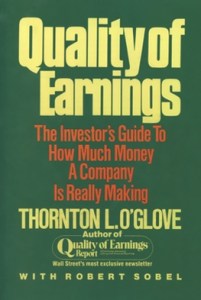
Quality of Earnings: The Investor’s Guide to How Much Money a Company is Really Making
by Thornton L. O’Glove
Thornton “Ted” O’Glove published the Quality of Earnings Report from 1969 through the 1980s, identifying red flags in financial statements for institutional investors. He wrote this book in 1987 to share his due diligence methods with individual investors.
“Often the stock can go north while the quality of earnings goes south, and vice versa.”
For example, the author provides examples of how reported net earnings growth can mask a decline in operating income — or even an operating loss.
“In what’s ahead you will read and learn to analyze several key documents, such as the 10-K, the 10-Q, and the proxy statement, all of which public corporations have to prepare and file with the Securities and Exchange Commission. Between the lines of these bland, legalistic, and too often overlooked filings are to be found stores of information.”
O’Glove states that the chapter on accounts receivable and inventory is the most important.
“Examples abound of how considerable increases in inventory and/or accounts receivable can forecast downward earnings and surprises. This is especially true in those industries subject to rapid changes in products and taste. Expect to find them in companies dealing with high fashion, seasonal goods, and especially high tech. No investor seriously involved with stocks in these industries can afford to ignore accounts receivable and inventories.”
Accounts Receivable
Accounts receivable is money owed by customers. “Conventional accounts receivable analysis involves running a ratio called days in accounts receivable. This ratio, which indicates receivable turnover, can illustrate the granting of more liberal credit terms and/or difficulty in obtaining payment from customers.”
“The difficulty comes when accounts receivable rise substantially over what they had been in the same reporting period during previous years… Whatever the cause, major increases in accounts receivable is a danger sign.”
In the case of Commodore (CBU) in 1983, “the company’s sales advanced by 102.6%, while accounts receivable rose by only 5.5%, an indication of surge in demand… But look what happened next… Indeed, in the first fiscal quarter ended September 30, 1984, CBU’s accounts receivable rose twice as fast as the company’s sales. This was a clear sign that CBU’s retailers were moving out its products at a slower than usual pace, while the company was shoveling out its old products in what looked like an attempt to dump them on the market in advance of new introductions.”
Inventory
“Obviously, higher trending inventories in relation to sales can lead to inventory markdowns, write-offs, etc. In addition, it is important to note that an excess of inventories, time and time again, is a good indicator of future slowdown in production. Within this context, it is important to analyze the components of inventories. If the finished goods segment of the inventories is rising much more rapidly than raw materials and/or work-in-progress, it is likely that the company has an abundance of finished goods and will have to slow down production. Akin to accounts receivable, bulging inventories are costly to carry.”
“The specific amount of inventory is not particularly meaningful in and by itself. What matters is comparisons with the same reporting period in previous years.”
TIE/Communications. “I observed that in 1983 the firm’s inventories had advanced at a considerably more rapid rate than its sales. The actual figures were a 157% increase in inventory versus an 89.9% advance in sales. This was a red flag, a sign the stock should be avoided.”
“Sometimes a phenomenon exists which I call ‘positive inventory divergence,’ meaning simply the reverse of some of the illustrations described thus far, which were of negative inventory divergences. The positive version transpires when the raw materials component of inventories is advancing much more rapidly than the work-in-process and finished goods components. Imagine what this might mean. The company receives many new orders, and management realizes that an inventories buildup is required. So it simultaneously ships products from its finished goods inventory (which declines) while ordering raw materials in larger amounts (so this component of inventories is enlarged.) — This, of course, is good news, and should trigger the bullish impulses in your psyche.”
“In order to conduct a thorough examination of a company’s quarterly statement, it may be necessary to secure the Form 10-Q report it files with the SEC. These contain balance sheets and make the proper segregation of data. Note that the 10-Q need not be filed until 45 days after the quarterly reporting period, and that most companies do not file their quarterlies until within five days of the reporting period deadline.”
The Shareholder Letter
“The Stockholder’s Letter… can provide insights into operations which may not only illuminate activities but also serve as a guide to reading and analyzing the statistics… It’s always helpful to be able to look over letters in reports of the past few years. Are they contradictory? Overly optimistic? … This word ‘challenge’ always puts me on guard; managements often use ‘challenge’ to mean ‘trouble.’”
Differential Disclosure
“Differential disclosure simply refers to the possibility that what the company says in one document is markedly different from what it says in another… Caution should be exercised when you encounter any significant divergences between annuals and quarterlies and the government-mandated documents.”
Nonoperating and/or Nonrecurring Income (NO/NR)
Operating income refers to profit generated by the operations of the core business, e.g. the sale of automobiles in the case of Ford Motor Company. In contrast, if Ford closed a plant and sold the real estate for a gain, that would be NO/NR income.
Sears, Roebuck. “Imagine the delight on the part of stockholders and the stock’s fans when Sears reported earnings of $1.54 per share for the fourth quarter, for a new yearly record of $4.01. The trouble is that some $468 million of Sears’ earnings that year, or $1.31 per share, came from earnings which to my mind could be construed to be of the NO/NR variety. To be fair, for the previous year Sears had $208 million in NO/NR earnings, which worked out at $0.59 per share. One way to take account for this would be to lower Sears’ 1984 reported earnings by $1.31, bringing them to $2.70, and then subtracting the $0.59 from Sears’ 1983 earnings would take them down to $3.21. This indicates that on an operating basis Sears had a decline of 16% instead of a gain of 5%.”
Beatrice (BRY). “We learn from the footnotes that in fiscal 1985 BRY recorded a gain totaling $19 million from the annual realignment of a portion of its outstanding sinking fund debentures [debt] in exchange for shares of a convertible adjustable preference stock [equity]. A lot of that was going on in 1984, as firms swapped debt for equity and vice versa in attempts to improve their balance sheets… to delight corporate treasurers and confuse wretches like me who tried to figured out what the real earnings had been… I would classify the realignment as NO/NR… In all, these three items accounted for… 54% of BRY’s fully diluted earnings… One can see that without NO/NR income, BRY had an earnings decline of $0.87 per share, which works out to 28%.”
Declining and Increasing Expenses
IBM. “As the real return on invested assets rose, most pension plans have upped the assumed rate of return on their holdings. Prior to 1984, IBM had utilized a very conservative 5.5% figure; in that year the company raised it to 7.5%… The assumed higher rate of return meant that in 1984 IBM could place less money into the fund. And since the support of the pension fund is an expense item, it would lower that cost.”
IBM also changed the method of calculating depreciation. “In 1984 IBM switched to straight-line depreciation of rental machines, plant, and other property acquired after 1983… which meant these charges would drop significantly… causing earnings to rise.”
Debt
“In analyzing the debt picture of a corporation, the investor should first turn to the Income Statement and glance at the interest expense, if any. Then interest expenses should be added back to the pre-tax income of the corporation. Next, interest expense should be computed as a percentage of adjusted pre-tax income. Why? … Simply stated, the higher the percentage, the more leveraged the firm is, and the greater the impact of higher earnings to the upside, and lower earnings to the downside.”
International Harvester. “Note that between 1979 and 1980 interest expense [increases] to almost $289 million from $148 million. When investors see this kind of situation develop, they should hear alarm bells go off in their heads. Rapidly growing interest charges as a percent of income can be caused by… increasing borrowings with stable income or declining income in relation to debt. If it is the former, consider whether the borrowings were made out of distress or to capitalize upon prospects for growth, and act accordingly. But should the percentage rise substantially due to poor earnings, be on guard for future problems.”
“The [following] ratios are useful in determining… how much the firm must throw off in cash flow to satisfy creditors before having earnings for the common shares…
- Long-term Debt to Equity Ratio = Long-term Debt / Shareholders’ Equity
- Total Debt to Equity Ratio = (Current Liabilities + Long-term Debt) / Shareholders’ Equity
- Times Interest Earned Ratio = Operating Income / Annual Interest Payments”
Cash Flow Analysis
“A knowledge of just how much cash a company takes in from its operating activities during any given time period is the kind of information that forms the bedrock of analysis. This is known as the Cash Flow from Operations (CFFO), to be distinguished from the term ‘Cash Flow,’ which refers to the sum of profits plus depreciation expenses.”
Dividends
“I have a certain distrust of firms with generous dividend policies, and so should you… Ailing corporations in stagnant industries, with little in the way of new opportunities, use surplus funds to increase payout.”
“Rapidly expanding companies cannot afford to pay dividends or repurchase shares. Companies with excess cash should use it to buy back equity, not increase dividends sharply. And finally, corporations with dividend payouts high in relation to earnings are to be carefully studied to uncover management’s reasons for such a policy.”
“The ITT example is a textbook illustration of what happens when a corporation becomes locked into the ritual of annual dividend increases… In November, 1982, [CEO Rand Araskog] proclaimed that in ‘exemplifying their continuing confidence in the future of our Company,’ the Board had approved the 19th consecutive annual increase in the dividend… Yet at the same time his company was borrowing funds in order to make the payout.”
“Look at Western Union, which for many years had an astonishing policy of paying out more than half its earnings in dividends, even though the firm’s capital spending perennially exceeded cash flow. Finally, after losing $3.24 per share in 1984, Western Union eliminated the dividend, and the stock collapsed.”
“Paying dividends when the business is short of capital is foolish.”
“The bottom line hereis that investors must keep an eye on dividend policy, and consider that for most industrial concerns, regular boosts in the face of irregular earnings can be a warning signal. So can the refusal of managements to lower dividends when earnings fall and/or capital requirements rise. Companies with high dividends and rising debt may be borrowing money to pay shareholders, a practice often resorted to by managements in fear of being ousted by some corporate raider.”
Restructuring
“The big bath refers to the practice of writing off every dubious asset in sight, and some that are not so questionable. Marginal operations are sold for whatever can be obtained, while existing plant, equipment, and inventory are written down to as low a level as management can defend to its outside auditors.”
“The costs of restructuring are crowded into one quarter or year, while the benefits will be realized later on…The point was brought out clearly by Professor Robert J. Swieringa of Cornell University, who related: ‘Generally accepted accounting principles require that estimated (current and future) costs associated with restructuring be charged against income in the year in which the decisions to restructure are made. A liability reserve is established and the actual expenditures (which are incurred in subsequent years) are charged against this reserve. The effect of this procedure is to match restructuring costs with the decision and not with the periods during which the restructuring occurs or when the benefits are realized.’”
“Wall Street analysts generally favor the big bath over a series of write-downs, because it suggests the company is finally ‘coming clean’ (no pun intended) on its current situation, while a series of write-downs can erode a corporation’s reputation and its price-earnings multiple. There is nothing the Street abhors more than surprises, and little it favors more than the aura of complete revelation.”
O’Glove, Thornton L., and Robert Sobel. Quality of Earnings: The Investor’s Guide to How Much Money a Company is Really Making. The Free Press, 1987. Buy from Amazon.com
Disclosure: As an Amazon Associate I earn from qualifying purchases.
Book mentioned:
Financial Statement Analysis: Theory, Application, and Interpretation by Leopold A. Bernstein (6th edition 1997)
Related Reading:
Thornton O’Glove interviewed by Tom Gardner, CEO of The Motley Fool (9 December 2004)
Discover more from The Key Point
Subscribe to get the latest posts sent to your email.


