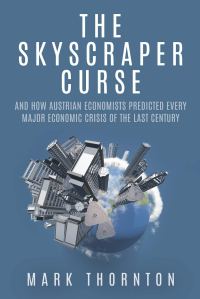
The Skyscraper Curse: And How Austrian Economics Predicted Every Major Economic Crisis of the Last Century
by Mark Thornton
This book covers three primary topics: Austrian Business Cycle Theory, Cantillon Effects, and the Skyscraper Curse. The common thread is the economic havoc caused by artificially low interest rates, including price inflation and greater economic inequality.
The author also sheds light on the dominating force funding economics research in the United States, presumably controlling the narrative and suppressing dissenting analysis.
THE SKYSCRAPER CURSE
“On January 8, 2010, CNN.com’s Kevin Voigt reported: ‘When the Burj Khalifa officially opened in Dubai on Monday, much of the world press noted the irony of the world’s tallest building unveiled just weeks after the emirate’s debt crash… The opening of every single ‘world’s tallest’ building in the past century has coincided with an economic downturn… Auburn University economist Mark Thornton… noted that economic depression or stock market collapse usually occurs prior to completion of such skyscrapers.’”
“Skyscrapers are essentially part of the boom phase of the cycle. The cause of both is artificially very low interest rates and artificially very easy credit conditions. This cause results in new record-breaking skyscrapers, a boom in the economy, and eventually a substantial economic crisis—the skyscraper curse.”
In 1999, Andrew Lawrence created the Skyscraper Index, “which purported to show that the building of the tallest skyscrapers coincides with economic booms. Specifically, he showed that the building of the world’s tallest skyscraper is a good proxy for dating the onset of a major economic crisis—the skyscraper curse. His index does not apply to the irregular ebbs and flows of the economy, only substantial economic crises.”
“According to his index, when there is a groundbreaking ceremony for a new world-record-height skyscraper the economy is booming, but when the record height is achieved a significant economic crisis soon follows. The ‘curse’ is the economic crisis, which is usually self-evident by the time the opening ceremony occurs.”
“Remember, a skyscraper alert is an indicator that suggests a significant economic crisis will occur in the near future, even though economic conditions currently appear good.”
“The important thing to remember is that skyscrapers do not cause economic crises. Rather they are just very noticeable examples of the distortions taking place throughout the economy when interest rates are kept artificially low by the central bank.”
“The Skyscraper Index is not based on general skyscraper construction, but instead on record-breaking skyscrapers. As we have seen before, because of the technology requirements and economic constraints, building two 100-story buildings is not the same things as building one 200-story building.”
“World-record breaking skyscrapers are a signal of economic crisis. Like world-record-breaking art prices, such as the $142 million selling price of a painting by Francis Bacon of his friend Lucian Freud at Christie’s in New York in 2013, such records are signs of economic excess.” As Michael Findlay similarly observed in The Value of Art, “There is an adage among old hands in the art world that the emergence of art investment funds signals that a boom is over.”
“It should not be surprising that the skyscraper, an important manifestation of the 20th-century business cycle and indicator of modern global capitalism and commerce, will itself be replaced in the same way by an unknown new capital and technologically intensive investment in the future.”
CANTILLON EFFECTS
In 1730, Richard Cantillon “showed how the interest rate and the money supply can create changes and distortions in the economy, a phenomenon now referred to as Cantillon effects.”
“New money has a disruptive impact on an economy and can cause what we now call the business cycle.”
“The first Cantillon effect is the impact of the rate of interest on the price of land… As a result, owners of land and real estate experience an increase in their wealth.”
“Paul Cwik demonstrates that the interest rate has an impact on the net present value of working capital and longer-lived fixed capital…. because the interest rate is used by entrepreneurs as a proxy for the discount rate… Net present value of an income stream has to exceed risk-adjusted cost of an investment for the project to be undertaken. High interest rates lead to heavy discounting of income streams, whereas low interest rates lead to less significant discounting, which makes long-term projects seem relatively more profitable.”
“For example, consider an investment project that is expected to produce $1 million in income above operating costs per year for ten years. In the tenth year of operation, if the discount rate is 4%, the calculated net present value of that year’s $1 million net income is $675,000. However, if the discount rate is 8% then the calculated net present value of that year’s income is only $463,000.”
“The second Cantillon effect from lower rates of interest is the impact on the size of firms…. The phenomenon of firms growing in size and scope in response to artificially low interest rates can be seen in the history of merger-and-acquisition waves… Mergers and acquisitions have occurred in clusters or waves during periods of low interest rates and easy credit conditions (the boom), and because they often start operating as a united company during the bust, their record of success has not been great.” Should we call this the M&A Curse?
“The third Cantillon effect is the impact of interest rates on the technology of constructing record-tall buildings… Every vertical beam, tube, cable, pipe, or shaft in a building takes away from leasable space on each floor built, and the more floors in the structure, the greater the required capacity of each system in the building, whether it is plumbing, ventilation, or elevators. So designers, architects, and building contractors cannot simply increase the size of each system to increase capacity. They must come up with new, more efficient systems to reach record heights.”
“Ames reports that KONE Corporation engineers have created a new elevator cable that weighs less than 7% of the weight of traditional steel cables, which each weight over 20 tons for a 400-meter high building. Obviously, a 20-ton cable would require an enormous amount of power to operate. Therefore, as building heights rise, technology must be advanced to conserve on the building system footprint.”
“All three Cantillon effects resulting from lower rates of interest are interrelated and reinforcing.”
“The main point of Cantillon’s broader analysis is that changes in money… results in winners and losers.”
INEQUALITY
“Some conventional disturbances caused by an increased money supply include a redistribution of wealth.”
“A monetary system that is dominated by a central bank, such as the Federal Reserve, and uses fiat money, as in our current monetary system, can expect to benefit certain people, such as bankers, financiers, and people with debt. Likewise, because such a system is inflationary, it tends to hurt wage workers and savers. Such a system can be expected to hurt the lower- and middle-income classes and enrich those in the financial industry and the upper-income class.”
“The first recipients of the money experience an increase in wealth, while those who do not receive it experience a decrease in wealth.”
“The big losers receive the money after prices have already risen. The losers would include private-sector workers and people on pensions or fixed income—in other words, the labor class. Inflation also harms savers and bond investors, as well as taxpayers who find themselves in higher tax brackets when wages catch up with price inflation.”
“It would seem that all this new money first went into the New York Stock Exchange, especially during the 1980s, then the NASDAQ stock market during the late 1990s, and finally into the housing market after the dot-com bust in 2000.”
“The entire increase in inequality has come after 1970 and the abolition of the Bretton Woods gold standard. The period beforehand, when we were on the gold standard, is one of increasing equality… A gold standard has historically had a tendency for prices to be stable or slightly deflationary. This means that wage rates, cash balances, savings, and bonds tend to gain purchasing power over time. This type of monetary system rewards the hard-working and frugal classes, which leads to an expansion of the middle-income class and the economy.”
AUSTRIAN BUSINESS CYCLE THEORY (ABCT)
“Ludwig von Mises (1881-1973) … formulated a theory about the business cycle… His student, Friedrich August von Hayek (1899-1992), further elaborated and extended Mises’s theory, a contribution for which he was awarded the Nobel Prize for economics in 1974. Their theory is now known as Austrian business cycle theory.”
“For ABCT, the cause of the boom and subsequent bust is when the central bank reduces the market rate of interest below the natural rate of interest by increasing the supply of money and credit… ABCT shows that as the amount of loanable funds expands, less credit-worthy borrowers will enter the market.”
“Every boom eventually peaks, and then the economy enters into a corrective phase, or bust… The price of assets will fall, and the unemployment rate will increase above the natural rate. Wages, incomes, and profits will fall, and the incomes of service workers will decline. House flippers will flop. Naturally the positive psychology of the boom will disappear and the social mood will turn gloomy. Austrians expect this to happen. We would be very surprised if it did not happen.”
“In a nutshell, ABCT warns that artificially low interest rates create malinvestments and a boom or bubble in the economy. This necessarily sets the stage for a recession, bust, or economic crisis when the cluster of entrepreneurial errors is revealed. This is an economic business cycle theory, although it anticipates and incorporates the technological shocks and psychological instability of the competing mainstream theories.”
“Austrian economists do not embrace an overinvestment theory, but rather a malinvestment theory.”
“While most people are very happy during boom times, the Austrian economists view the boom as the real problem because this is where resources are misallocated. This is also when people become financially overextended and engage in excessive luxury spending. Inflationary periods tend to be when the rich get richer and the poor get poorer.”
“Prior to Fed involvement, the amount of savings and borrowing are equal at the market-determined interest rate. Actual loan rates of interest vary from loan to loan based on the combination of the base rate, risk premium, inflation premium, and processing costs.”
INFLATION
“The federal funds rate [is] the rate that banks can borrow from other banks in order to meet their reserve requirements imposed by the Fed. The Fed ‘targets’ this short-term rate and injects reserves into this market by purchasing government bonds from banks, thereby freeing up reserves in the banking system. This is essentially the engine of inflation because the Fed simply makes a bookkeeping entry in the bank’s account with the Federal Reserve—modern inflation is essentially an electronic bookkeeping entry.”
DEFLATION
“When aggregate demand does not keep up with aggregate supply, this leads to lower prices, or price deflation… Mainstream economists have an unwarranted phobia of deflation. They think that deflation causes economic crises from which an economy cannot ever escape.” The author coined the term “apoplithorismosphobia” — the irrational fear of price deflation. “Austrians have shown that deflation is actually the corrective process by which asset prices are wages fall relative to consumer goods, thus creating profit opportunities for entrepreneurs to reorganize and employ such resources.”
JAPAN
“The success of Japan after WWII was due entirely to the free market economy, small government, low taxes, an appreciating currency, and a very high personal savings rate. That all changed when the bubble was born in the late 1980s because of overly stimulating monetary policy. A quarter century after the stock market meltdown Japan is still mired in an economic slump. At the prodding of mainstream economists, such as Paul Krugman, Japan has embarked on massive amounts of public works projects, enormous amounts of government borrowing, and extreme levels of monetary stimulus and quantitative easing. None of this has worked. It has left the country with the largest national debt relative to GDP in the world.”
THE CRASH THAT CURED ITSELF
“The alternative approach to business cycle contractions… involves shrinking government and balancing the budget, expanding resources in the private sector, and a non-expansionary monetary policy. This was employed by presidents Woodrow Wilson and Warren G. Harding during the 15-month-long depression of 1920-21. This period was one of the most severely deflationary in US history, and yet it is hardly mentioned in history textbooks… James Grant found that the reason this depression was so short was because it largely cured itself before government meddling could begin.”
Fast forward to the 2008 financial crisis. “If we take the government’s measure of the economy (i.e. GDP) and adjust for the government’s measure of price increases (i.e. the GDP deflator) and then adjust that figure by the increase in population, we find that the US economy grew at less than 4% over the entire period from 2008 to mid-2016. Compare that to the years during the free-banking era (1837-62) when inflation-adjusted, per capital GDP growth was 3% or even higher per year. That is a stark contrast.”
“The Austrian answer for economic crisis… in general, government should follow a philosophy of laissez-faire. First, stop the inflation, raise the interest rates, and achieve market-determined interest rates. Second, do not enact any policy that attempts to reduce bankruptcy or unemployment. Third, do not attempt to interfere with the prices, wages, consumption, and saving.”
“This would allow the market’s corrective processes to proceed at a fast pace to end the economic crisis quickly. On the active positive side, government should cut its budget, its taxes, and all types of regulations and prohibitions in order for more resources to be used productively and efficiently in the private sector. Following these policy recommendations would result in an economic crisis that is painful, but short.”
“The Austrian policy approach tends to hurt the wealthy relatively more than the middle- and lower-income classes, while mainstream policy approaches tend to hurt the middle- and lower-income classes and help the rich.”
FED FUNDING BIASES ECONOMICS RESEARCH
“The Fed spends vast resources on economic policy research, particularly on money, banking, and macroeconomics. This funding, as both carrot and stick, has no doubt produced a status quo bias in academic research on subjects that are the concern of the institution of the Fed.”
According to economics professor Larence H. White, “‘The Fed employed about 495 full-time staff economists in 2002. That year it engaged more than 120 leading academic economists as consultants and visiting scholars, and conducted some 30 conferences that brought 300-plus academics to the podium alongside its own staff economists. It published more than 230 articles in its own research periodicals. Judging by the abstracts compiled by the December 2002 issue of the e-JEL [Journal of Economic Literature], some 74% of the articles on monetary policy published by US-based economists in the US-edited journals appear in Fed-published journals or are co-authored by Fed staff economists.’”
“White puts the size of the Fed’s research staff into perspective by noting that the Fed’s staff of economists in 2002 was 27% larger than the number of macroeconomists and experts in money and banking employed by the top 50 PhD-granting economics departments in the United States combined. The Fed has numerous research journals that publish an enormous number of articles, but the articles that are published are vetted by the staffs at both the regional Fed banks and the Board of Governors in Washington D.C. This no doubt creates a tremendous bias against criticism of the Fed itself.”
“White also found that the Fed dominates the editorial boards of the leading academic journals specializing in money, banking, and macroeconomics.”
BIAS IN ACADEMIA
“A survey of economic textbooks at the undergraduate or graduate level would find hardly a word about Austrian business cycle theory or about Cantillon effects… It certainly is time at least to introduce these concepts in classrooms and textbooks so that students can consider an alternative paradigm and evaluate its merits.”
AUTHOR’S CONCLUSION
“Market forces alone should regulate money and banking, just like the markets for aspirin, shoes, and cell phones… The first thing to do is to disband the Federal Open Market Committee (FOMC) and allow the interest rate in the federal-funds market—the federal funds rate, which banks charge other banks for short-term loans—to be determined by market forces.”
This is a very informative book about monetary policy. The other driver of inflation is fiscal policy, i.e. government spending.
Thornton, Mark. The Skyscraper Curse: And How Austrian Economists Predicted Every Major Economic Crisis of the Last Century. Mises Institute, 2018. Buy from Amazon.com
Disclosure: As an Amazon Associate I earn from qualifying purchases.
Related Reading:
- Choice: Cooperation, Enterprise, and Human Action by Robert P. Murphy (2015)
- The Fed at One Hundred: A Critical View on the Federal Reserve System by David Howden and Joseph T. Salerno (2014)
- The Austrian Theory of the Trade Cycle and Other Essays edited by Richard M. Ebeling, with essays by F. A. Hayek, Ludwig von Mises, Murray Rothbard, Gottfried Haberier, and Roger Garrison (2014)
- The Forgotten Depression: 1921: The Crash That Cured Itself by James Grant (2014)
- Meltdown: A Free-Market Look at Why the Stock Market Collapsed, the Economy Tanked, and Government Bailouts Will Make Things Worse by Thomas E. Woods (2009)
- Deflation by Chris Farrell (2005)
- The Trouble with Prosperity: The Loss of Fear, the Rise of Speculation, and the Risk to American Savings by James Grant (1996)
- The Case for Gold by Ron Paul and Lewis Lehrman (originally published in 1982)
- The Go-Go Years: The Drama and Crashing Finale of Wall Street’s Bullish 60s by John Brooks (originally published in 1973)
- The Theory of Money and Credit by Ludwig von Mises (originally published in 1912)
Discover more from The Key Point
Subscribe to get the latest posts sent to your email.


3 thoughts on “The Skyscraper Curse”
Comments are closed.