Restaurant & Bar Marketing


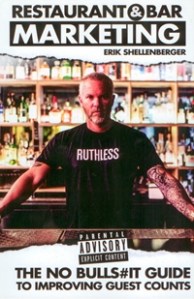
Restaurant & Bar Marketing: The No Bullshit Guide to Improving Guest Counts
by Erik Shellenberger

Erik Shellenberger cuts through the hype and tells you what really works—and what doesn’t—to bring more customers into restaurants and bars. Before getting into the tactics, he presents his ocean versus fishbowl concept.

The fishbowl includes people who follow you on social media, who subscribe to your email list, etc. “The ocean—NOT the fishbowl—is where you improve guest counts… People who have no idea you exist. People who are looking to branch out and try new places to eat and drink in their home city… The tourist economy is almost exclusively an ocean environment. It includes the person using Google or online reviews to find a business like yours.”

Continue reading “Restaurant & Bar Marketing”

The Responsible Company


The Responsible Company: What We’ve Learned from Patagonia’s First 40 Years
by Yvon Chouinard and Vincent Stanley

We hear a lot about sustainability, but the authors contend “no human economic activity is yet sustainable… Responsible seems to us the apt, more modest, word to use… The term itself is necessary shorthand; there is no responsible company, only responsible companies of varying degrees, who act strategically to do less harm while improving, not sacrificing, the health of the business.”

Doing good and seeking profit are not incompatible. Wal-Mart’s initial environmental efforts were motivated by reputation management, “but removing excess packaging from deodorant sticks, concentrating laundry detergent in small bottles, and installing auxiliary power units in their trucks to reduce idling time turned out to save them millions of dollars.”

Continue reading “The Responsible Company”

Humble Inquiry


Humble Inquiry: The Gentle Art of Asking Instead of Telling
by Edgar H. Schein (1928-2023)

Retired MIT Sloan School of Management professor Edgar Schein asserts, “Without good upward communication, organizations can be neither effective nor safe… Your organization may be underperforming because various employees or groups do not recognize the degree to which they are, in fact, interdependent.” The gist of this book is about creating a trusting environment with open communication across hierarchical boundaries. This entails less telling, more asking, and better listening.

“The U.S. culture is strongly built on the tacit assumptions of pragmatism, individualism, and status through achievement… Given those cultural biases, doing and telling are inevitably valued more than asking and relationship building. However, as tasks become more complex and interdependent, collaboration, teamwork, and relationship building will become more necessary. That, in turn, will require leaders to become more skilled in humble inquiry.”

Continue reading “Humble Inquiry”

Simple Complexity: a Management Book for the Rest of Us, a Guide to Systems Thinking


Simple Complexity: a Management Book for the Rest of Us, a Guide to Systems Thinking
by William Donaldson

This book is about applying the principles of complexity and systems thinking to management. “Every organization is a system—in fact, a system of systems, perfectly designed to get the results it is getting today… Systems thinking is the unifying discipline that brings clarity to all of the other disciplines at work in your enterprise… The key, defining concept of systems thinking to remember is that nothing in the system is ever unconnected.”

Donaldson emphasizes the importance of context. “You have to ensure everyone has shared mental models of the enterprise and its management system… Remembering that context can enhance learning and comprehension by 50-100 percent, you must give employees context for both the part of the system they play a role in and the whole system.”

Continue reading “Simple Complexity: a Management Book for the Rest of Us, a Guide to Systems Thinking”

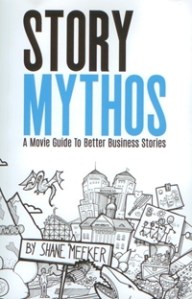
Story Mythos: A Movie Guide to Better Business Stories


Story Mythos: A Movie Guide to Better Business Stories
by Shane Meeker

“People are inspired and moved by stories…Story is about human emotions… Stories de-commodify your brand/product.” The premise of this book is that the same principles used by Hollywood filmmakers can be used to develop powerful brand stories. The author is the company historian and corporate storyteller at Procter & Gamble.

“What are your most powerful company stories, and how are you using them to inspire your people? How do you explain your purpose through different stories? What stories best demonstrate your company beliefs? How are you documenting and protecting the stories that matter? … How can you use a story to demonstrate a company’s culture?”

Continue reading “Story Mythos: A Movie Guide to Better Business Stories”

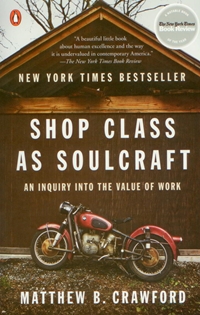
Shop Class as Soulcraft: An Inquiry into the Value of Work


Shop Class as Soulcraft: An Inquiry into the Value of Work
by Matthew B. Crawford

This book is primarily about restoring honor to the manual trades. Crawford writes about the “rich cognitive challenges and psychic nourishment” that come with “the experience of making things and fixing things.”

It makes sense to start with some context about the author’s career path. “I started working as an electrician’s helper shortly before I turned fourteen… When I couldn’t get a job with my college degree in physics, I was glad to have something to fall back on, and went into business for myself.” Later, Crawford went back to school and earned a Ph.D. in political philosophy. He took a job as executive director of a think tank, but he found the work dispiriting. “Despite the beautiful ties I wore, it turned out to be a more proletarian existence than I had known as a manual worker.” After only five months, he quit and opened a motorcycle repair shop. “Perhaps most surprising, I often find manual work more engaging intellectually.”

Continue reading “Shop Class as Soulcraft: An Inquiry into the Value of Work”

Read This If You Want to Take Great Photographs of People


Read This If You Want to Take Great Photographs of People
by Henry Carroll

“Don’t take pictures of people. Take pictures about people.”

Carroll explains the rules of thumb for a traditional portrait, but the book is mainly about moving beyond that.  “Don’t suppress your subject’s physical nuances. This is what makes them who they are. There are rules in portraiture about how your subjects should stand, what they should do with their hands, and so on. These rules are fine for corporate headshots, because they’re designed to remove any trace of a person’s individuality. But that’s not what we’re about, right?” 

Continue reading “Read This If You Want to Take Great Photographs of People”

Federal Plain Language Guidelines


Federal Plain Language Guidelines

Although oriented towards helping U.S. government employees write clear regulations, the Federal Plain Language Guidelines offers great advice for any nonfiction writer. It includes a section on writing content for web sites.

Here are some highlights.

Address one person, not a group. Remember that even though your document may affect a thousand or a million people, you are speaking to the one person who is reading it. When your writing reflects this… [it] has a greater impact.”

Continue reading “Federal Plain Language Guidelines”

BadMen: How Advertising Went From a Minor Inconvenience to a Major Menace


BadMen: How Advertising Went from a Minor Inconvenience to a Major Menace
by Bob Hoffman

In this concise, informative, hilariously irreverent, and brutally honest book, former advertising agency CEO Bob Hoffman explains why ad tech is bad for advertisers, publishers, and consumers. He also calls on advertisers to stop enabling this menace.

“Surveillance marketing is powered largely by advertisers through the tracking of our movements on the web. This is called ‘ad tech.’”

Continue reading “BadMen: How Advertising Went From a Minor Inconvenience to a Major Menace”

The Halo Effect and the Eight Other Business Delusions That Deceive Managers


The Halo Effect and the Eight Other Business Delusions That Deceive Managers
by Phil Rosenzweig

Many business books and articles have been written about what Phil Rosenzweig calls “the mother of all business questions… What leads to high performance?” This book explains why much of this analysis is “riddled with errors.”

Using the examples of Cisco, ABB, and others, the author demonstrates the phenomenon. When times were good—strong revenue growth and a soaring stock price—these companies were praised for their exemplary strategy, culture, and CEO. When financial performance fell, the same strategy, culture, and CEO were ripped apart as severely flawed.

Why does this happen? Because we love stories. “As long as Cisco was growing and profitable and setting records for its share price, managers and journalists and professors inferred that it had a wonderful ability to listen to its customers, a cohesive culture, and a brilliant strategy. And when the bubble burst, observers were quick to make the opposite attribution. It all made sense. It told a coherent story.”

“Yet there’s a bit more to it. Our desire to tell stories, to provide a coherent direction to events, may also cause us to see trends that do not exist or infer causes incorrectly. We may ignore facts because they don’t fit into our story.”

How does this happen? Introducing the Halo Effect. 

Continue reading “The Halo Effect and the Eight Other Business Delusions That Deceive Managers”