Why Can’t You Just Give Me The Number?


Why Can’t You Just Give Me the Number? An Executive’s Guide to Using Probabilistic Thinking to Manage Risk and Make Better Decisions
by Patrick Leach

Decisions can be based on a deterministic calculation only in conditions of certainty, that is to say the input parameters are known quantities. But strategic decisions are often made in a context of uncertainty and complexity, where a definite answer is unknowable, so we must turn to probabilistic thinking.

Uncertainty. “I make the case that all value generated by business executives comes—directly or indirectly—from how they manage uncertainty. Without uncertainty, a share of a company’s stock is effectively a bond, with guaranteed future cash flows. Guaranteed bonds don’t need management. But stocks (or rather, companies issuing stock) certainly do.”

Continue reading “Why Can’t You Just Give Me The Number?”

HBR Guide to Buying a Small Business


HBR Guide to Buying a Small Business: Think big, buy small, own your own company
by Richard S. Ruback and Royce Yudkoff

This book provides a methodology to find, evaluate, finance, and acquire a small business. The autonomy of entrepreneurship is compelling to many, but the failure rate of start-ups is high—more than two-thirds of them never deliver a positive return to investors. In contrast, this approach seeks to buy and manage an existing “enduringly profitable” business. The authors teach a course in entrepreneurship through acquisition at Harvard Business School.

Continue reading “HBR Guide to Buying a Small Business”

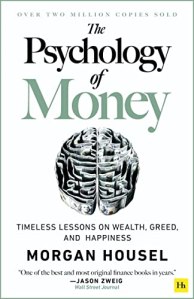
The Psychology of Money


The Psychology of Money: Timeless Lessons on Wealth, Greed, and Happiness
by Morgan Housel

Financial success is a soft skill, writes Morgan Housel, “where how you behave is more important than what you know.” This is a book about developing the mindset of a long-term investor, with a realistic attitude towards risk and reward. The book is conspicuously free of financial jargon and math. Here are some key points.

Continue reading “The Psychology of Money”

How Finance Works


How Finance Works: The HBR Guide to Thinking Smart About the Numbers
by Mihir A. Desai

This is an outstanding book which presents some complicated topics in a clear, well-organized manner with real-world examples. The author, a professor of finance and taxation at Harvard Business School and Harvard Law School, includes some sidebar commentary from two CFOs, an investment banker, and a hedge fund manager.

Continue reading “How Finance Works”

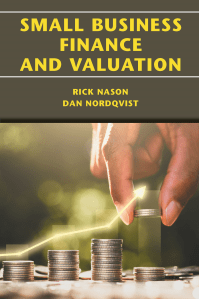
Small Business Finance and Valuation


Small Business Finance and Valuation
by Rick Nason and Dan Nordqvist

A finance professor and a CPA have teamed up to explain finance and risk management concepts specifically for small business, defined as assets under $5 million. They acknowledge that the objectives of small business owners often differ from those of a Fortune 500 CFO, whose focus is typically maximizing shareholder value. Freedom, peace of mind, and other quality of life issues may be more important to a small business owner.

Continue reading “Small Business Finance and Valuation”

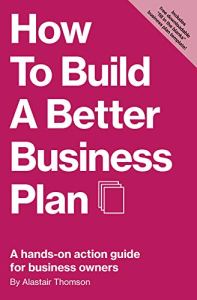
How to Build a Better Business Plan


How to Build a Better Business Plan: A Hands-On Action Guide for Business Owners
by Alastair Thomson

One of the primary benefits of a business plan is “finding a business model that works.” Alastair Thomson, an accountant and experienced C-level executive, guides you to think from a lender’s or investor’s perspective, whether or not you are seeking outside financing. From their side of the table, would you find your business compelling?

The completed plan becomes your “roadmap” for execution. “With the right business plan, you do your thinking up-front. You know how to take advantage when new opportunities come your way and you know exactly what problem needs solving if performance veers off-course.” Thomson encourages planning for three scenarios: best-case, worst-case, and likely outcome. “The biggest danger for a pessimist is under-resourcing their business.”

Continue reading “How to Build a Better Business Plan”

An interview with Alastair Thomson author of Cash Flow Surge

After posting more than 250 book reviews, I decided to try something new: an author interview on YouTube. I am grateful to Alastair Thomson for graciously sharing his wisdom on managing small and medium-sized businesses. Alastair has an accounting background, but this conversation is not about debits and credits. It’s about improving your business from the perspective of an experienced CEO and CFO. We cover cash flow, profit, customer experience, metrics, business ethics, marketing, quality, continuous improvement, front-line employees, growth, margins, inventory, and receivables.


An interview with Alastair Thomson, author of Cash Flow Surge
July 16, 2020 – 1 hour – Book ReviewAmazon


Transcript

Continue reading “An interview with Alastair Thomson author of Cash Flow Surge”

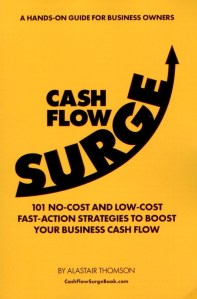
Cash Flow Surge: 101 No-Cost and Low-Cost Fast-Action Strategies to Boost Your Cash Flow


Cash Flow Surge: 101 No-Cost and Low-Cost Fast-Action Strategies to Boost Your Business Cash Flow
by Alastair Thomson (interview)

In college I took a course called Small Business Finance. The main thing I remember from this course is the emphasis on “cash flow, cash flow, cash flow.” Alastair Thomson is an accountant who has been a CFO and CEO of several businesses in the U.K., across variety of industries. He wrote this book for owners of small and medium-size businesses. While cash flow and profit are not the same thing, many of the ideas in the book can improve both.

The 101 chapters cover suppliers and expenses, customers and revenue, staffing and procedures, communication, insurance, logistics, contracts, and technology. Here are some snippets:

Continue reading “Cash Flow Surge: 101 No-Cost and Low-Cost Fast-Action Strategies to Boost Your Cash Flow”

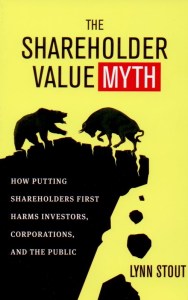
The Shareholder Value Myth


The Shareholder Value Myth: How putting shareholders first harms investors, corporations, and the public
by Lynn Stout (1957-2018)

Business schools and law schools teach that the purpose of a corporation is to maximize shareholder wealth. “Shareholder wealth, in turn, is typically measured by share price—meaning share price today, not share price next year or next decade.” Lynn Stout (1957-2018), who was a business law professor at Cornell, makes the case that this is both untrue and harmful.

“United States corporate law does not, and never has, required directors of public corporations to maximize either share price or shareholder wealth… State statutes similarly refuse to mandate shareholder primacy… As long as boards do not use their power to enrich themselves, the [business judgment rule] gives them a wide range of discretion to run public corporations with other goals in mind, including growing the firm, creating quality products, protecting employees, and serving the public interest. Chasing shareholder value is a managerial choice, not a legal requirement.”

Continue reading “The Shareholder Value Myth”