The Skyscraper Curse


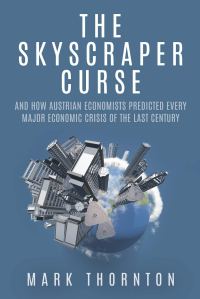
The Skyscraper Curse: And How Austrian Economics Predicted Every Major Economic Crisis of the Last Century
by Mark Thornton

This book covers three primary topics: Austrian Business Cycle Theory, Cantillon Effects, and the Skyscraper Curse. The common thread is the economic havoc caused by artificially low interest rates, including price inflation and greater economic inequality.

The author also sheds light on the dominating force funding economics research in the United States, presumably controlling the narrative and suppressing dissenting analysis.

Continue reading “The Skyscraper Curse”
Entrepreneurship


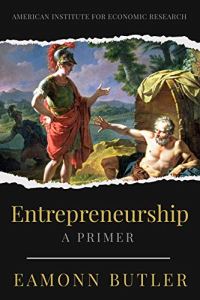
Entrepreneurship: A Primer
by Eamonn Butler

“Entrepreneurship is the unseen factor of production. Land, labor, and capital produce nothing until they are actively put to work. They need to be directed and focused by some human mind—an entrepreneurial mind that realizes how they can be used to create value.”

“British philosopher and economist John Stuart Milll (1806-1873) identified entrepreneurs as people who assume both the risk and the management of a business. Today, economists focus on the role of entrepreneurs as innovators or in spotting opportunities or taking risks in a world of future uncertainty.”

Continue reading “Entrepreneurship”

Essays on Hayek


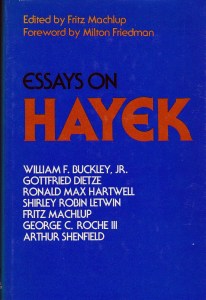
Essays on Hayek
Edited by Fritz Machlup

Friedrich Hayek (1899-1992) received the Nobel Prize in Economics on December 11, 1974 for his theory of business cycles and the effects of monetary and credit policies. The following year, the Mont Pelerin Society held a conference at Hillsdale College covering various aspects of Hayek’s work. This book is a collection of the papers presented and discussed.

I find it noteworthy that Hayek wrote The Road to Serfdom (1944) on the consequences of socialism in the same era that George Orwell wrote Animal Farm (1945) and 1984 (1949).

Continue reading “Essays on Hayek”

I, Pencil


I, Pencil
by Leonard E. Read

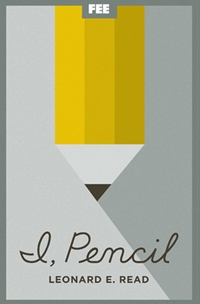
This is the story of how a simple pencil is manufactured using numerous raw materials from all over the world, as told in the first person by the pencil itself.  It was first published in 1958 to explain how free-market economies work and to discredit centrally-planned economies, such as the Soviet Union. While trade barriers are not expressly discussed in the story, the reader can infer potential consequences rippling through the supply chain.

Continue reading “I, Pencil”