The Shaping of an Effective Leader


The Shaping of an Effective Leader: Eight Formative Principles of Leadership
by Gayle D. Beebe

Westmont College president Gayle Beebe presents his eight principles of effective leadership and weaves in the wisdom of Peter Drucker, under whom he studied. The eight principles are character, competence, chemistry, culture, compatibility, convictions, connections, and commitment.

“Character is the foundation of all leadership responsibilities for all our life.” However, “without threshold competencies, even the most well-meaning individual can do real harm.”

Continue reading “The Shaping of an Effective Leader”
More Human


More Human: How the Power of AI Can Transform the Way You Lead
by Rasmus Hougaard and Jacqueline Carter

More human means leveraging AI to unlock the best of our humanity and, simultaneously, to help us overcome some of our limitations. This is the art of the toggle, where we skillfully navigate getting the best of both human capabilities and AI. In this way, we can develop ourselves as better human leaders and thereby create better and more-human workplaces.”

The authors quote Tim Cook, CEO of Apple: “I’m not worried about artificial intelligence giving computers the ability to think like humans. I’m more concerned about people thinking like computers, without values or compassion, without concern for consequence.”

Continue reading “More Human”

Managing Oneself and What Makes an Effective Executive


Managing Oneself and What Makes an Effective Executive
by Peter F. Drucker (1909-2005)

Peter Drucker is often referred to as the leading management thinker of the 20th century. His seminal works include Concept of the Corporation (1946) and The Practice of Management (1954). This short volume includes two of Drucker’s articles: “Managing Oneself” and “What Makes an Effective Executive.” Here are some highlights.

Continue reading “Managing Oneself and What Makes an Effective Executive”

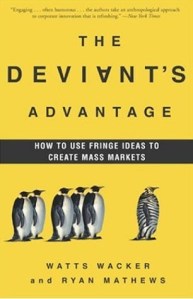
The Deviant’s Advantage


The Deviant’s Advantage: How to Use Fringe Ideas to Create Mass Markets
by Watts Wacker and Ryan Mathews

“Deviance is the source of all true innovation, growth, and indeed our collective survival. Deviance is defined by time, place, and circumstances.”

“Without deviance there would be no art, no scientific breakthroughs, no technological advances… Physical evolution is perhaps the perfect example of deviance in action. Without mutation—essentially deviance from an established DNA pattern—nature would remain static.”

“Don’t let the words deviant and deviance scare you. They’re being used in their purest definition—something or someone operating in a defined measure away from the norm.”

Continue reading “The Deviant’s Advantage”

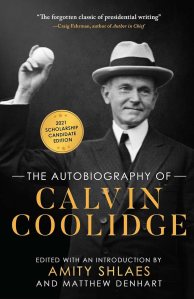
The Autobiography of Calvin Coolidge


The Autobiography of Calvin Coolidge
by Calvin Coolidge (1872-1933) with introduction and footnotes by Amity Shlaes and Matthew Denhart

Calvin Coolidge became the 30th president of the United States on August 3, 1923 upon the death of President Warren G. Harding. He ran for reelection in 1924 and served one full term of his own. He did not seek reelection in 1928. To give some context of his time, Coolidge was the first president whose inauguration address was broadcast nationwide on the radio, and he was the first president to make a transatlantic telephone call.

Continue reading “The Autobiography of Calvin Coolidge”

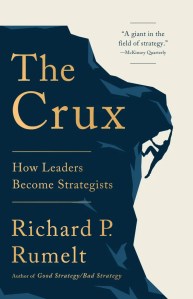
The Crux: How Leaders Become Strategists


The Crux: How Leaders Become Strategists
by Richard P. Rumelt

In rock climbing “there are many mountains and boulders, each promising a different mixture of difficulty and reward… Climbers call such boulders ‘problems’ and describe the toughest parts as ‘the crux’… The first climber said that he chooses the climb having the greatest expected reward and whose crux he believes he can solve.”

Rumelt observes that strategists do the same. “Whether facing problems or opportunities, they focused on the way forward promising the greatest achievable progress—the path whose crux was judged to be solvable.”

Continue reading “The Crux: How Leaders Become Strategists”

Mansfield and Dirksen: Bipartisan Giants of the Senate


Mansfield and Dirksen: Bipartisan Giants of the Senate
by Marc C. Johnson 

In contrast to today’s polarized politics, the US Senate of the 1960s functioned with a great deal more civility and bipartisan cooperation, despite deep political divisions. This book is both a history lesson and a study in the leadership styles majority leader Michael Mansfield (Democrat) and minority leader Everett Dirksen (Republican).

Continue reading “Mansfield and Dirksen: Bipartisan Giants of the Senate”

A Full Life: Reflections at 90


A Full Life: Reflections at 90
by Jimmy Carter (1924-2024)

Jimmy Carter was born on October 1, 1924 and was elected the 39th president of the United States in 1976. The world has changed a lot in the 100 years since Carter grew up in the segregated south. At the same time, many of the issues he writes about sound quite familiar, such as inflation, contested elections, and conflict in the Middle East.

I was surprised by Carter’s emphasis on fiscal discipline—something we haven’t seen in recent administrations. (At the end of the Carter administration, the national debt to GDP ratio was 32%. In 2022 it was 123%.) What also stands out is Carter’s cooperative relationships with presidents Gerald Ford and George H.W. Bush, in stark contrast to more recent polarization.

Continue reading “A Full Life: Reflections at 90”

WCVB-TV Boston: How We Built the Greatest Television Station in America


WCVB-TV Boston: How We Built the Greatest Television Station in America
by Robert M. Bennett (1927-2016)

In this memoir, the highlight of television executive Bob Bennett’s career was launching and growing WCVB-TV, Channel 5 in Boston. A major theme is his commitment to locally-produced programming. Another theme is Bennett’s leadership style, whereby he encouraged new ideas and risk-taking from his lieutenants, and inspired a sense of pride which brought out the best in people at all levels of the organization. It’s also a high-risk, high-reward story that could have turned out very differently.

The book is comprised of Bennett’s recollections interspersed with commentary from former colleagues.

Continue reading “WCVB-TV Boston: How We Built the Greatest Television Station in America”

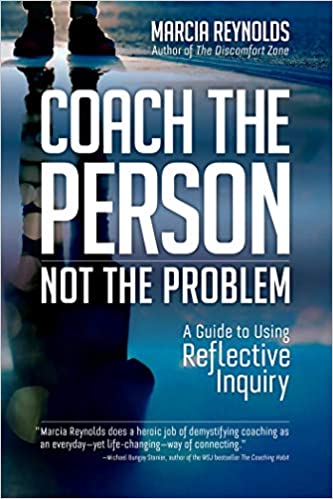
Coach the Person, Not the Problem


Coach the Person, Not the Problem: A Guide to Using Reflective Inquiry
by Marcia Reynolds

Marcia Reynolds trains leaders how to use a coaching approach. “Coaching should be a process of inquiry, not a series of questions. The intent of inquiry is not to find solutions but to provoke critical thinking about our own thoughts. Inquiry helps the people being coached discern gaps in their logic, evaluate their beliefs, and clarify fears and desires affecting their choices. Solutions emerge when thoughts are rearranged and expanded.”

“When people are overwhelmed, stressed, and angry, coaching reminds them of their purpose, visions, and power to move forward.”

Continue reading “Coach the Person, Not the Problem”