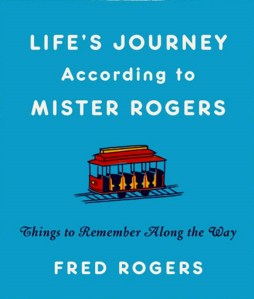
Life’s Journeys According to Mister Rogers: Things to Remember Along the Way by Fred Rogers (1928-2003)
And now a Thanksgiving palette cleanser.
Fred Rogers was the creator and host of the children’s television show Mister Rogers’ Neighborhood from 1968 to 2001. This short book is a posthumously published collection of his writing for adults.
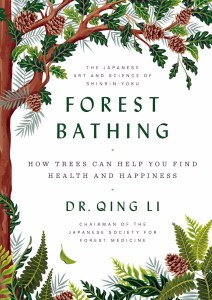
Forest Bathing: The Japanese Art and Science of Shinrin-Yoku by Qing Li, MD, PhD
“The concept that humans have a biological need to connect with nature has been called biophilia… The American biologist E.O. Wilson… believed that, because we evolved in nature, we have a biological need to connect with it.”
Qing Li is an immunologist and associate professor at Nippon Medical School in Tokyo who studies how spending time in the forest improves our health. In Japanese, shinrin (森林) means forest and yoku (浴) means bathing. “So shinrin-yoku means bathing in the forest atmosphere, or taking in the forest through our senses.” The term forest bathing is analogous to sunbathing, nikkou-yoku (日光浴) in Japanese.
The Little Book of Mindfulness: 10 Minutes a Day to Less Stress, More Peace by Dr. Patrizia Collard
Dr. Patrizia Collard is a psychotherapist, stress management consultant, and lecturer at the University of East London. She writes, “The goal of any mindfulness practice is simply to experience life as it unfolds. To stay present and calm and not slip back into thinking/worrying mode, we choose an anchor of awareness—a point of focus we direct our mind to.”
“Mindfulness is being aware of or bringing attention to this moment in time deliberately and without judging the experience. So, when we go for a mindful walk we really notice every little detail and all we encounter—trees, cars, flowers growing out of small cracks, or a cat crossing the road—rather than creating to-do lists.”
“When we procrastinate and distract ourselves with ‘busyness,’ we avoid engaging with the real thing—our lives… Living in the moment, and seeing everything afresh without judgment and worry lets us experience life rather than simply get through it.”
Happiness: A Guide to Developing Life’s Most Important Skill by Matthieu Ricard
Matthieu Ricard gave up a career in cellular genetics at the Institut Pasteur to study Buddhism in the Himalayas. In this book he shares his wisdom about happiness drawing from thirty-five years of studying Buddhism and psychology.
“A change, even a tiny one, in the way we manage our thoughts and perceive and interpret the world can significantly change our existence. Changing the way we experience transitory emotions leads to a change in our moods and to a lasting transformation of our way of being.”
Managing the Unexpected: Assuring High Performance in an Age of Complexity by Karl E. Weick and Kathleen M. Sutcliffe
University of Michigan business school professors Weick and Sutcliffe studied common management attributes of “high reliability organizations” (HROs) such as aircraft carriers and nuclear power plants, where glitches can have deadly consequences. “The key difference between HROs and other organizations in managing the unexpected often occurs in the earliest stages, when the unexpected may give off only weak signals of trouble… Managing the unexpected is about alertness, sensemaking, updating, and staying in motion.”
Lama Marut, aka Brian K. Smith, was a professor of comparative religion, he studied Hinduism and Sanskrit in India, he was a Buddhist monk, and he is the son of a Baptist preacher. So he presents a well-informed viewpoint rather than a myopic dogma. Fortunately, you don’t need to climb a mountain to be enlightened by this wise man; he imparts wisdom in his book, Be Nobody.
Marut writes about living in the iEra. “Our contemporary culture of consumerism, materialism, narcissism, and the worship of fame encourages the idea that we will be happy only when we become exceptional. But maybe we’ve got it wrong—exactly wrong. Maybe our deepest and most authentic happiness will be found only when we finally lay down this heavy burden of trying to be a somebody… Maybe true fulfillment in life requires an emptying, not a filling.”


 The Key Point