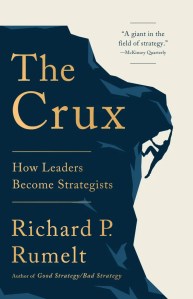
The Crux: How Leaders Become Strategists
by Richard P. Rumelt
In rock climbing “there are many mountains and boulders, each promising a different mixture of difficulty and reward… Climbers call such boulders ‘problems’ and describe the toughest parts as ‘the crux’… The first climber said that he chooses the climb having the greatest expected reward and whose crux he believes he can solve.”
Rumelt observes that strategists do the same. “Whether facing problems or opportunities, they focused on the way forward promising the greatest achievable progress—the path whose crux was judged to be solvable.”
CHALLENGE-BASED STRATEGY
“A strategy is a mixture of policy and action designed to surmount a high-stakes challenge. It is not a goal or wished-for end state. It is a form of problem solving, and you cannot solve a problem you do not understand or comprehend. Thus, challenge-based strategy begins with a broad description of the challenges—problems and opportunities—facing the organization. They may be competitive, legal, due to changing social norms, or issues with the organization itself.
As understanding deepens, the strategist seeks the crux—the one challenge that is both critical and appears to be solvable. This narrowing down is the source of much of the strategist’s power, as focus remains the cornerstone of strategy.”
IMPORTANT AND ADDRESSABLE
“I call what passes the joint filters of critical importance and addressability an ASC (addressable strategic challenge). The number of ASCs that can be simultaneously worked depends on the size and resource depth of the organization and the graveness of the most serious.”
“A challenge’s importance is measured by the degree to which it threatens the basis of a group’s or company’s strategy or even its existence. An opportunity is important because it is large and risky and because it requires an adjustment in the company’s strategy.”
“Addressability is the degree to which the challenge appears to be solvable… The question that often breaks this into pieces small enough to think about is ‘Why is this hard?’ That is, what are the obstacles to dealing with this challenge?”
“The discipline of addressability does not pass over complex long-term challenges. It encourages breaking such challenges into smaller chunks, one of which can be tackled today.”
“Don’t pick a challenge you cannot yet deal with—attack the crux of the situation, build momentum, and then reexamine your position and possibilities… Understand the sources of power and leverage that are relevant to your situation. To punch through the crux, you will use one or more of them. Willpower is not enough.”
COHERENT ACTION
“When we assign too many priorities, the concept loses its meaning.”
“Attacking the crux of a problem or challenge requires actions. And that means making some activities, people, and departments more important than others. These shifts in roles, influence, and resources are the concomitant of focus, making some objectively more important than others.”
“Coherent actions support one another. At the simplest level, coherence means that actions and policies do not contradict each other. In the best cases, coherence comes from actions working synergistically to create additional power.”
“One sees how coherence is easily lost. The cost of coherence is saying no to many interests with reasonable values and arguments. A strategist tries not to be a politician. The art of compromise and building the big tent that everyone can shelter under is not that of the strategist. Rather, it is coherence aimed at the crux of the problem.”
STRATEGY IS ONGOING
“Strategy should be an ongoing process. This concept of strategy allows a company to have a strategy process that is not a constant restatement of some vague overall purpose and intent. The strategy process becomes the much more entrepreneurial task of solving challenges and grabbing opportunities, as they appear, along the way.”
“There is nothing that motivates an army or company better than winning. By tackling an important objective and overcoming it, leadership sets the stage for the next battle. Think of strategy as a series of proximate objectives rather than a long-term vision… The task, or objective, is proximate in that it can be done and can be done fairly soon.”
“A second advantage of creating tasks that are proximate is that it facilitates an emphasis on action.”
DON’T START WITH GOALS
“A good goal is the result of effective strategy work that targets certain actions that will move the organization forward… Unsupported goals, like hitting a specific profit target in the next twelve months, are Dilbert-style corporate management, because such goals are disconnected from the reality of the situation.”
“Good strategic goals are the outcome of strategy, not its input.”
STRATEGY IS DESIGN, NOT MULTIPLE CHOICE
“Strategy creation is a special form of problem solving. By a form of problem solving, I mean that it treats much less structured and much more complex problems than you found in the traditional homework problems of your school days. When talking and writing about strategy, it seems better to say ‘challenges.’”
“The result is a design rather than a choice. It is a creation embodying a purpose. I call it a ‘creation’ because it is nonobvious to most others, the product of insight and judgment rather than an algorithm.”
At Salesforce.com, “as each challenge was met, the ambition shifted and escalated. At each step, the response was a design for dealing with the challenge. It is common to say that strategy is about choice. The word choice implies a set of given alternatives from among which to choose… The approaches Benioff took were designs, not choices. And the power was in these designs coupled with a willingness to shift and adapt as well as in forceful implementation… The free sign-up has evolved into free trials.”
THINK AGAIN
“There are situations that are both very important and about which we have little experience. In such strategic situations, the costs of running with the first intuition can be very high… There is a theory that people have difficulty seeing a subtle yet superior solution to a complex problem when there is an attractive, seemingly simpler alternative—a distraction. This is the basis of the ‘think again’ advice in Chapter 20.”
“Injecting more money into an ineffective system is just feeding the bloat. Fix it before you grow it.”
STRATEGY VS. TACTICS
“The distinction between strategy and tactics arises in the military and denotes the difference between the general’s action plan and the top sergeant’s action plan. It is not about long-term versus short-term.’”
METRICS
“Measuring something doesn’t always mean it can be improved… Don’t let the metrics drown out thought.”
BUREAUCRACY
“The ‘blob’ is the complex interconnected structure at the heart of so many older organizations. It is fairly bureaucratic and has numerous policies and norms that have evolved over many years… You don’t want that bureaucratic structure trying to manage a growth business… A larger company can find growth opportunities within itself or via acquisitions. I call such growth opportunities ‘seedlings,’ and they need to be cultivated and shielded from the blob.”
RISK
“The kinds of ventures a large company should seek are those that require more than just a small cadre of engineers or programmers. What the larger company is trying to achieve is a greater level of risk-taking along with some leverage from the parent’s reputation, skills, and market position. To make this work, the company has to go easy on, or eliminate, the standard hit-your-numbers reviews and, instead, conduct monthly help sessions on the seedling’s challenges and action policies. If the seedling fails, the managers in charge should not be punished or let go. Such actions spray herbicide on your garden.”
EXECUTION
“Management work—accomplishing given objectives—is often called execution… Success is the outcome of both good strategy and good execution.”
Richard Rumelt previously wrote Good Strategy/Bad Strategy: The Difference and Why It Matters (2011).
Rumelt, Richard P. The Crux: How Leaders Become Strategists. Public Affairs, 2022. Buy from Amazon.com
Disclosure: As an Amazon Associate I earn from qualifying purchases. I received a review copy of this book.
Selected books mentioned:
- Strategy Beyond the Hockey Stick: People, Probabilities, and Big Moves to Beat the Odds by McKinsey consultants Chris Bradley, Martin Hirt, Sven Smit (2018)
- Thinking, Fast and Slow by Daniel Kahneman (2011)
- Rude Awakening: The Rise Fall and Struggle for Recovery of General Motors by Maryann Keller (1989)
- The Practice of Management by Peter Drucker (1954)
Discover more from The Key Point
Subscribe to get the latest posts sent to your email.

 The Key Point