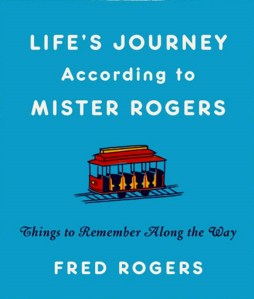
Life’s Journeys According to Mister Rogers: Things to Remember Along the Way
by Fred Rogers (1928-2003)
And now a Thanksgiving palette cleanser.
Fred Rogers was the creator and host of the children’s television show Mister Rogers’ Neighborhood from 1968 to 2001. This short book is a posthumously published collection of his writing for adults.
“The grandfather I was named for, Fred McFeely, used to say to me after we’d had a visit together. ‘Freddy, you made this day a special day for me.’”
“When people help us to feel good about who we are, they are really helping us to love the meaning of what we create in this life.”
“All I can say is, it’s worth the struggle to discover who you really are and how you, in your own way, can put life together as something that means a lot to you. It’s a miracle when you finally discover whom you’re best equipped to serve—and we’re all equipped to serve in some way.”
AUTONOMY. “My personal introduction to the Dalai Lama was by way of television—in a hotel room. I was in Washington D.C., preparing for a conference on children and the media and was looking for a certain news program when I happened upon His Holiness saying, ‘Someone else’s action should not determine your response.’ I was so intrigued, I wrote down those words, turned off the television, and thought about nothing else the whole evening.”
SILENCE. “I need thinking time when someone asks me a searching question. I wonder why it seems to be so uncomfortable for many people to wait through the silence. People of all ages have deep feelings, and if we have the patience to wait through the silence, it’s often astounding what people will tell us.”
Long before smartphones and social media, Rogers wrote, “Sometime in your day today, try to turn off all the noises you can around you, and give yourself some ‘quiet time.’ In the silence, let yourself think about something. Or if possible… think about nothing. Most of us have so few moments like that in our lives. There’s noise everywhere… Some of us must have forgotten how nourishing silence can be. That kind of solitude goes by many names. It may be called ‘meditation’ or… ‘downtime.’ In some circles, it may even be criticized as ‘daydreaming.’ Whatever it’s called, it’s a time away from outside stimulation, during which inner turbulence can settle, and we have a chance to become more familiar with ourselves.”
IT’S A BEAUTIFUL DAY IN THE NEIGHBORHOOD. Rogers defines neighbors as “those who we happen to be with at the moment… All we’re ever asked to do in this life is to treat our neighbor—especially our neighbor who is in need—exactly as we would hope to be treated ourselves. That’s our ultimate responsibility.”
THE INVISIBLE ESSENTIAL. “Years ago, a friend gave me a piece of calligraphy which I have always kept in my office. It’s a quotation from The Little Prince by Antoine de Saint-Exupéry that reads, L’essentiel est invisible pour les yeux. What is essential is invisible to the eyes.”
“I started to look behind the things that people did and said; and little by little, concluded that Saint-Exupéry was absolutely right… I began a lifelong search for what is essential, what it is about my neighbor that doesn’t meet the eye.”
“What is essential about you that is invisible to the eye? What are some of the things about your very being that allow you to look to the years ahead with confidence?”
“As you may know by now, that’s one of the major themes of our work: The invisible essential. Oh, the outsides of life are important, but the insides are what enhance so much of the rest.”
GUIDED DRIFT. “I am glad that I’ve been able to do what I’ve done and not been sidetracked along the way. A teacher of mine calls it guided drift. Isn’t that wonderful? You’re drifting, and yet you’ve got a rudder.”
“Sometimes it surprises me to think that my work on that first children’s program was almost by chance! Isn’t it mysterious how so many wonderful things in life come to us seemingly without our planning? We start traveling down the street, and we find ourselves interested in something we never expected on a side street; and as we explore it, the side street becomes the main road for us.”
“The most important moments are rarely center stage; they most often happen ‘in the wings.’ Have you found that to be true, too? That what you expected to be the big occasion or the main event turned out to be merely an excuse for you to be somewhere in order to be touched by something you might have otherwise considered of little importance?”
“Transitions are almost always signs of growth, but they can bring feelings of loss. To get somewhere new, we may have to leave somewhere else behind.”
“As work grows out of play, an attitude toward work grows with it—an attitude that may persist through our workaday life. That attitude can have a lot to do with how we accept challenges, how we cope with failures, and whether we can find in the jobs we do, the inner fulfillment that makes working worthwhile, in and of itself.”
HELP. “We’d all like to feel self-reliant and capable of coping with whatever adversity comes our way, but that’s not how most human beings are made. It’s my belief that the capacity to accept help is inseparable from the capacity to give help when our turn comes to be strong. It can sometimes be difficult to ask for support when we need it, but having someone we can count on to stick with us through the tough times can make those times much more bearable.” See also Helping by Edgar Schein.
GETTING STUCK. “Sometimes, when I’m working on a script or composing a song, writing flows easily, but there are lots of times it doesn’t. It’s probably true that all writers have frustrating and discouraging moments. Sometimes it helps me to get away from the work—by taking a walk, sitting in a quiet room, listening to music, talking with a friend. Sometimes I just go over to the piano and play out my feelings through music. That kind of break seems to nourish me, and I can come back renewed.”
WHO YOU ARE. “There are many times that I wish I had heard that ‘just who you are at this moment, with the way that you’re feeling, is fine. You don’t have to be anything more than who you are right now.’ I’d like to think it’s also something that’s happened to me through the years, that I’m more able to accept myself as I happen to be, rather than as somebody thought I should be.”
Rogers, Fred. Life’s Journeys According to Mister Rogers: Things to Remember Along the Way. Hyperion, 2005. Buy from Amazon.com
Disclosure: As an Amazon Associate I earn from qualifying purchases.
More books by Fred Rogers:
- This Beautiful Day by Fred Rogers (2024)
- The World According to Mister Rogers: Important Things to Remember by Fred Rogers (2019)
- Many Ways to Say I Love You: Wisdom for Parents and Children from Mister Rogers by Fred Rogers (2019)
- You Are Special: Neighborly Words of Wisdom from Mister Rogers by Fred Rogers (1995)
Books about Fred Rogers:
- The Mister Rogers Effect: 7 Secrets to Bringing Out the Best in Yourself and Others from America’s Beloved Neighborby Dr. Anita Knight Kuhnley (2020)
- The Good Neighbor: The Life and Work of Fred Rogers by Maxwell King (2019)
- Kindness and Wonder: Why Mister Rogers Matters Now More Than Ever by Gavin Edwards (2019)
- The Simple Faith of Mister Rogers by Amy Hollingsworth (2012)
May 1, 1969: Fred Rogers testifies before the Senate Subcommittee on Communications
Discover more from The Key Point
Subscribe to get the latest posts sent to your email.

 The Key Point
One thought on “Life’s Journeys According to Mister Rogers”
Comments are closed.