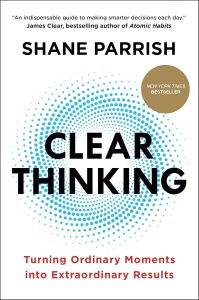
Clear Thinking: Turning Ordinary Moments into Extraordinary Results
by Shane Parrish
“If you’re a knowledge worker, you produce decisions. That’s your job.” This book is about how to make better decisions. Here are some highlights.
DEFAULTS. “You have little hope of thinking clearly… if you can’t manage your defaults… Four stand out…
- The emotion default: we tend to respond to feelings rather than reasons and facts.
- The ego default: we tend to react to anything that threatens our sense of self-worth or our position in group hierarchy.
- The social default: we tend to conform to the norms of our larger social group… The social default inspires virtue signaling—getting other people to accept or praise your professed beliefs. Especially when there is no cost to such signals…
- The inertia default… We tend to resist change, and to prefer ideas, processes, and environments that are familiar… Another big reason we find action hard is that we’re afraid of being wrong. In this case inertia holds us in place as we gather more and more information in the false hope that we can ultimately eliminate uncertainty.”
DECISION-MAKING PROCESS. The crux of this book is the decision-making process. “That process is about weighing your options with the aim of selecting the best one, and it’s composed of four stages: defining the problem, exploring possible solutions, evaluating the options, and finally making the judgment and executing the best option.”
DEFINE THE PROBLEM. “The first principle of decision-making is that the decider needs to define the problem. If you’re not the one making the decision, you can suggest the problem that needs to be solved, but you don’t get to define it. Only the person responsible for the outcome does.”
“Build a problem-solution firewall. Separate the problem-defining phase of the decision-making process from the problem-solving phase.”
“Defining the problem starts with identifying two things: (1) what you want to achieve, and (2) what obstacles stand in the way of getting it.”
“Since you can’t solve a problem you don’t understand, defining the problem is a chance to take in lots of relevant information. Only by talking to the experts, seeking the opinions of others, hearing the different perspectives, and sorting out what’s real from the what’s not can the decision-maker understand the real problem.”
“Writing out the problem makes the invisible visible… If you find yourself using jargon in your description, it’s a sign that you don’t fully understand the problem.”
TREATING THE SYMPTOMS. “Unfortunately, people too often end up solving the wrong problem… They end up missing the real problem and merely addressing a symptom of it.”
“Finding a short-term fix signals to others that they’re doing something. That’s the social default at work… Time eventually reveals short-term solutions to be Band-Aids that cover deeper problems.”
“A handy tool for identifying the root cause of a problem is to ask yourself, ‘What would have to be true for this problem not to exist in the first place?’”
MEETINGS. “One way to keep meetings short… is simply asking everyone, ‘What do you know about this problem that other people in the room don’t know?’ That question makes people think. They stop filling the air with ideas everyone already knows and start explaining how they think about the problem.”
SECOND-LEVEL THINKING. Echoing Howard Marks, Parrish writes, “First-level thinking looks to solve the immediate problem without regard to any future problems a solution might produce. Second-level thinking looks at the problem from beginning to end. It looks past the immediate solution and asks, ‘And then what?’”
BINARY THINKING. “Binary thinking is a sign that we don’t fully understand a problem—that we’re trying to reduce the problem’s dimensions before fully understanding them… False dualities prevent you from seeing alternative paths and other information that might change your mind.”
Some techniques to overcome binary thinking:
- “Force yourself to explore at least three possible solutions to a problem. If you find yourself considering only two options, force yourself to find at least one more.”
- “Imagine that one of the options is off the table. Take each of the options you’re considering, and one at a time, ask yourself, ‘What would I do if that were not possible.’”
- “Rather than grappling with seemingly opposed binary options, combine them. Simplistic Either-Or options become integrative Both-And options. You can keep costs down and invest in a better customer experience… Roger Martin, former dean of the Rotman School of Management in Toronto, refers to this technique as integrative thinking… Martin put it this way: ‘Thinkers who exploit opposing ideas to construct a new solution enjoy a built-in advantage over thinkers who can consider only one model at a time.’”
OPPORTUNITY COST. “Consider what opportunities you’re forgoing when you choose one option over another… View opportunity costs through these three lenses: (1) Compared with what? (2) And then what? (3) At the expense of what? … In many cases, the real value to thinking through opportunity costs in to understand the indirect hidden costs. Time is not as easy to see as money but it’s just as important.”
SIGNAL VS. NOISE. “Know what you’re looking for before you start sorting through the data… Most information is irrelevant. Knowing what to ignore—separating the signal from the noise—is the key to not wasting valuable time.”
ABSTRACTION. “Real knowledge is earned, while abstractions are merely borrowed. Too often decision-makers get their information and observations from sources that are multiple degrees removed from the problem. Relying on these abstractions is a prime opportunity for the ego default to work its mischief. It conjures the illusion of knowledge: we feel confident about what we do without really understanding the problem.”
SEE FOR YOURSELF. “If you want to make better decisions, you need better information. Whenever possible, you need to learn something, see something, or do something for yourself. Sometimes the best information is the least transmissible.” (In The Toyota Way, this idea is called genchi genbutsu.)
Parrish tells a story about a squadron of pilots in the Pacific refusing to fly during World War II. General George Marshall sent his direct report to investigate. He found out that airplane mechanics were working under lights attracting mosquitos. They were so drugged on malaria medication, “the pilots didn’t trust their work and refused to fly.” With this information, Marshall sent mosquito nets for the mechanics. Problem solved.
EXPERT ADVICE. “The goal isn’t to have someone tell you what to do; rather, it’s to learn how an expert thinks about the problem, which variables they consider relevant, and how those variables interact over time. If you present a problem, and an expert simply tells you what to do, they’re just giving you an abstraction. You might get the answer right, but you haven’t learned anything. And if things go wrong, which they inevitably will, you won’t have a clue as to why… If you ask them how they think about the problem, that’s when you start deepening your understanding.”
HIGH STAKES / LOW STAKES. “A helpful way of categorizing decisions [is] by considering how consequential they are, and how reversible they are… When the cost of a mistake is low, move fast… When the stakes are high, and there are no take-backs, you want to decide at the last moment possible, and keep as many options on the table as you can while continuing to gather information.”
MOVING FORWARD. “You don’t always need to have the ultimate solution to make progress. If it remains unclear which path is best, often the next best step is just to eliminate paths that lead to outcomes you don’t want. Avoiding the worst outcomes maintains optionality and keeps you moving forward.”
WHAT COULD POSSIBLY GO WRONG? “Imagining what could go wrong doesn’t make you pessimistic. It makes you prepared… Imagine the things that could go wrong and how you’ll overcome them if they do.”
MARGIN OF SAFETY. “If the cost of failure is high, and outcomes are more consequential, you want a large margin of safety… The margin of safety is often sufficient when it can absorb double the worst-case scenario. So the baseline for a margin of safety is one that could withstand twice the amount of problems that would cause a crisis, or maintain twice the amount of resources needed to rebuild after a crisis.”
“Keep in mind as you’re preparing for the future that the worst outcomes in history have always surprised people at the time. You can’t use the historical worst case as your baseline.”
ANNOUNCING. “Many leaders want to announce a decision the moment they’ve made it…. But announcing right away can be like the email you can’t unsend. It starts things moving, and makes changing your mind harder. That’s why I created a rule for myself: I make major decisions and then sleep on them before telling anyone… I added another element to the rule: before going to bed, I would write a note to myself explaining why I’d made the decision.”
COMMANDER’S INTENT. “Teams need to know how to adapt when circumstances change… Commander’s intent empowers each person on a team to initiate and improvise as they’re executing the plan. It stops you from being the bottleneck, and it enables the team to keep each other accountable to the goal without your presence.”
“Commander’s intent has four components: formulate, communicate, interpret, and implement. The first two components—formulate and communicate—are the responsibility of the senior commander. You must communicate the strategy, the rationale, and the operational limits to the team. Tell them not just what to do, but why to do it, how you arrived at your decision, so they understand the context, as well as the boundaries for effective action—what is completely off the table. Subordinate commanders then have the tools for the last two components: interpreting the changing contexts and implementing the strategy in those contexts.”
DECISION REVIEW. “When you evaluate a decision, focus on the process you used to make the decision and not the outcome… You can only control the process you use to make the decision. It’s that process that determines whether a decision is good or bad. The quality of the outcome is a separate issue.”
“Our tendency to equate the quality of our decision with the outcome is called resulting… Engaging in resulting doesn’t help us get better. The result of resulting is instead stagnation.”
“Rarely are you making decisions that have a 100% chance of success. And the kind of decision that has a 90% chance of success still has a bad outcome 10% of the time. What matters are results over time and ensuring that 10% of the time won’t kill you.”
Parrish, Shane. Clear Thinking: Turning Ordinary Moments into Extraordinary Results. Portfolio/Penguin, 2023. Buy from Amazon.com
Disclosure: As an Amazon Associate I earn from qualifying purchases.
Selected books mentioned:
- Atomic Habits: An Easy & Proven Way to Build Good Habits & Break Bad Ones by James Clear (2018)
- The Undoing Project: A Friendship That Changed Our Minds by Michael Lewis (2017)
- 30 Lessons for Living: Tried and True Advice from the Wisest Americans by Karl Pillemer (2012)
- Great by Choice: Uncertainty, Chaos and Luck – Why Some Thrive Despite Them All by Jim Collins and Morten T. Hansen (2011)
- The Black Swan: Second Edition: The Impact of the Highly Improbable by Nassim Nicholas Taleb (2010)
- The Opposable Mind: How Successful Leaders Win Through Integrative Thinking
- by Roger L. Martin (2009)
- Good to Great: Why Some Companies Make the Leap… and Others Don’t by Jim Collins (2001)
- The Path of Least Resistance: Learning to Become the Creative Force in Your Own Life by Robert Fritz (1989)
- The Stakes of Diplomacy: Civility and the Great War by Walter Lippmann (originally published 1915)
Discover more from The Key Point
Subscribe to get the latest posts sent to your email.

 The Key Point
One thought on “Clear Thinking”
Comments are closed.