The Art of Responsive Drawing
by Nathan Goldstein (1927-2013)
I was prompted to read this book after a discussion with an art professor about what makes a work of art compelling. I commented that spontaneous gesture drawings can capture an intangible quality—energy, attitude, spirit—that is often lost in more technically resolved drawings and paintings. How does an artist preserve the initial spark of interest in a more complete work?
Nathan Goldstein writes about the expressive character of a drawing—that is to say, its psychological appeal—grounded by the fundamentals of representational drawing: gesture, shape, line, value, perspective and foreshortening, volume, color, and composition.
“The best drawings always disclose a blend of facts and feelings, and to displace intuition and empathy with a dry intellectual examination of a subject’s structural condition upsets the necessary and delicate balance between discipline and indulgence that gives master drawings their individual character and spirit.”
“Responsive drawing is the ability to choose from among the parts and impressions of an observed or envisioned subject those characteristics that hold meaning for us and to be able to set them down in concise and (to us) attractive visual terms. It is the ability to join percept to concept, that is, to merge what we see in the subject with what we want to see in the drawing, and to show this integration of inquiry and intent in the completed work. To do this we must recognize that one of the most compelling features of any subject is its overall expressive character—its fundamental visual and emotive nature.”
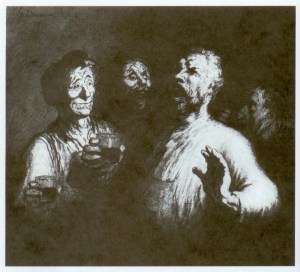
GESTURAL EXPRESSION. “Experienced artists, even before they ask themselves, ‘What does the subject look like?’ ask, ‘What is the subject doing?’”
“Gesture drawing is more about the rhythmic movements and energies coursing through a subject’s parts than about the parts themselves. That is why such drawings show a concentration more on the essential pattern and the general form of the parts than on their edges, or contours.”
“The earlier we establish the general state of the formal relationships—the system of abstract harmonies and contrasts that constitute a drawing’s particular organizational system—the more integrated the completed drawing will be. And, for the responsive artist, a drawing’s abstract life—that is, its dynamics—is as important as its representational state.”
“Good drawings do not result from the accumulation of details… Regardless of the subject, the process of collecting parts in sequence which should add up to a figure, a tree, a bridge, or whatever is always bound to fail.”
LINE QUALITY. “In responsive drawing the lines that denote—that describe what forms look like—also evoke; that is, they convey the artist’s emotional responses to forms. Consequently, all lines are partly descriptive, partly emotive… Description alone skirts all the responsive possibilities of line and is always expressively dull.”
“We must also recognize that it is inquiry, empathy, economy, and invention, not the desire to imitate nature, that is at the heart of a knowing use of line.”
PERSPECTIVE. “Perspective can contribute to expressive meanings by enabling the artist to draw a subject from the angle most evocative of its actions and character, and most compatible with the artist’s feelings and intent.”
The author also shows how linear perspective affects the shape and scale of cast shadows.
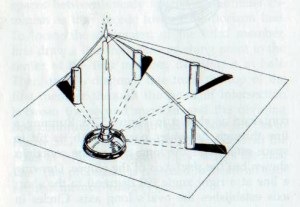
VALUE. “Where the light’s behavior explains a form’s structure, it can be used; where light confuses or denies structure, it can be changed. In responsive drawing the artist, and not the accidental effects of light, determines the clarity of a subject’s volumes and the spaces they occupy.”
VOLUME. “To establish volume, it is always necessary to analyze and extract the measurable, planar, and dynamic qualities that define it.”
“Placing the emphasis on volume first and surface effects second communicates far more of the form’s total character than the reverse… An exclusive concentration upon surface effects generally smothers volumetric clues, thus destroying the very masses whose surfaces are so painstakingly examined.”
“Just as gestural drawing includes (or develops into) a search for the subject’s structural generalities, so must the structural analysis embrace considerations of the subject’s actions and energies. To do otherwise too often results in drawings that are rather dry inventories of planar facts, unfertilized by feeling.”
“Any greater form, if it is to retain a sense of its basic volume character and unity, requires its component parts, large and small, to be subordinate to it. Many otherwise admirable student drawings have suffered [when, for example] a few folds of a coat sleeve appear more important than, and compete with, the arm inside.”
“Reversing the visual order of showing smaller parts as belonging to larger ones isolates the specifics as ends in themselves… and destroys the unity of the drawing.”
“Often undeveloped passages serve compositional or expressive functions. In master drawings that stress volumes in space, undeveloped areas often serve as passive foils for other areas that stand out as crescendos of structural emphasis. In this way, the weight and sculptural strength of emphasized parts take on greater visual and expressive meaning.”
MEDIA AND MATERIALS. “It is impossible to say where drawing ends and painting begins… The use of paints in drawing tends to promote a broader and often more daring approach, which can act as a healthy corrective for those who tend to make tiny drawings in a timid manner.”
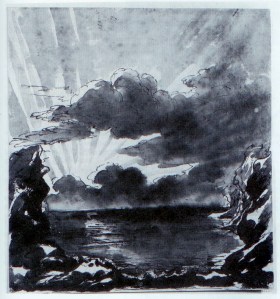
COMPOSITION. “When similarities overpower contrasts, the result is boredom. When contrasts overpower similarities, the result is chaos. A successful design must avoid both of these extremes. Its contrasts may threaten but should never succeed in destroying balance and unity. The artist must organize contrasting elements into some greater system of formal order.”
“Drawings developed without an organizational strategy always disclose a kind of wandering, a lack of visual purpose.”
“In the best drawings, all parts of the image fall short of completeness; they ‘need’ each other to become completed. A part or form that doesn’t need the rest of the drawing to have its full effect is, by its very independence, isolated.”
MEANING. “Genuine expressive meanings are not sought out at all, but come as a natural by-product of a genuine empathy with the subject’s form and content. Nor must expression be understood only as passion. Expressive qualities can be contemplative, humorous, or serene.”
“The content of any drawing contains certain intangibles that express the artist’s personality and philosophy that are not only subconscious, but resistant to any attempts by the artist to be free of them.”
“Responsive artists are always inquisitive… The old adage, ‘You are what you eat’ can be extended to the realm of art: You are what you draw. Your drawings reflect what fascinates you as an artist and as an individual. Responsive artists do not make drawings of their subjects, but about them. They don’t draw as they think they should, but as they feel they must.”
“Subjects we strongly want to draw contain something in their arrangement or meaning that attract us, although we can seldom say why. Indeed, it is easier for us to explain why we don’t want to draw a particular subject (or in a particular style) than to say why we do.”
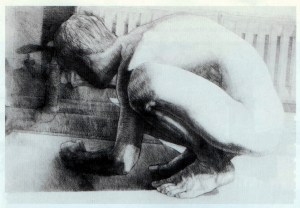
FUNDAMENTAL SKILLS. “One does not help the visually illiterate by directing their interest toward a particular esthetic ideology. The teacher’s task is to turn such students away from advanced concepts (that make perceptual, organizational, and expressive failure certain) and toward fundamental visual matters having to do with gesture, planar analysis, scale and value relationships, balance, and the like.”
EXPLORATORY MARKS. “As these basic perceptions are made, a general and tentative armature emerges that both holds and guides further structural (and dynamic) observations and ideas… Some of these perceptions may uncover ways in which the armature must be adjusted. Therefore, it is best to regard these first estimates and insights as exploratory and to state them economically in a light and fluid manner. Being approximations, they are almost always right in noting essentials but frequently somewhat ‘off’ in exact measurements of shape, scale, location, or direction. Yet without these preliminary probes—‘near misses’ and all—our subsequent estimates and judgments about the subject’s structure and spirit are almost impossible to establish.”
FEAR OF MISTAKES. “Stiff or wooden drawings [suggest] a fear of making errors and a disregard for gestural and rhythmic considerations. Ironically, the concern over making mistakes… and the dread of making changes—of making a mess—have probably ruined more drawings than anything else.”
ECONOMY. “In drawing, economy reveals understanding—or the lack of it. That is still another reason why quick drawings are so important to the student… A brief drawing time makes it necessary to be assertive in choosing what to extract from the subject. That necessity, in turn, forces us to think more about what it is we are after in our drawings—what attracts us about a subject and about a means for expressing it… An economy of means usually strengthens emotive force.”
QUALITY. “While determining quality in drawing is bound to be a largely subjective judgment, certain criteria such as economy, authority, organizational and expressive clarity, and unity are sure to remain universally important in the evaluation of a drawing’s quality, if only because our human sensibilities naturally look for balance and order, meaning and spirit.”
FINIS. “Responsive drawings are complete when they cannot be made more visually and expressively exciting and succinct.”
Goldstein, Nathan. The Art of Responsive Drawing. 6th edition, Prentice Hall, 2005. Buy from Amazon.com
Disclosure: As an Amazon Associate I earn from qualifying purchases.
Related Reading:
- Drawing to See by Nathan Goldstein and Harriet Fishman (2004)
- Figure Drawing: The Structure, Anatomy and Expressive Design of the Human Form, 6th Edition by Nathan Goldstein (2003)
- The Art of Seeing: An Interpretation of the Aesthetic Encounter by Mihaly Csikszentmihalyi and Rick E. Robinson (1990)
- Design and Composition by Nathan Goldstein (1989)
“Art history is really the history of innovation.”
Discover more from The Key Point
Subscribe to get the latest posts sent to your email.

 The Key Point