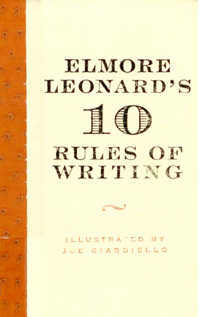
Elmore Leonard’s 10 Rules of Writing offers good advice about writing fiction, although the implicit theme pertains to any writing. Essentially, don’t let your writing style distract from what you are trying to say.
My favorite tip is #10: “Try to leave out the part that readers tend to skip.”
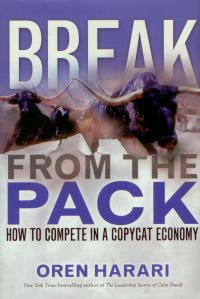
Break From the Pack: How to Compete in a Copycat Economy by Oren Harari
Break-from-the-pack companies are analogous to the small cluster of runners at the front of a marathon. The Copycat Economy is analogous to the majority of runners who lag behind. In the words of former IBM CEO Sam Palmisano, “Either you innovate or you’re in commodity hell. If you do what everybody else does, you have a low-margin business.”
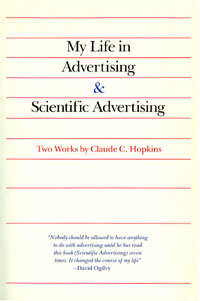
My Life in Advertising and Scientific Advertising by Claude C. Hopkins (1866-1932)
Claude C. Hopkins was a pioneer in the advertising industry. This volume consists of his two books: Scientific Advertising, written in 1923, and My Life in Advertising, written in 1927. NBC and CBS were founded around the time of Hopkins’ retirement, so his work predated the broadcasting era. The media of his time were newspapers, magazines, and direct mail.
“Salesmanship-in-print is exactly the same as salesmanship-in-person.” If the purpose of advertising is to sell, then its effectiveness can be measured by resulting sales volume. Hopkins tested ads on a small scale before risking money on a large-scale campaign. He also compared results using different headlines in order to discover the best performing approach.
The Experience Economy: Work is Theatre & Every Business is a Stage by B. Joseph Pine II and James H. Gilmore
The Experience Economy is about the progression of economic value:
Commodities – coffee beans
Goods – ground coffee
Services – a cup of coffee at a diner
Experiences – cup of coffee at a fine restaurant or trendy café
“Commodities are fungible, goods are tangible, services intangible, and experiences memorable… The easiest way to turn a service into an experience is to provide poor service.”
Think India: The Rise of the World’s Next Great Power and What It Means for Every American by Vinay Rai and William L. Simon
Vinay Rai is clearly a cheerleader for his native country, so in that sense the book is biased, but informative and interesting nonetheless.
India has a rich history. “In the early eighteenth century… India, rich in resources and at peace with the world, accounted for an incredible twenty-five percent, more or less, of global trade; by the time the British boarded their ships in 1947, India accounted for no more than one percent of global trade.”
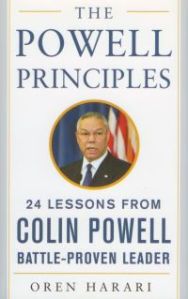
The Powell Principles: 24 Lessons From Battle-Proven Leader Colin Powell
by Oren Harari
Business professor Oren Harari (1949-2010) encapsulated Colin Powell’s (1937-2021) lessons of leadership in 24 three-page chapters. “The Powell Principles constitute a clear, strategic, philosophical, value-based, and ethical blueprint. The blueprint guides Powell, but the blueprint has enormous flexibility and opportunism built into it.” The 24 lessons are:
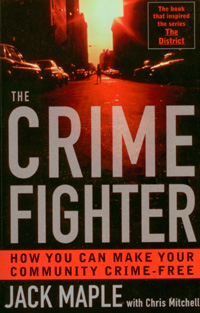
The Crime Fighter: How You Can Make Your Community Crime Free by Jack Maple
Engaging stories from Maple’s career as a detective for the NY Transit Police, deputy commissioner of NYPD, and consultant to Newark, Philadelphia, and New Orleans police departments make this a very interesting read. The fact that the problems and solutions discussed are relevant to other cities—not just NYC—broadens the appeal of this book. While some of the principles will apply to smaller police jurisdictions, the context of all examples is with large cities.
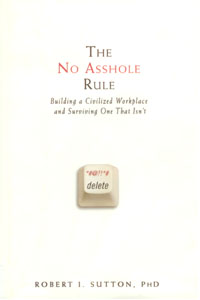
The No Asshole Rule: Building a Civilized Workplace and Surviving One That Isn’t by Robert I. Sutton
Assholes create a toxic work environment, destroying productivity. Sutton introduces the Total Cost of Assholes (TCA) metric. In the case of a salesman named Ethan, the cost was estimated at $160,000, including time spent by Ethan’s manager, HR professionals, senior executives, outside counsel, as well as the costs related to high turnover of support staff.
Sutton warns not to hire wimps and polite clones. “A series of controlled experiments and field studies in organizations show that when teams engage in conflict over ideas in an atmosphere of mutual respect, they develop better ideas and perform better. For this reason, Intel requires all new employees to take “constructive confrontation class.”
Sutton, Robert I. The No Asshole Rule: Building a Civilized Workplace and Surviving One That Isn’t. New York: Business Plus, 2010. Buy from Amazon.com
Disclosure: As an Amazon Associate I earn from qualifying purchases.
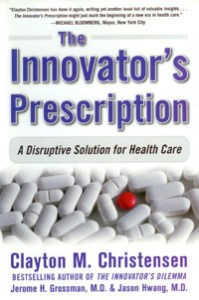
The Innovator’s Prescription by Clayton Christensen, Jerome H Grossman M.D., and Jason Hwang M.D
Building on the framework of disruptive innovation presented in his prior book The Innovator’s Dilemma, Christensen and two medical doctors present a vision for how to make the American health care system “higher in quality, lower in cost, and more conveniently accessible to all.”
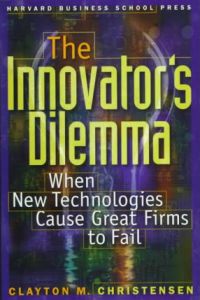
Why have many once market-leading companies failed to stay relevant? It would be easy to assume that they had stagnant engineers or complacent management, but Clayton Christensen concludes otherwise: “Because they carefully studied market trends and systematically allocated investment capital to innovations that promised the best returns, they lost their positions of leadership.”
How is that possible? The key is to understand the distinction between sustaining and disruptive innovation. Large companies are good are sustaining innovation—product improvements demanded by existing customers.


 The Key Point